
Suunto has spent the last few years quietly rebuilding its reputation and the Suunto Run is the clearest expression yet of what the Finnish brand is trying to be: a serious running watch at an accessible price, with no unnecessary complexity.
Launched in May 2025 at $249, the Run sits at the entry point of Suunto’s AMOLED lineup, below the Race S ($349) and Race ($399). It’s specifically designed for runners, and you can feel that in every design decision. Dual-frequency GPS uses the same Sony L1+L5 chip as Suunto’s flagship watches. Track Run mode for lane-accurate splits. Marathon Mode with real-time finish time estimates. MP3 music storage. Breadcrumb navigation. Training load and TSS tracking. Gorilla Glass and a steel bezel. All at $249.
The result, according to multiple reviewers testing it over months, is one of the best-value running watches available from any brand.
The gaps are honest, no offline topographic maps, optical HR reliability can be inconsistent, and the magnetic charging cradle is fiddly. But for road runners who want serious GPS, smart training tools, and a watch that looks and feels premium at this price, the Suunto Run is a compelling case.
Here’s the full breakdown in Suunto Run Review:
Quick Verdict
Overall Rating: 4.3 / 5
| Best For | Road runners and casual trail runners who want dual-frequency GPS, an AMOLED display, and Suunto’s training ecosystem under $250 |
| Skip If | You need offline topographic maps, reliable treadmill tracking, or chest-strap-free HR accuracy during intervals |
| Price | $249 |
| Road runners and casual trail runners who want dual-frequency GPS, an AMOLED display, and Suunto’s training ecosystem under $250 | Dual-frequency Sony GPS + Gorilla Glass + steel bezel + Track Mode + MP3 music at $249 |
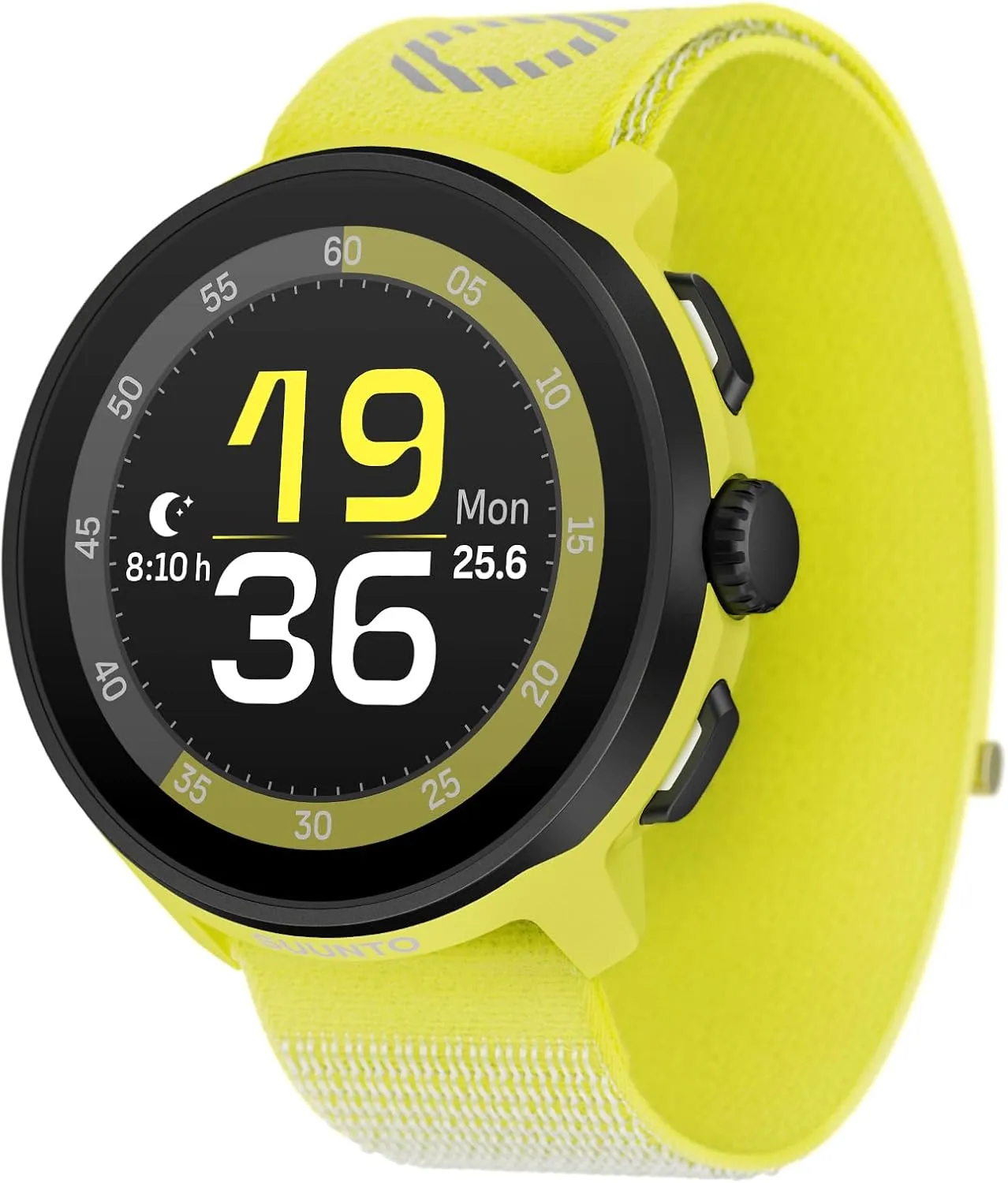
Best Suunto Watch – Suunto Run
Pros
Cons
Specs Overview
| Spec | Details |
|---|---|
| Display | 1.32″ AMOLED, 466×466px, always-on capable |
| Case Size | 46mm |
| Bezel | Steel |
| Glass | Gorilla Glass |
| Weight | 36g |
| Battery (Smartwatch) | Up to 12 days (gesture mode) / ~4 days (always-on) |
| Battery (GPS) | Up to 20 hours (performance) / 40 hours (power save) |
| GPS | Dual-frequency Sony L1+L5 |
| Heart Rate | Optical wrist-based |
| Water Rating | 5 ATM (50m) |
| Navigation | Breadcrumb only (no offline topo maps) |
| Music | 4GB MP3 storage + Bluetooth playback |
| Straps | Nylon (two sizes included) / 22mm standard |
| Colors | Black, Red, Lime, Light Grey |
| Price | $249 |
| Released | May 2025 |
Related: Best GPS Running Watches / Best Affordable watches
Price
The Suunto Run launched at $249, a deliberate positioning that undercuts several comparable watches from Garmin and Coros while delivering specifications that those watches don’t always match.
| Watch | Price | AMOLED | Dual-Band GPS | Music Storage | GPS Battery |
|---|---|---|---|---|---|
| Suunto Run | $249 | ✅ | ✅ | ✅ MP3 | 20 hrs |
| Garmin Forerunner 165 | $249 | ✅ | ❌ | ❌ | 19 hrs |
| Coros Pace 4 | $249 | ✅ | ✅ | ❌ | 41 hrs |
| Coros Pace Pro | $299 | ✅ | ✅ | ❌ | 38 hrs |
| Suunto Race S | $349 | ✅ | ✅ | ✅ MP3 | 26 hrs |
| Polar Pacer Pro | ~$269 | ❌ | ❌ | ❌ | 35 hrs |
At $249, the Suunto Run clearly stands out from the Garmin Forerunner 165 at the same price, but the Run adds dual-frequency GPS, music storage, and a Track Mode. Against the Coros Pace 4, same price, same AMOLED and dual-frequency GPS, the Suunto Run adds music storage and Track Mode but trails significantly on GPS battery life (20 vs 41 hours) and overall battery endurance.
The choice between the Suunto Run and Coros Pace 4 at identical pricing is the most interesting comparison in this bracket: Run wins on materials (Gorilla Glass, steel bezel) and music. Coros wins on battery life and training analytics depth.
Design
For $249, the Suunto Run’s build quality consistently surprises reviewers. The combination of Gorilla Glass lens, steel bezel, and glass fibre-reinforced polyamide case exceeds what competitors offer at this price. Garmin’s Forerunner 165 uses standard plastic and basic glass, while the Coros Pace 4 uses plastic throughout.
The 46mm case houses a 1.32-inch display, and at 36g with the nylon strap, it sits alongside the Coros Pace 4 (32g) and Polar Pacer (40g) as one of the lightest capable running watches available. Multiple reviewers describe it as disappearing on the wrist during runs the ideal result for a watch designed for 24/7 wear.
The nylon strap ships in two sizes, a thoughtful inclusion for runners with different wrist sizes. Standard 22mm lug width means aftermarket band options are widely available, unlike Polar’s proprietary system.
Four color options: Black, Red, Lime, and Light Grey. The Lime colorway is particularly distinctive — eye-catching without being garish.
Two design frustrations worth noting: the magnetic charging cradle requires accurate positioning and is easily knocked off. Multiple reviewers identify this as one of the Suunto Run’s most consistent real-world frustrations. It’s improved over older Suunto designs but still trails Apple Watch-style magnetic pucks for convenience. And the touchscreen cannot be fully disabled in standard watch mode, leading to accidental inputs in the pool or shower a firmware fix that Suunto needs to address.
Display
The Suunto Run uses the same 1.32-inch AMOLED display at 466×466 resolution as the more expensive Suunto Race S, a fact that makes it particularly remarkable at $249.
The display is bright, sharp, and comfortable to use in all lighting conditions, including direct sunlight. Three brightness settings allow you to balance visibility against battery life. The always-on display mode keeps data visible at a glance without a wrist raise useful for racing and training sessions.
The trade-off is battery life. In always-on mode, the 12-day smartwatch battery drops to approximately 4 days. In gesture (raise-to-wake) mode, real-world experience consistently delivers 7–10 days, a significant difference that most runners will choose gesture mode for.
One limitation: watch face customization is minimal. The Suunto Run doesn’t have a watch face store or extensive design options; you get the default face and limited configuration. If watch face variety matters to you, the Garmin Connect IQ store or Coros app offers significantly more options.
Training Features
Running-Specific Tools
- Track Run Mode: Choose your lane, and the watch calibrates after a couple of laps, delivering near-perfect distance accuracy and clean GPS traces on the track, precise enough for 200m and 400m repeat splits. One of the standout differentiating features at this price
- Marathon Mode (Finish-Time Mode): Provides real-time finish time estimates based on your current pace throughout a race a runner-focused alternative to the virtual pacer approach of competing watches
- Structured Workouts: Build and sync interval workouts from the Suunto app. On-watch prompts guide you through each session, effective for fartlek, tempo, and interval training
- Metronome Mode: Vibration-based cadence targets to maintain a set step frequency — useful for cadence training and injury prevention
- Hydration and Nutrition Reminders: Timed alerts during long runs to prompt eating and drinking, a useful addition for marathon and ultra training
- Breadcrumb Navigation: Follow uploaded routes with off-course deviation alerts, adequate for road running in unfamiliar cities, limited for complex off-grid trails
Training Load & Recovery
- Training Load Pro: Cumulative training stress monitoring across sessions
- TSS (Training Stress Score): Post-workout intensity and impact scoring
- Recovery Score: Combines sleep quality, HRV, and training load into a daily readiness number updated throughout the day
- HRV monitoring: Overnight HRV tracking informs recovery recommendations
- Post-exercise HR tracking: Monitors how quickly your heart rate drops after a session — a useful fitness progress indicator
Note: No sleep score metric raw sleep stage data is available, but no single synthesized score, which some reviewers noted as a gap.
Music
- 4GB MP3 storage: Transfer music files via the proprietary USB-C cable and drag-and-drop, then play through paired Bluetooth headphones without your phone
- No streaming services (Spotify, Apple Music, etc.) MP3-only
- Basic playback controls available as a workout data screen overlay
Smart Features
- Smartphone notifications (calls, texts, app alerts) note: sender’s name not displayed
- Strava and TrainingPeaks sync
- Weather alerts
- No contactless payments (except in China)
- No SuuntoPlus app store (available on Race and Race S)
Performance
GPS Accuracy
The Suunto Run uses the Sony dual-frequency L1+L5 GPS chip, the same hardware found in Suunto’s flagship Race and Vertical models. This is the Suunto Run’s single most important performance advantage over several competitors at the same price.
In real testing across road runs, trail sessions, and track workouts, GPS performance is consistently rated as excellent. In a controlled 2-mile benchmark course, the Suunto Run tracked 1.98 miles within 0.02 miles of actual distance. On a marathon run, one long-term tester recorded 42.55km vs. the actual 42.2km, approximately 0.8% long, which is within acceptable tolerances for most runners.
Satellite lock is fast, GPS trace quality on switchbacks and technical terrain is clean, and urban canyon performance benefits from the dual-frequency design. Head-to-head testing against the Garmin Forerunner 965 on 1km auto-laps produced results within seconds of each other, an impressive result for a watch at half the price.
One area of concern from some users: occasional distance readings that run 2–3% long on certain GPS conditions. Not universal across reviewers, but worth noting. The majority of testing shows strong accuracy.
Track Mode specifically delivers lane-accurate splits that GPS alone typically can’t achieve at any price, a meaningful bonus for structured track athletes.
Heart Rate Accuracy
This is where the Suunto Run’s limitations show most clearly. The optical HR sensor delivers solid results for resting heart rate, easy running, and general daily monitoring, but becomes inconsistent during high-intensity intervals, cycling, and rapid effort changes. One reviewer noted a spike to near 200bpm during an easy outdoor run clearly erroneous.
The consistent recommendation across reviewers: use a chest strap or arm-based HR monitor (like Polar H10 or Garmin HRM-Run) during any structured interval session where HR zone accuracy drives workout execution. Wrist optical HR is fine for casual runs and daily monitoring.
Battery Life
Suunto claims 20 hours of GPS (performance mode) and 12 days of smartwatch mode (gesture-based). Real-world testing is close:
- Smartwatch with gesture mode: 7–10 days
- Smartwatch always-on: 3–4 days
- GPS performance mode: 20 hours
- GPS power save: Up to 40 hours
For most marathon runners and triathletes, 20 hours of GPS battery is sufficient. For ultramarathons exceeding 20 hours, the power-save mode extending to 40 hours provides coverage at reduced GPS resolution.
Bottom line on performance: Dual-frequency GPS accuracy is the standout strength flagship-level tracking at a mid-range price. Optical HR requires a chest strap for precision training. Battery is adequate for most use cases, but trails Coros’s Pace 4 significantly in GPS endurance.
Who Should Buy It?
Buy the Suunto Run if:
- You’re a road runner who wants dual-frequency GPS, an AMOLED display, and structured workout tools at $249
- Track training is part of your routine. Track Mode’s lane-accurate splits are genuinely valuable for interval runners
- You want music storage without paying more. 4GB MP3 storage is unique at this price among running-focused watches
- Premium build materials at a budget price matter. Gorilla Glass and a steel bezel are rare at $249
- You’re attracted to the Suunto ecosystem and want an entry point without paying $349+ for the Race S
- You do primarily road running with occasional light trail use
Skip it if:
- You need offline topographic maps for trail running. The Suunto Race S at $349 adds these
- Treadmill running is a significant part of your training, but accuracy is poor and frustrating
- Precise heart rate zone training without a chest strap is important, as optical HR inconsistency is a real limitation
- GPS battery life matters for ultras or multi-day events. The Coros Pace 4 at $249 delivers 41 hours vs 20 hours
- You want the richest training analytics ecosystem. Garmin Connect and Coros Training Hub go deeper
- No charging cradle frustration, Garmin and Coros USB-C cables are simpler
Final Verdict
The Suunto Run is a genuinely impressive running watch at $249. Dual-frequency GPS that matches Suunto’s flagship performance, Gorilla Glass and a steel bezel, a 1.32-inch AMOLED shared with the Race S, Track Mode, Marathon Mode, hydration reminders, metronome, and MP3 music storage, all in a 36g body. Tom’s Guide called it “one of the best value sports watches available from any brand,” and that’s a defensible position.
The limitations are real and specific: no offline maps, inconsistent optical HR under intensity, poor treadmill tracking, and a fiddly charging cradle. For road runners who don’t need maps and are willing to use a chest strap for intervals, most of these gaps don’t affect daily training.
Where it lands in the $249 category: the Suunto Run and Coros Pace 4 are the two strongest options at this price. The Run wins on materials, music, and Track Mode. The Coros Pace 4 wins on GPS battery life (41 vs 20 hours) and training analytics depth. Your priorities determine the better choice.
Scores:
| Category | Score |
|---|---|
| Design | 4.4 / 5 |
| Display | 4.5 / 5 |
| Training Features | 4.3 / 5 |
| Performance | 4.2 / 5 |
| Value | 4.6 / 5 |
| Overall | 4.3 / 5 |
This review is based on aggregated expert testing data, long-term field use reports, and real user feedback compiled from across the running and multisport community. We bring together the most accurate and up-to-date information so you can make a confident buying decision.
Frequently Asked Questions
Is the Suunto Run good for running?
Yes, it’s designed specifically for runners. Dual-frequency GPS, Track Mode, Marathon Mode, structured workout support, hydration reminders, metronome, and breadcrumb navigation cover everything most road runners need. For trail runners who need offline topographic maps, the Suunto Race S at $349 is the right step up.
Is the Suunto Run heart rate accurate?
For resting and easy-to-moderate running, yes — solid accuracy. During high-intensity intervals or cycling, the optical sensor can produce inconsistent readings. Multiple reviewers recommend using a chest strap or arm-based HR monitor for any session where precise HR zone data is important.
Does the Suunto Run have music?
Yes — 4GB of onboard storage for MP3 files, playable via Bluetooth headphones without your phone. There is no support for streaming services (Spotify, Apple Music). Transfer music via the proprietary cable using drag-and-drop.
Does the Suunto Run have dual-frequency GPS?
Yes, the Sony L1+L5 dual-frequency chip is the same one used in Suunto’s flagship Race and Vertical models. GPS accuracy is one of the Suunto Run’s standout competitive advantages at this price.