
The Polar Pacer Pro sits in one of the most competitive price brackets in the running watch market.
The battery life underdelivers for its price class, the display is basic compared to modern AMOLED rivals, and there’s no multi-band GPS or on-watch music.
Here’s my full breakdown in Polar Pacer Pro Review
Quick Verdict
Overall Rating: 4.2 / 5
| Best For | Serious runners and beginner triathletes who want premium training tools without paying premium prices |
| Skip If | You need long battery life, maps, an AMOLED display, and on-watch music |
| Price | $349 |
| Standout Feature | Running Power on wrist + deep Polar training ecosystem at an accessible price |
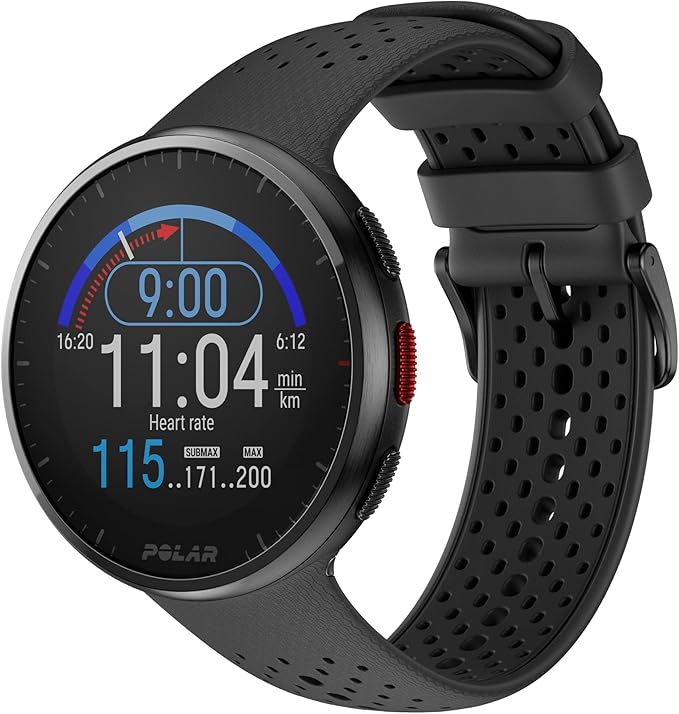
Polar Pacer Pro
Pros
Cons
Specs Overview
| Spec | Details |
|---|---|
| Display | 1.2″ Color MIP, 240×240 |
| Case Size | 45mm |
| Thickness | 11.5mm |
| Weight | 41g (with strap) |
| Battery (Smartwatch) | Up to 7 days |
| Battery (GPS) | Up to 35 hours |
| GPS | GPS + GLONASS / GPS + Galileo / GPS + QZSS (switchable) |
| Heart Rate | Polar Precision Prime optical sensor |
| Water Rating | 50m (5 ATM) |
| Running Power | Wrist-based |
| Barometric Altimeter | Yes |
| Maps/Navigation | Route import via Komoot + breadcrumb navigation |
| Music | Smartphone control only (no onboard storage) |
| Price | $349.99 |
| Released | April 2022 |
Related: Best GPS Running Watches / Best Affordable watches
Price
The Polar Pacer Pro retails at $349.99, a price that positions it squarely against some of the strongest competition in the mid-range running watch market.
| Watch | Price | Running Power | Multi-band GPS | AMOLED | Battery (GPS) |
|---|---|---|---|---|---|
| Polar Pacer Pro | $349 | ✅ | ❌ | ❌ | 35 hrs |
Ready to Start Training?
Training plans are designed and reviewed by Ilya Tyapkin, Rio 2016 Olympian. Find the plan that matches your goal:
Design
The Polar Pacer Pro is one of the lightest running watches available. At 41g with the strap, it’s the same weight as the Garmin Forerunner 255 but in a more refined package.
The 45mm case uses a plastic body with an aluminum bezel and Gorilla Glass lens. It measures just 11.5mm thick noticeably slimmer than most Garmin or Suunto competitors at this price point. The result is a watch almost does not feel on your wrist during long runs, even in warm weather.
The silicone strap reduces skin irritation during sweaty runs. The downside is the proprietary connection system, which may limit you to Polar’s own strap range rather than the another aftermarket options available on competitors.
Five physical buttons navigate everything, no touchscreen. The button layout mirrors Garmin’s approach, just mirrored. After a brief adjustment period, most runners find it intuitive. Navigation is notably fast thanks to the upgraded processor, an improvement over the laggy experience on older Polar models like the Vantage M2 and Grit X.
Available in grey, white, blue, and maroon colorways, understated and sporty rather than bold.
Light, slim, and comfortable for all-day and multi-hour wear. The proprietary strap is the one design frustration.
Display
The Polar Pacer Pro uses a 1.2-inch color Memory-in-Pixel (MIP) display at 240×240 resolution. If you’re coming from an AMOLED watch, you’ll notice the MIP displays are less vibrant, with more muted colors and lower contrast.
That said, MIP has real advantages for a running watch:
Excellent sunlight readability — no squinting mid-run
Lower power consumption directly contributes to the 35-hour GPS battery life
White backlight provides clean illumination at night without the color muddiness of blue backlights on some competing watches
The bezel around the display is on the large side, eating into screen real estate a noted criticism from reviewers who feel more of the case could be used for display area.
There’s no always-on mode, but the brightness is adjustable through the watch’s menu to balance readability and power consumption.
Functional and sunlight-readable, but noticeably behind the AMOLED displays now available on competitors like the Garmin Forerunner 265 at a similar price. For pure running use, it gets the job done well.
Training Features
Running-Specific Tools
Running Power (wrist-based) measures power output in watts directly from the wrist — no external pod needed. Useful for pacing on varied terrain where pace alone is misleading
Automatically detects and breaks down uphill and downhill segments, showing effort and time split, excellent for trail runners and hilly road runners
Provides accurate real-time elevation data, a feature typically reserved for higher-priced watches
VO2 max estimate that tracks improvement over time
Compete against other athletes on Strava Live Segments in real time
Training Load & Recovery
Training Load Pro monitors the cumulative intensity of your training and shows whether you’re undertraining, on track, or at risk of overtraining.
Cardio Load, Muscle Load separates cardiovascular and muscular training stress — useful for understanding where your body is being taxed
Recommends how much recovery time you need after each session
Sleep quality combined with overnight HRV data to assess morning readiness feeds directly into your daily workout recommendations
Sleep Tracking
Tracks light, deep, and REM sleep stages throughout the night
Synthesizes sleep quality with your autonomic nervous system recovery for a practical daily readiness score
Coaching & Nutrition
Daily personalized workout suggestions based on your current fitness, recent training load, and recovery status. Recommends cardio sessions, strength work, and even stretching routines with on-watch exercise demonstrations
Smart fueling reminders during long workouts prompt you to take carbohydrates or hydrate based on your effort level and workout duration
Navigation
Komoot route import with breadcrumb navigation and basic turn-by-turn directions
Back to Start: Navigates you back to your starting point useful when running in unfamiliar cities or trails
No offline maps navigation is route-based only
Multisport
Pool swimming, cycling, triathlon mode, hiking, and gym workouts are all supported and work well as a beginner triathlon watch despite its runner-focused marketing.
Running Power, Training Load Pro, FitSpark, FuelWise, and Sleep Plus Stages represent Polar’s best analytical tools.
Performance
GPS Accuracy
The Pacer Pro supports GPS paired with GLONASS, Galileo, or QZSS, switchable depending on your region and terrain. Notably, it does not have multi-band GPS, which means accuracy can degrade slightly in challenging environments like dense urban areas, forest trails, or canyons, where single-band GPS struggles.
In open conditions, road running, track sessions, and open trails, GPS performance is consistently described as excellent. In head-to-head comparisons with phone GPS using MapMyRun, the Pacer Pro matched distance and pace readings closely. For most runners who train primarily on roads or open paths, a single-band GPS is completely good.
For trail runners or city runners in areas with tall buildings, the lack of multi-band is worth noting.
Heart Rate Accuracy
The Polar Precision Prime optical HR sensor is one of the strongest wrist-based sensors at this price point. It uses multiple colored light sensors to improve reading accuracy across different skin tones and lighting conditions.
In testing across steady-state runs and interval sessions, HR readings closely match chest strap results Polar’s optical HR technology has a solid reputation built over years of refinement. Performance in high-intensity intervals is reliable, though like all optical sensors, it can briefly struggle during rapid effort changes.
External sensor pairing is fully supported for chest straps, cycling speed/cadence sensors, and stride sensors, all of which connect over Bluetooth.
Battery Life
Polar claims up to 7 days in smartwatch mode and up to 35 hours in GPS mode. Usually, a smartwatch battery lasts around 5 days with regular activity tracking and notifications.
For comparison, the Coros Pace 3 offers 38 hours of GPS and 20 days of smartwatch at $70 less. The Garmin Forerunner 255 manages 30 hours of GPS at a similar price. For a runner doing daily training and one long run per week, the Pacer Pro needs charging roughly twice a week manageable but worth knowing.
For ultra runners or multi-day adventure athletes, battery life is a limitation. For standard marathon training schedules, it’s sufficient.
GPS and HR accuracy are strong for the price. The lack of multi-band GPS is a real-world limitation in challenging terrain. Battery life is the watch’s biggest competitive weakness.
Who Should Buy It?
Buy the Polar Pacer Pro if:
- You’re a serious runner who wants running power, training load analytics, and sleep-based recovery tools at an accessible price
- You’re new to the Polar ecosystem and want to experience its best training features without paying flagship prices
- You prioritize lightweight design at 41g, it’s one of the lightest capable running watches available
- You’re a beginner triathlete it handles swim, bike, and run tracking competently
- You do most of your running on roads or open trails, where a single-band GPS is sufficient
- You value recovery analytics Training Load Pro and Nightly Recharge are class-leading at this price
Skip it if:
- You run in dense urban areas or technical trails where multi-band GPS matters
- Battery life is a priority the Coros Pace 3 and Garmin FR255 outlast it significantly
- You want an AMOLED display the Garmin Forerunner 265 adds AMOLED and multi-band GPS for ~$50 more
- You want offline maps no watch at this price offers true offline maps, but the route breadcrumbs are limited
- You want on-watch music Spotify and other streaming require your phone nearby
- You’re already invested in the Garmin ecosystem and want seamless Connect app integration
Final Verdict
The Polar Pacer Pro is one of the best-value running watches on the market for athletes who want deep, serious training analytics without paying flagship prices. Running Power, Training Load Pro, FitSpark coaching, FuelWise fueling reminders, and Sleep Plus Stages these are tools that athletes on other platforms pay $400–$500+ to access. The Pacer Pro delivers all of them for $$349.
The tradeoffs are real but manageable. Battery life is shorter than that of competitors. The MIP display lacks the visual punch of AMOLED rivals. Multi-band GPS is absent. And the proprietary strap system limits customization.
For a dedicated road runner who trains 5–6 days a week, follows a structured plan, and wants actionable recovery data, the Polar Pacer Pro is an exceptional choice that will genuinely help you run faster and recover smarter. For trail runners, ultra runners, or those prioritizing smart features, display quality, or GPS reliability in tough terrain, look elsewhere.
Scores:
| Category | Score |
|---|---|
| Design | 4.3 / 5 |
| Display | 3.5 / 5 |
| Training Features | 4.8 / 5 |
| Performance | 4.2 / 5 |
| Value | 4.3 / 5 |
| Overall | 4.2 / 5 |
Frequently Asked Questions
Is the Polar Pacer Pro worth it?
For serious runners who want premium training analytics at an accessible price, yes, it delivers most of Polar’s flagship feature set for $349. If you prioritize AMOLED display, multi-band GPS, or long battery life, competitors offer better value.
What is the difference between Polar Pacer and Polar Pacer Pro?
The Pacer Pro adds a barometric altimeter, Running Power (wrist-based), Hill Splitter, and Komoot route navigation over the base Polar Pacer. For runners focused on performance data and navigation, the $100 Pro upgrade is worth it.
Is the Polar Pacer Pro good for triathlons?
Yes, despite its runner-focused marketing. It supports pool swimming, cycling, triathlon, multisport mode, and full training load tracking across disciplines. It’s a solid beginner-to-intermediate triathlon watch.
Does the Polar Pacer Pro have music?
No onboard music storage. The Pacer Pro offers smartphone music control — you can play, pause, and skip tracks from the watch, but music streams from your phone. Spotify and similar apps require your phone to be nearby.
This review is based on aggregated expert testing data, long-term user reports, and technical specifications compiled from across the running and multisport community. We bring together the most accurate and comprehensive information so you can make a confident buying decision.