

How to Stop Side Stitches While Running
To stop a side stitch fast, slow your pace by 20–30 seconds per kilometer, switch to deep belly breathing, and forcefully exhale every time the foot opposite the pain hits the ground. Press two fingers into the painful spot and lean your torso toward that side. Most stitches break within 30–90 seconds using this protocol. The medical name is exercise-related transient abdominal pain (ETAP), and roughly 70% of runners report experiencing it in the past year — so if you’re getting them, you’re in normal company.
This guide gives you the in-the-moment fix, the actual science of why stitches happen (the explanations you’ve heard about your liver or spleen swelling are outdated), and a prevention protocol built around what peer-reviewed research and Olympic-level coaching agree on.
Personaly Coach’s experience says, in 90% of the runners I coach who chronically get stitches, the fix is breathing depth and core engagement, not running slower. Slower running just hides the problem.
How to Stop a Side Stitch Mid-Run: 5-Step Protocol
When the pain hits, work this sequence in order. Don’t skip steps; each one targets a different mechanism.
1. Drop the pace, don’t stop
Cut your speed by 20–30 seconds per kilometer (about 30–45 seconds per mile). Stopping cold often makes the pain rebound when you start again. Keep moving at an easy effort.
2. Switch from chest breathing to belly breathing
Most stitch sufferers are shallow chest breathers under load. Push your stomach out as you inhale through the nose, and let it fall as you exhale through pursed lips. Three to five deep breaths is usually enough to feel the cramp loosen.
3. Sync your exhale to the opposite foot strike
This is the single most effective tactic. If the stitch is on your right side, force a hard exhale every time your left foot lands. If it’s on the left, exhale on the right foot. This breaks the rhythmic stress pattern that’s irritating the abdominal lining.
4. Press and lean
Push two fingers firmly into the painful area and lean your torso toward the side that hurts (not away from it). Hold for 10–15 seconds while continuing the opposite-foot exhale.
5. If it’s still there after 90 seconds, walk for 30
A short walk break almost always resets the system. You’ll usually be able to resume running with the stitch gone or significantly reduced.
What Causes Side Stitches?
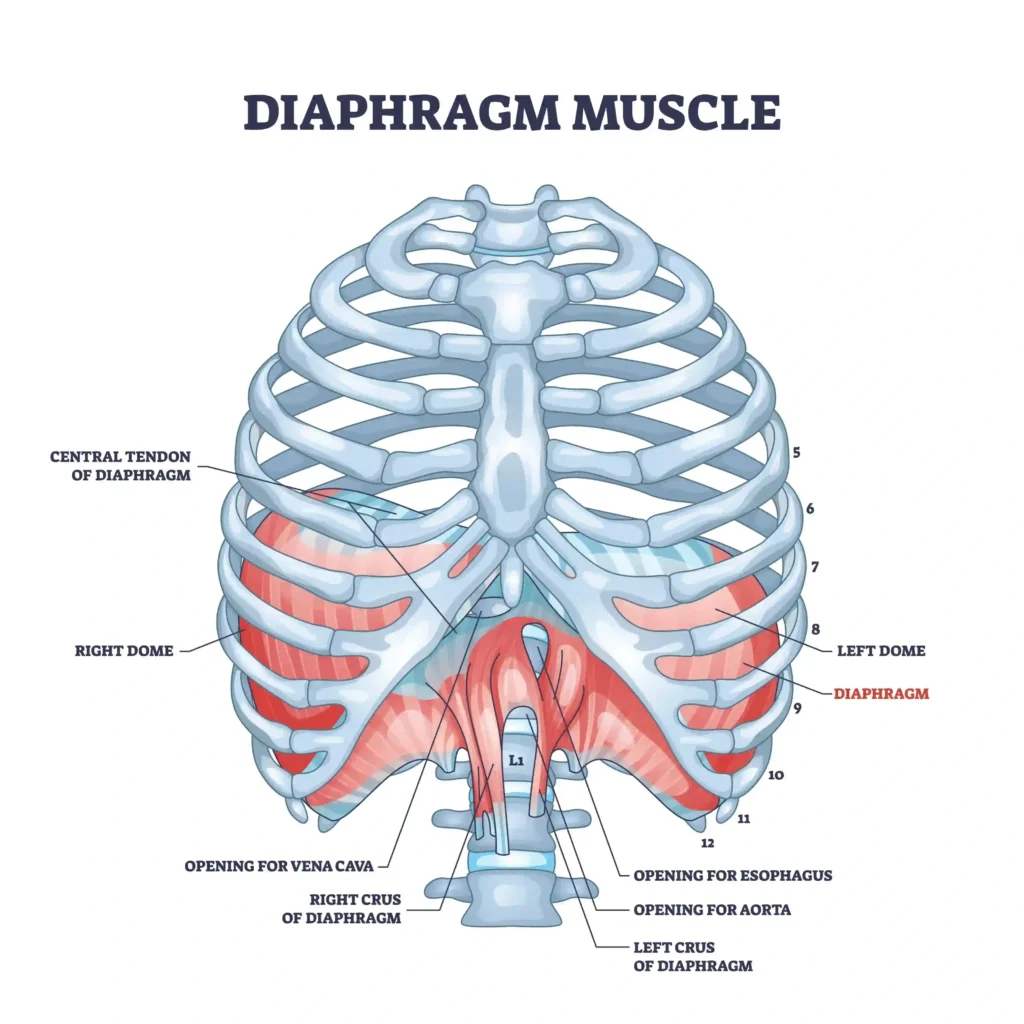
The popular explanations — your liver “swells,” your spleen “squeezes,” your diaphragm cramps — are mostly outdated. The current scientific consensus comes from researcher Darren Morton at Avondale University, who has spent 20+ years studying ETAP. His 2014 review in the journal Sports Medicine concluded that irritation of the parietal peritoneum is the most likely cause.
Here’s what that means in plain English:
- The parietal peritoneum is a thin membrane lining the inside of your abdominal wall.
- The visceral peritoneum wraps your organs.
- A small amount of fluid sits between the two layers, normally letting them slide past each other without friction.
- During running, repetitive torso movement, postural stress, and changes to that fluid (especially after drinking sugary or hypertonic beverages) cause the two layers to rub. The resulting irritation is the sharp pain you feel.
This explains a lot about the older theories that couldn’t:
- Why do hypertonic drinks (sugary sports drinks, juice, soda) provoke stitches. Morton’s research shows these beverages change the osmotic balance in the peritoneal cavity, not just the weight of the stomach.
- Why posture matters. Slouched thoracic posture and a weak core increase friction on the membrane.
- Why the diaphragm theory doesn’t fully hold up. Morton’s spirometry studies showed no significant changes in breathing function during an active stitch — meaning the diaphragm itself isn’t cramping the way the old textbooks claimed.
- Why do beginners get them more. Untrained runners typically have weaker core musculature and less rib-cage mobility, both of which load the peritoneum more heavily.
A 2013 study by Mole and colleagues found something especially actionable: runners who chronically get stitches have measurably thinner transversus abdominis muscles and worse core stability than runners who don’t. That makes ETAP partly a strength problem, not just a luck problem.
Why One Side Hurts More Than the Other
You’ve probably read that right-side stitches come from your liver and left-side stitches come from your spleen. Both claims are popular but not supported by current research. The pain location is now believed to track with the intercostal nerves that supply the parietal peritoneum, which is why ETAP shows up most often in the lateral mid-abdomen along the lower rib line, on either side.
What does seem to influence which side hurts:
- Breathing pattern. Runners who consistently exhale on the same foot strike load one side of the abdominal wall more than the other.
- Asymmetric core strength. A weaker oblique on one side means more passive load on the peritoneum on that side.
- What you ate and which way you sleep. Stomach contents shift; partially digested food on one side can change pressure during impact.
The fix is the same regardless of which side: opposite-foot exhale, deep belly breathing, and core work between runs.
How to Prevent Side Stitches Before Your Next Run
Once you stop chasing the pain and start fixing the cause, stitches become rare. Here’s the evidence-based prevention stack:
Time your fueling
Morton’s recommendation— backed by the research consensus is to avoid large food and fluid volumes for at least 2 hours before exercise, and to specifically avoid hypertonic beverages (regular sports drinks at full concentration, fruit juice, soda) close to a run. If you need a pre-run drink, water or a half-strength sports drink is far less provocative.
Build your transverse abdominis
Mole’s research linked stitch-prone runners to weaker deep core muscles. You don’t need a complicated routine 5–10 minutes of dead bugs, planks (front and side), and bird dogs three times per week is enough to make a measurable difference within 6–8 weeks.
Fix your thoracic posture
A slumped upper back compresses the abdominal cavity and changes how the peritoneum loads. Cat-cow, thoracic rotations, and a daily 30-second wall-angel hold cost almost no time and pay off in stitch reduction.
Warm up properly
Five to ten minutes of easy jogging plus a few drills lets blood flow shift gradually. Cold-starting at race pace is a top trigger for both new and experienced runners.
Strengthen your breathing pattern
Practice 4-count belly breathing for two minutes a day off the run. The goal is to make deep diaphragmatic breathing your default, so it stays online when effort goes up.
Consider a supportive belt for long efforts.
Morton lists abdominal support belts among accepted prevention strategies, especially for runners with chronic ETAP.
If stitches are limiting your training, structured plans build the volume, breath-rhythm consistency, and core demands that prevent them. Our 5K Training Plans include all of this for runners early in their journey, and our Half Marathon Plans layer in the long-run-specific work for athletes pushing further.
Can You Run Through a Side Stitch?
Yes, in most cases. ETAP is benign, uncomfortable, but not damaging tissue. If you’re racing or running a workout you don’t want to abandon, the 5-step protocol above will usually break the stitch within 60–90 seconds without you having to stop.
The exception: if the pain is severe, escalating, or doesn’t respond to the protocol within 2–3 minutes, stop. That’s not a normal stitch — see the warning signs below.
Race-day rule: “In a 5K, if you feel a stitch, you don’t slow down meaningfully, you change your foot-strike-breath rhythm and hold form. The stitch breaks within sixty seconds. Slowing too much in a short race costs you more than the stitch does.”
When Side Pain Is Not a Side Stitch
A normal ETAP stitch fades within minutes of stopping. See a doctor if the pain has any of these features:
- Lasts longer than a few hours after exercise
- Returns at rest, hours after your run
- Comes with fever, nausea, vomiting, or dizziness
- Feels deep rather than at the abdominal wall
- Is on the upper-right side and worsens after fatty meals (possible gallbladder)
- Radiates to the shoulder or back
- Is accompanied by blood in stool or unusual bruising
These can signal gallbladder issues, hernias, kidney problems, or, rarely, cardiac referral pain. None of them resolves with the breathing technique. Get them checked.
FAQ
What is the medical name for a side stitch?
Side stitches are medically called exercise-related transient abdominal pain (ETAP). The term was formalized by researcher Darren Morton in 2000 and is now standard in sports medicine literature.
How long does a side stitch last?
Most stitches resolve within 30 seconds to 5 minutes once you slow down and apply the breathing protocol. A stitch that lasts longer than 10 minutes after stopping isn’t a normal ETAP and should be evaluated.
Can you run through a side stitch?
Yes. ETAP is benign and doesn’t damage tissue. Use the 5-step protocol slow slightly, deep belly breathe, exhale on the opposite foot strike, press the spot, and lean toward the pain, and most stitches break within 60–90 seconds without stopping.
Why do beginners get more side stitches than experienced runners?
Newer runners have weaker transversus abdominis muscles, less rib-cage mobility, less efficient breathing patterns, and tend to start at higher relative intensity without warming up. All of these increase load on the parietal peritoneum.
Does drinking water during a run cause side stitches?
Plain water is unlikely to provoke a stitch. The culprits are hypertonic beverages, full-strength sports drinks, fruit juice, and soda consumed within 1–2 hours before or during exercise. They change the osmotic balance in the peritoneal cavity and provoke ETAP independently of stomach weight.
Should I see a doctor about side stitches?
Routine ETAP doesn’t require medical care. See a doctor if pain persists at rest, returns hours after exercise, comes with fever, nausea, or vomiting, or is accompanied by other unusual symptoms.
Why do I only get side stitches on long runs?
Cumulative postural fatigue. As your form degrades over miles, thoracic posture collapses and core engagement drops — both of which load the peritoneum more. Long-run-specific core work and posture drills usually solve it.
Do side stitches go away with training?
Yes, for most runners. Trained athletes still experience them but significantly less often. Building core strength, refining breathing, and improving posture are the variables that change fitness alone is not enough.
Sources
- Morton, D. P., & Callister, R. (2014). Exercise-Related Transient Abdominal Pain (ETAP). Sports Medicine. https://link.springer.com/article/10.1007/s40279-014-0245-z
- Morton, D. P., & Callister, R. (2000). Characteristics and etiology of exercise-related transient abdominal pain. Med Sci Sports Exerc, 32(2), 432–438. https://pubmed.ncbi.nlm.nih.gov/10694128/
- Mole, J. L., Bird, M. L., & Fell, J. W. (2013). The effect of transversus abdominis activation on exercise-related transient abdominal pain. J Sci Med Sport, 17(3), 261–265. https://www.sciencedirect.com/science/article/abs/pii/S1440244013001448