
The Polar Pacer doesn’t try to be everything. It doesn’t have offline maps, power over USB, a barometric altimeter, or an AMOLED screen. It knows exactly what it is, a lightweight, no-fuss GPS running watch packed with Polar’s best training and recovery tools, and it delivers on that promise exceptionally well.
For new runners, casual athletes, and anyone who wants reliable GPS, solid recovery metrics, and personalized training guidance without paying for features they’ll never use, the Polar Pacer is one of the cleanest value propositions at its price point.
Here’s the full picture in the Polar Pacer Review:
Quick Verdict
Overall Rating: 4.0 / 5
| Best For | New to intermediate runners who want Polar’s training and recovery ecosystem in the most affordable package |
| Skip If | You need route navigation, running power, a barometric altimeter, or AMOLED display |
| Price | ~$149–$169 (MSRP $199) |
| Standout Feature | FitSpark daily workout suggestions + Nightly Recharge recovery scoring at an accessible price |
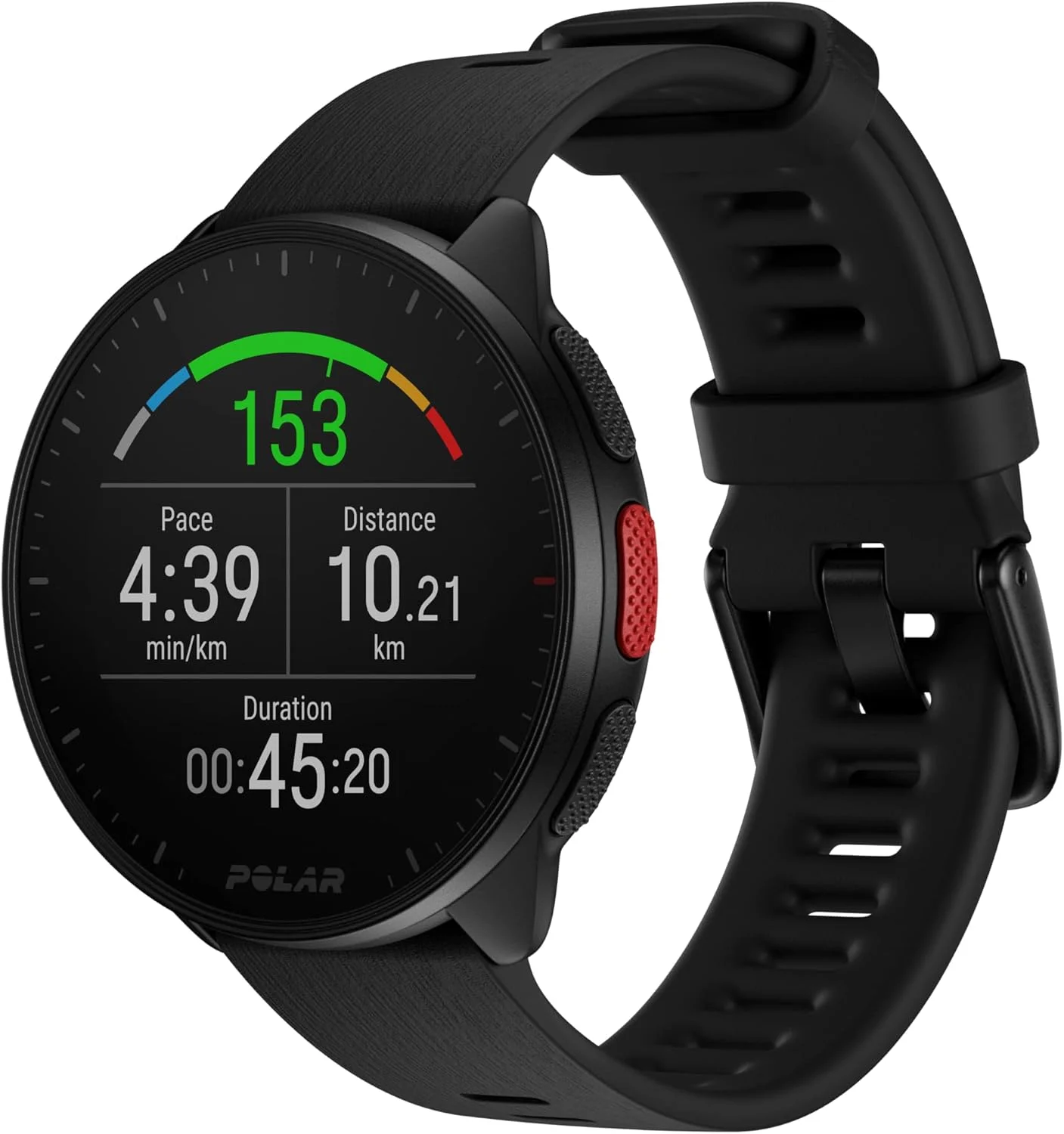
Polar Pacer
Pros
Cons
Specs Overview
| Spec | Details |
|---|---|
| Display | 1.2″ Color MIP, 240×240, Gorilla Glass |
| Case Size | 45mm |
| Thickness | 11.5mm |
| Weight | ~40g |
| Battery (Smartwatch) | Up to 7 days |
| Battery (GPS) | Up to 35 hours |
| GPS | GPS + GLONASS / GPS + Galileo / GPS + QZSS |
| Heart Rate | Polar Precision Prime optical sensor |
| Water Rating | 5 ATM (50m) |
| Altimeter | GPS-based only (no barometric) |
| Navigation | None |
| Music | None |
| Colors | Night Black, Cloud White, Deep Teal, Purple Dusk |
| MSRP | $199 |
| Current Price | ~$149–$169 |
| Released | May 2022 |
Related: Best GPS Running Watches / Best Affordable watches
Price
The Polar Pacer launched at $199 and now regularly sells for $149–$169 at Amazon and Walmart a meaningful discount that sharpens its value argument considerably. It sits directly beneath the Polar Pacer Pro (~$269–$279).
| Watch | Price | GPS Battery | Altimeter | Navigation | Training Analytics |
|---|---|---|---|---|---|
| Polar Pacer | ~$149–$169 | 35 hrs | ❌ GPS-only | ❌ | FitSpark, Nightly Recharge, Training Load |
Ready to Start Training?
Training plans are designed and reviewed by Ilya Tyapkin, Rio 2016 Olympian. Find the plan that matches your goal:
Design
The Polar Pacer shares an identical form factor with the Pacer Pro, a 45mm plastic case, 11.5mm thin, 40g with a strap. It’s light, slim, and comfortable for all-day and overnight wear without the bulk or wrist fatigue of heavier watches.
The case is plastic, no metal bezel here, unlike the aluminum on the Pacer Pro. The Gorilla Glass lens provides meaningful scratch protection for everyday use. Four color options, Night Black, Cloud White, Deep Teal, and Purple Dusk, give more personality than most competitors at this price.
Five physical buttons with a textured, “super grip” finish surround the display. They’re well-positioned, easy to press with sweaty hands or mid-run, and clearly distinguished from each other no accidental button presses during workouts. No touchscreen, which keeps the interface reliable in any condition.
One design frustration: the proprietary strap connection limits band replacement options to Polar’s own range. Third-party bands aren’t compatible, which reduces customization compared to watches using standard 20mm lug width.
The charging cable uses a magnetic POGO pin connection, not USB-C. A minor inconvenience in 2025 when most runners carry USB-C cables for everything else.
Display
The Polar Pacer uses a 1.2-inch color MIP display at 240×240 resolution, protected by Gorilla Glass. It’s the same display technology and size as the Pacer Pro, a consistent choice across the Polar lineup at this tier.
The MIP display’s standout quality is sunlight readability. Unlike AMOLED displays that can wash out in bright light, the Polar Pacer’s reflective MIP panel actually becomes clearer in direct sunlight, a real practical advantage for outdoor running. The always-on nature of MIP means you never need to raise your wrist or press a button to check your pace mid-run.
The display does feel dated by standards, with no color vibrancy, no AMOLED depth, and the bezel around the screen eats into available display area more than it should at this size. For pure running use glancing at pace, heart rate, time, and distance, it’s completely functional. For anything more visually demanding, the limitation shows.
Night mode via the backlight is clean a white light rather than the blue backlight of some Garmin models, which reviewers consistently prefer for nighttime readability.
Bottom line on display: Sunlight-readable and always-on, the right priorities for a running watch. Visually basic by 2025 standards, but functional for everything it needs to do.
Training Features
Running Tools
- Daily personalized workout recommendations based on your current fitness level, recent training history, and recovery status. Recommends cardio sessions, strength work, and recovery/stretching routines with on-watch exercise demonstrations for strength and flexibility moves
- Training Load tracks cumulative cardio and muscle training stress across sessions
- Post-workout recovery time recommendation based on session effort and HRV data
- Running Index: VO2 max estimate that tracks your aerobic fitness improvement over time
- Race Pace sets a recommended target pace based on your training history and goal time for a specific distance
- Smart fueling reminders during longer workouts prompt you to eat carbohydrates or drink water based on your effort level and duration. Particularly useful for marathon and half-marathon training
- Cadence, stride length, and step count tracking
Sleep & Recovery
- Automatically detects and tracks light, deep, and REM sleep throughout the night
- Combines sleep quality data with overnight HRV (heart rate variability) to produce a daily readiness score, one of the most actionable recovery metrics available on any running watch at this price.
- Continuous HRV monitoring during sleep
What the standard Pacer lacks vs. the Pacer Pro:
- No barometric altimeter, elevation data relies on GPS, which is less accurate on hilly routes
- No Hill Splitter, no automatic detection and breakdown of climbing vs descending segments
- No running power (wrist-based)
- No route navigation or breadcrumb trail following
Health & Wellness
- 24/7 heart rate monitoring
- Stress tracking
- Blood oxygen (SpO2)
- All-day activity tracking: Steps, calories, intensity minutes
- Women’s health: Menstrual cycle tracking
Smart Features
- Smartphone notifications like calls, texts, and app alerts
- Phone music controls: Play, pause, skip from wrist (no onboard storage)
- Weather display
- Strava, TrainingPeaks, and MyFitnessPal integration
- 130+ sport profiles: Running (road, trail, track, indoor), cycling, swimming, strength, HIIT, yoga, and more
Performance
GPS Accuracy
The Polar Pacer supports GPS + GLONASS, GPS + Galileo, or GPS + QZSS switchable based on region and conditions, plus Assisted GPS for faster satellite acquisition. Single-band only no multi-band dual-frequency.
In real testing and user reports, GPS accuracy is consistently solid for road running and open-path use. In urban canyons with tall buildings or under dense forest canopy, single-band GPS can occasionally drift, as with all single-band watches in this price bracket.
One advantage over many competitors: GPS lock time is notably fast thanks to Assisted GPS. Less standing on the pavement waiting for a signal before setting off.
Heart Rate Accuracy
The Polar Precision Prime optical sensor is one of the better wrist-based HR sensors at this price. Using multiple colored LEDs and photodetectors, it’s designed to reduce skin tone and motion interference. In testing during steady-state runs, readings closely match chest strap data. During high-intensity intervals, a brief lag can occur, consistent with all optical wrist sensors.
External sensor pairing via Bluetooth and ANT+ is supported, with chest straps, cycling speed/cadence, and stride sensors all compatible.
Battery Life
- GPS mode: Up to 35 hours
- Smartwatch mode: Up to 7 days
The smartwatch battery is the Polar Pacer’s most notable competitive weakness. People who use daily sleep tracking and multiple GPS sessions typically deliver 5–6 days between charges.
The 35-hour GPS battery is strong sufficient for ultramarathon events and multi-day training blocks without mid-event charging. It’s the smartwatch battery that requires more frequent attention.
Who Should Buy It?
Buy the Polar Pacer if:
- You’re a new or intermediate runner wanting Polar’s training and recovery tools in the most accessible package
- Nightly Recharge and FitSpark are appealing you want daily readiness guidance and personalized workout suggestions without complex setup
- You run primarily on roads and familiar routes where navigation isn’t needed
- You want a lightweight watch, 40g is comfortable for 24/7 wear, including sleep tracking
- You care about recovery analytics. Polar’s Nightly Recharge is genuinely class-leading at this price
- You’re switching from a basic fitness tracker and want a proper running watch with training guidance
- Budget matters at $149–$169, it’s one of the most affordable dedicated GPS running watches available
Skip it if:
- You need route navigation or a breadcrumb trail. Following the Coros Pace 3 at $199 adds this
- Running power or Hill Splitter is an important step up to the Polar Pacer Pro (~$269)
- Accurate elevation data on hilly terrain matters no barometric altimeter, GPS-only elevation is less reliable
- You want a longer smartwatch battery, the Garmin Forerunner 55 or Coros Pace 3, both outlast the Pacer significantly in everyday mode
- You need on-watch music, no storage of any kind
- You’re deeply invested in the Garmin, Garmin Coach, Connect IQ, and Body Battery, which aren’t available here
Final Verdict
The Polar Pacer is a focused, honest running watch that knows exactly who it’s for. Strip away the features it doesn’t have, no altimeter, no maps, no running power and what remains is a lightweight, comfortable watch with reliable GPS, one of the best recovery scoring systems available at this price, and genuinely useful daily training guidance.
At $149–$169, it competes directly with the Garmin Forerunner 55 and trades blows evenly. The Polar Pacer wins on GPS battery (35 vs 20 hours) and recovery analytics depth. The Forerunner 55 wins on smartwatch battery (14 vs 7 days), Garmin Coach, and the broader Garmin Connect ecosystem. The choice comes down to whether you value Polar’s recovery focus or Garmin’s training guidance.
For any runner who wants to train smarter through better recovery awareness, the Polar Pacer delivers meaningful value at an accessible price.
Scores:
| Category | Score |
|---|---|
| Design | 3.9 / 5 |
| Display | 3.5 / 5 |
| Training Features | 4.1 / 5 |
| Performance | 4.0 / 5 |
| Value | 4.5 / 5 |
| Overall | 4.0 / 5 |
Frequently Asked Questions
Is the Polar Pacer worth buying?
At $149–$169, yes, for new to intermediate road runners who want Polar’s training and recovery tools at an accessible price. If you need route navigation, running power, or a barometric altimeter, the Polar Pacer Pro or Coros Pace 3 are better options for more money.
What is the difference between Polar Pacer and Polar Pacer Pro?
The Pacer Pro adds a barometric altimeter, Hill Splitter, wrist-based running power, and Komoot route navigation with breadcrumb trail following. It also has a slightly more premium build. The Pacer Pro costs approximately $100–$120 more. For road runners who don’t need elevation accuracy or navigation, the standard Pacer delivers the same core training and recovery tools for less.
Is the Polar Pacer good for beginners?
Yes, it’s one of the best beginner running watches available, particularly for runners who want guided daily training recommendations. FitSpark suggests daily workouts (including cardio, strength, and recovery sessions) based on your fitness level and recovery status, taking the guesswork out of what to do each day.
This review is based on aggregated expert testing data, long-term user reports, and current market pricing compiled from across the running community. We bring together the most accurate and up-to-date information so you can make a confident buying decision.