
The Apple Watch SE 3 starts at $249. The Garmin Forerunner 55 sits at around $149. On the surface, that $100 gap should make the decision easy. But it doesn’t, because these two watches are built for fundamentally different people, and choosing the wrong one means paying for features you’ll never use while missing ones you actually need.
If you’re an iPhone user who wants a capable everyday companion that also tracks your runs, the SE 3 is a serious contender. If you’re a runner first, who wants a watch built specifically to make you faster and smarter about your training, the Forerunner 55 is a different kind of tool entirely.
Let’s work through what actually matters in Apple Watch SE 3 vs Garmin Forerunner 55.
Quick Comparison Table
| Feature | Apple Watch SE 3 | Garmin Forerunner 55 |
|---|---|---|
| Price | From $249 (GPS) | ~$149 |
| Display | Always-On Retina LTPO AMOLED | 1.04″ Color MIP, 208×208 |
| Case Size | 40mm / 44mm | 42mm (one size) |
| Weight | ~26g (40mm) | 37g |
| Battery (Smartwatch) | Up to 18 hours | Up to 14 days |
| Battery (GPS) | ~18 hours total use | Up to 20 hours GPS |
| GPS | Single-band L1 | Single-band GPS+GLONASS/Galileo |
| HR Sensor | Optical | Optical |
| ECG | ❌ | ❌ |
| Always-On Display | ✅ | ❌ |
| Navigation | Limited (Apple Maps cache) | ❌ |
| Music | Streaming + offline (Apple Music) | ❌ |
| Contactless Payments | ✅ Apple Pay | ❌ |
| Cellular Option | ✅ 5G | ❌ |
| Training Plans | ❌ | ✅ Garmin Coach |
| Body Battery / HRV | ❌ | ✅ Body Battery |
| Daily Suggested Workouts | ❌ | ✅ |
| PacePro / Race Tools | ❌ | ✅ PacePro |
| Sleep Apnea Detection | ✅ | ❌ |
| Fall / Crash Detection | ✅ | ❌ |
| Compatibility | iPhone only | iOS + Android |
| Charging | Magnetic USB-C | Proprietary USB-A |
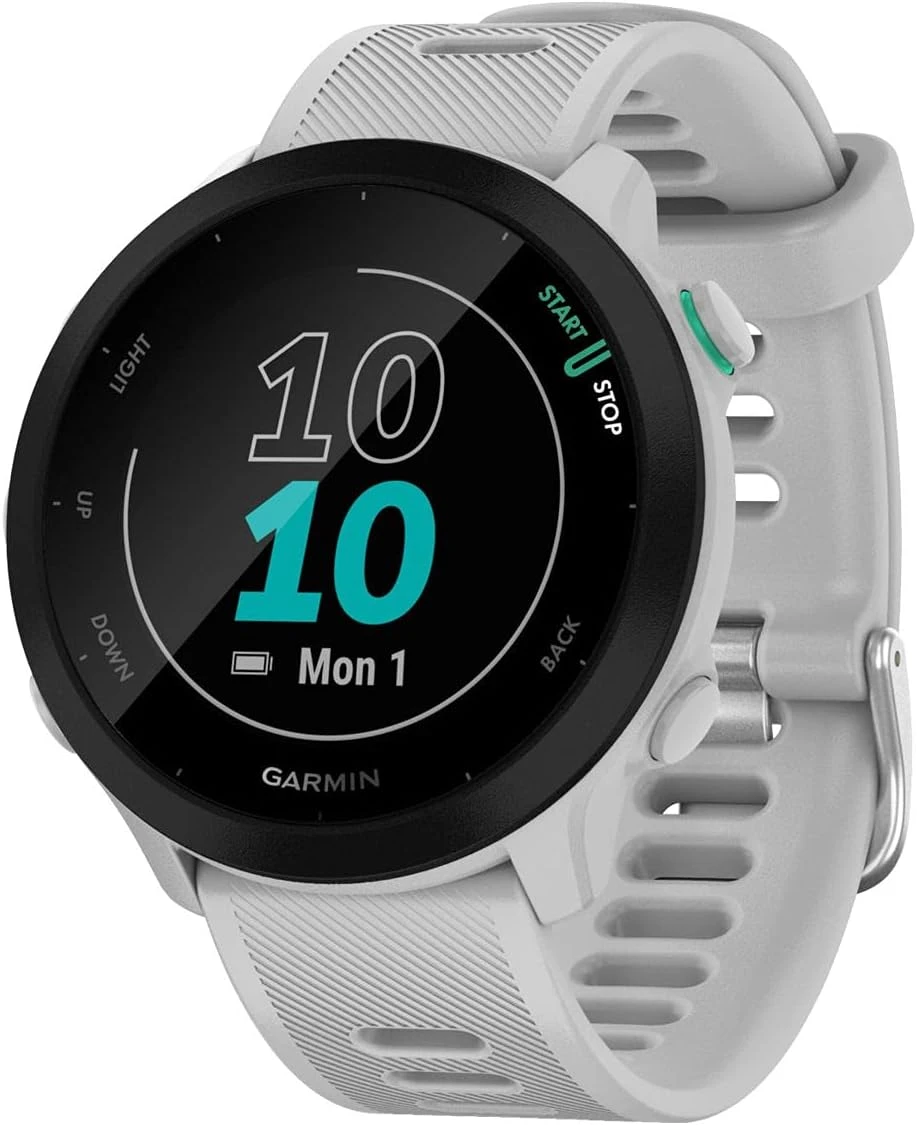
Garmin Forerunner 55
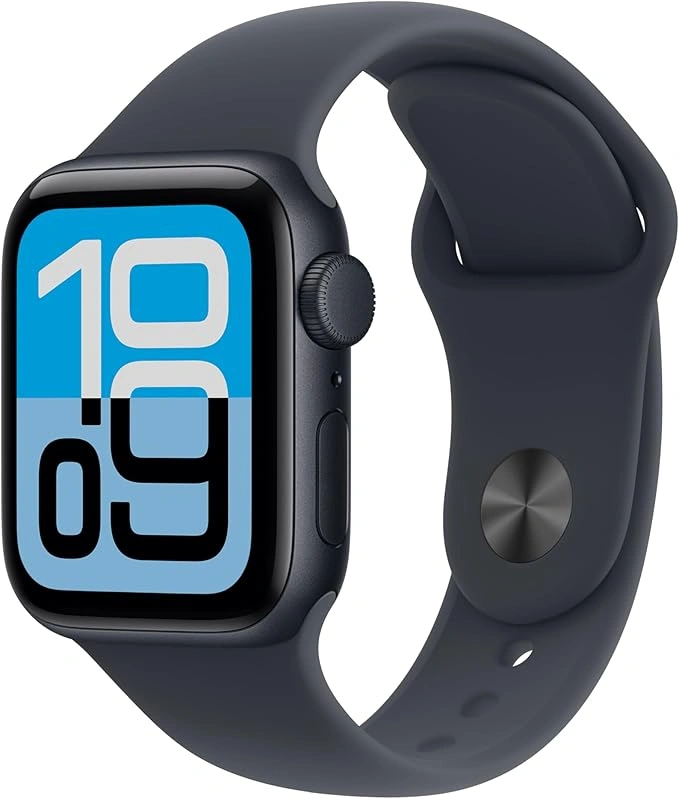
AppleWatch SE 3
Price — What Does the Extra $100 Actually Buy?
The Apple Watch SE 3 starts at $249 for the GPS model, $100 more than the Garmin Forerunner 55 at approximately $149. Add cellular to the SE 3, and the gap grows to $150.
That $100 is real money. But it’s important to understand what it’s buying, and what it isn’t.
The SE 3’s premium buys you a dramatically better display, Apple Pay, streaming music, always-on capability, sleep apnea detection, fall detection, crash detection, and the entire Apple ecosystem integration. It does not buy you better GPS accuracy, better running analytics, longer GPS battery, or a more capable coaching tool for structured training.
The Forerunner 55 at $149 buys you more GPS battery, better training coaching tools, 14 days between charges, and a watch built specifically for runners, for $100 less.
The question isn’t which watch costs more. It’s what you’re actually going to use it for.
Related: Best GPS Running Watches / Best Affordable watches
Display — Apple Wins Clearly
This is the most visible difference between these two watches, and the Apple Watch SE 3 wins it without much contest.
The Apple Watch SE 3 has an Always-On Retina LTPO AMOLED display, vivid, colorful, sharp, and bright enough to read in direct sunlight. The always-on capability means you can glance at your pace mid-stride without raising your wrist or pressing anything. It’s a genuinely modern smartwatch display, and it shows.
The Garmin Forerunner 55 has a 1.04-inch color MIP display at 208×208 resolution. It’s small. By 2025 standards, the resolution feels dated. There’s no always-on capability; press a button or raise your wrist to see the screen. What the MIP does well is sunlight readability and power efficiency, but aesthetically, it’s not in the same conversation as the SE 3.
If you’re the kind of person who looks at their watch 50 times a day during meetings, coffee runs, and workouts, the SE 3 display is a noticeably better daily experience.
If you’re a runner who primarily looks at pace, heart rate, and time during a run, the FR55 shows those clearly enough, and the display limitation rarely affects actual performance.
Winner: Apple Watch SE 3 — by a wide margin on everyday aesthetics and always-on readability.
Design & Comfort
The Apple Watch SE 3 is lighter — approximately 26g on the 40mm model compared to the Forerunner 55’s 37g. Both are comfortable for all-day wear, but the SE 3’s lightness and refined rectangular form factor feel more like a lifestyle watch, less like sports equipment.
The Forerunner 55 has a rounder, more traditional sports watch look. It’s functional, unpretentious, and comfortable, but nobody’s going to mistake it for an Apple Watch in a boardroom.
Where the Forerunner 55 has a quiet advantage: five physical buttons that work reliably in any condition, rain, sweat, gloves, freezing temperatures. The Apple Watch SE 3’s touchscreen, while excellent in normal conditions, becomes less responsive when wet or when wearing gloves. The Digital Crown and Side Button help, but button-driven watches have an inherent reliability advantage during difficult training conditions.
Available sizes: Apple offers 40mm and 44mm. The Forerunner 55 comes in one size — 42mm. Both suits most wrists comfortably.
Winner: Apple Watch SE 3 on design and lightness. Garmin Forerunner 55 on wet-weather reliability.
GPS Accuracy — Essentially Equal
Both watches use single-band GPS, and in everyday running conditions, both perform well.
The Apple Watch SE 3 uses Apple’s built-in GPS for outdoor workout tracking. In normal road running conditions, route accuracy is reliable and consistent with Apple Watch quality. In urban canyons with tall buildings or under dense tree cover, single-band GPS shows occasional drift — the same limitation it shares with the Forerunner 55.
The Garmin Forerunner 55 uses GPS paired with GLONASS or Galileo, and in controlled testing, recorded within ±0.08 miles of a known 2.8-mile course. That’s impressively accurate for a budget GPS watch.
In everyday road running, park loops, and track sessions, both are accurate enough to give you reliable distance and pace data. Neither has multi-band or dual-frequency GPS, which is the main limitation at this price tier.
Winner: Draw — both are solid for everyday running conditions.
❤️ Heart Rate Accuracy
Both watches use optical wrist-based HR sensors, and both perform similarly during steady-state running and easy efforts.
The honest reality for both watches: optical HR is reliable for easy and moderate intensity running. As soon as you get into high-intensity intervals with rapid HR spikes and drops, both sensors can show brief lag or deviation. This is a category limitation, not a specific watch failure.
The SE 3 pairs beautifully with AirPods Pro 3, which provide additional biometric heart rate data via the ear canal, potentially improving accuracy during high-intensity efforts when combined with the wrist sensor. If you run with AirPods anyway, this is a practical advantage.
The FR55 supports ANT+ chest strap pairing for athletes who want the most precise HR data during structured sessions.
Winner: Draw for general running. SE 3 + AirPods Pro 3 has an edge for AirPods users; FR55 + chest strap for serious interval athletes.
Battery Life — Garmin Wins Decisively
This is where the comparison tilts firmly toward the Forerunner 55, and for many runners, it’s the deciding factor.
| Mode | Apple Watch SE 3 | Garmin Forerunner 55 |
|---|---|---|
| Normal Use | Up to 18 hours | Up to 14 days |
| GPS Tracking | ~18 hours total | Up to 20 hours GPS |
The Apple Watch SE 3 needs to be charged every day. That’s the reality of a vibrant AMOLED display, 5G hardware, and the power demands of watchOS. Most users charge it overnight. If you run in the morning and forget to charge the night before, you’re heading out with a depleted watch.
The Garmin Forerunner 55 charges roughly once a week with daily use and multiple GPS sessions. It does 14 days in smartwatch mode and 20 hours in GPS mode. You don’t think about charging the FR55 you just wear it.
For sleep tracking specifically, the SE 3 requires careful battery management to track sleep without running dry overnight. The FR55 tracks sleep without any planning; it’s always got charge to spare.
Winner: Garmin Forerunner 55 decisively. The battery difference changes how you relate to the watch entirely.
Training Features — Garmin Is in a Different League
This is the most important section for runners, and it’s where the FR55 makes its strongest case.
Garmin Forerunner 55 Running Tools
- Garmin Coach: Free built-in adaptive training plans for 5K, 10K, and half-marathon. The plans adjust week by week based on your fitness and recovery. For new runners following a structured plan for the first time, this is one of the most valuable tools available at any price
- Daily Suggested Workouts: Garmin’s algorithm recommends a personalized workout every day — easy run, tempo, recovery, rest — adapting over time as your fitness changes
- PacePro: Grade-adjusted pacing guidance for goal races. Load a course, set a target, and the watch tells you exactly what pace to run on every hill and flat section
- Body Battery: Energy monitoring score based on HRV, sleep, stress, and activity — practical for deciding when to push and when to hold back
- Race Time Predictor: Estimates finish times for 5K, 10K, half-marathon, and marathon based on current fitness
- Track Run Mode: Locks GPS to standard track geometry for accurate lap splits
- Cadence alerts: Set a target cadence range, get notified when drifting
- Recovery Advisor: Post-workout recovery time recommendation
- Incident Detection: Detects accidents mid-run and sends the location to emergency contacts
Apple Watch SE 3 Running Tools
- Custom Workouts: Build structured sessions with multiple intervals, targets, and rest periods
- Pacer: Set a target pace and get real-time feedback during a run
- Advanced running metrics: Cadence, stride length, ground contact time, vertical oscillation
- Auto workout detection: Starts tracking automatically when you begin running
- Activity Rings: Move, Exercise, Stand — Apple’s core fitness motivation system
- Workout Buddy: AI-powered spoken motivation and pacing guidance (requires iPhone nearby + AirPods)
What the SE 3 doesn’t have: structured training plans, adaptive daily workout suggestions, Body Battery, race-specific pacing tools, or a coaching system that learns and adapts to your fitness over time.
The Apple Watch SE 3 tracks your runs well. The Garmin Forerunner 55 coaches your running. That’s a genuinely meaningful difference for anyone who wants to improve.
Winner: Garmin Forerunner 55 — by a significant margin for structured running training.
Smart Features — Apple Watch in Its Own World
If the Forerunner 55 wins on running-specific tools, the Apple Watch SE 3 wins comprehensively on everything else.
- Apple Pay — tap your wrist to pay anywhere contactless terminals exist
- Streaming music — Apple Music, Spotify via iPhone, podcasts, all seamlessly integrated
- 5G cellular (on cellular models) — calls, messages, and data independently from your iPhone
- Siri — on-device, fast, with health data context
- Fall Detection and Crash Detection — genuine safety features that have saved lives
- Sleep apnea notifications — passive health monitoring that could identify a serious condition
- watchOS 26 ecosystem — thousands of third-party apps, deep iPhone integration, AirPods pairing, and Apple Health consolidation
The Garmin Forerunner 55 has smartphone notifications, basic music controls for your phone, and Garmin Connect IQ for watch faces. That’s about it on the smartwatch front.
If you want a watch that handles your whole life, not just your runs the SE 3 is the obvious choice.
Winner: Apple Watch SE 3 — not close on everyday smartwatch functionality.
Ready to Start Training?
Training plans are designed and reviewed by Ilya Tyapkin, Rio 2016 Olympian. Find the plan that matches your goal:
Who Should Buy the Apple Watch SE 3?
The SE 3 is the right watch if:
- You’re an iPhone user who wants one device that handles fitness, health monitoring, daily smartwatch use, and safety features
- You’re a casual runner — 2–4 runs per week, no structured training plan, primarily tracking distance and time
- Everyday smartwatch features matter as much as or more than running analytics — Apple Pay, streaming music, Siri, notifications
- Sleep apnea detection and Fall Detection are meaningful health features for your situation
- You don’t want to think about charging more than once a day — you already charge your iPhone nightly, adding a watch to that routine is no change
- You’re switching from an older Apple Watch and want the best value upgrade
Who Should Buy the Garmin Forerunner 55?
The FR55 is the right watch if:
- You’re serious about improving your running — Garmin Coach, Daily Suggested Workouts, PacePro, and Body Battery actively make you a smarter athlete
- Battery life matters — 14 days between charges vs daily charging is a fundamental lifestyle difference
- Budget is the priority — $149 vs $249 is a real difference, and the FR55 outperforms the SE 3 on running-specific tools despite costing less
- You’re on Android — the SE 3 is iPhone-only, the FR55 works with both
- You want ANT+ chest strap compatibility for precise HR during intervals
- You train for specific race goals — PacePro and race time predictor give you tools the SE 3 simply doesn’t have
Final Verdict
These two watches are targeting different people, and once you understand that, the decision becomes clear.
The Apple Watch SE 3 is a smartwatch for iPhone users that also tracks fitness well. If running is part of your broader active lifestyle and you want a device that handles everything elegantly — workouts, health, daily life, safety, the SE 3 is a genuinely excellent choice. Pay the premium, enjoy the ecosystem.
The Garmin Forerunner 55 is a running watch that also does basic smart things. If improving your running is the goal, and you want a coaching tool that tells you what to do, adapts to your fitness, and lasts a week between charges, the FR55 does that for $100 less than the SE 3. It’s not as pretty. It’s not as smart. But for a runner, it’s arguably more useful.
The simplest possible summary: buy the Apple Watch SE 3 if you’re an iPhone user who runs. Buy the Garmin Forerunner 55 if you’re a runner who also has an iPhone.
That single distinction makes all the difference.
This comparison is based on aggregated expert testing data, official specifications, and real-world user feedback compiled from across the running and smartwatch community. We bring together the most accurate and up-to-date information so you can make a confident buying decision.
Frequently Asked Questions
Apple Watch SE 3 or Garmin Forerunner 55 — which is better for beginners?
It depends what kind of beginner. New to running and want coaching and structure? The Forerunner 55’s Garmin Coach is better. New to fitness tracking and want a capable everyday device that tracks everything? The SE 3 is the more complete package. Both are excellent entry points.
Does the Apple Watch SE 3 have better GPS than the Garmin Forerunner 55?
Both use single-band GPS and deliver comparable real-world accuracy in normal running conditions. Neither has multi-band or dual-frequency GPS at these price points. For road and park running, both are accurate enough.
How long does the Apple Watch SE 3 battery last vs Garmin Forerunner 55?
The SE 3 lasts up to 18 hours in normal use — requiring daily charging for most people. The Forerunner 55 lasts up to 14 days in smartwatch mode and 20 hours in GPS mode. The battery difference is dramatic and fundamentally changes how you manage each watch.
Can the Apple Watch SE 3 be used for marathon training?
Yes — Custom Workouts, Pacer, and running metrics cover marathon training basics. However, the Garmin Forerunner 55 goes further with Garmin Coach training plans, PacePro race-day pacing, and race time predictor — tools designed specifically for marathon preparation.
Does the Garmin Forerunner 55 work with an iPhone?
Yes — the Forerunner 55 is compatible with both iOS and Android via the Garmin Connect app. Unlike the Apple Watch SE 3, it’s not locked to an iPhone.