
Affiliate disclosure: This post contains affiliate links. If you buy through them, esenbay.com may earn a commission at no extra cost to you.
The verdict
For most runners, the Hyperice Hypervolt 3 ($249) is the recovery tool worth owning quiet enough to use on the couch at 10 pm, with around 60 lbs of stall force so it won’t quit on tired quads, and a heated head that warms tight calves before you go deep.
The Hypervolt 3 won’t fix bad training, but for flushing a long run out of your legs in three minutes, it’s the model I’d put in a runner’s hands first. Want it lighter and cheaper? The Go 3 ($149). Want more power? The 3 Pro ($349).
Check the current price on the Hypervolt 3 →
Does a Hypervolt actually help runner recovery?
Related: Best Massage Guns For Runners
If you’ve spent any time on running forums, you’ve seen the Hypervolt name. It’s the percussion gun half the elite field seems to use, and Hyperice has built its whole brand around recovery. Fair question: does it actually do anything for your legs, or is it a $249 vibration toy?
After a hard, long run, three minutes of percussion on your calves and quads moves blood through fatigued muscle faster than sitting still does. It won’t repair muscle damage, it won’t undo overtraining, and it isn’t magic. What it does is make recovery quick enough that you’ll actually do it. The runner who guns their calves for two minutes every night recovers better than the one who owns a foam roller and never gets on the floor.
The Hypervolt is one of the better-built tools for that job. Whether the latest version earns its price over a $40 Amazon gun is the real question, so let’s get specific.
The specs that actually matter for runners
In March 2026, Hyperice replaced the Hypervolt 2 line with three new models: the Hypervolt Go 3, the Hypervolt 3, and the Hypervolt 3 Pro. This review centers on the standard Hypervolt 3, the model most runners should look at first.
Two numbers decide how any massage gun feels: amplitude (how deep the head punches, in mm) and stall force (how hard you can press before the motor stops).
Here’s the part nobody tells you: Hyperice doesn’t publish either number on its own product pages. That’s a real transparency gripe, and reviewers have called it out for years. Independent testing fills the gap: the Hypervolt 3 runs roughly at a 12 mm amplitude and about 60 lbs of stall force. Verify these before you lean on them in a buying decision, since they’re third-party figures, not manufacturer specs.
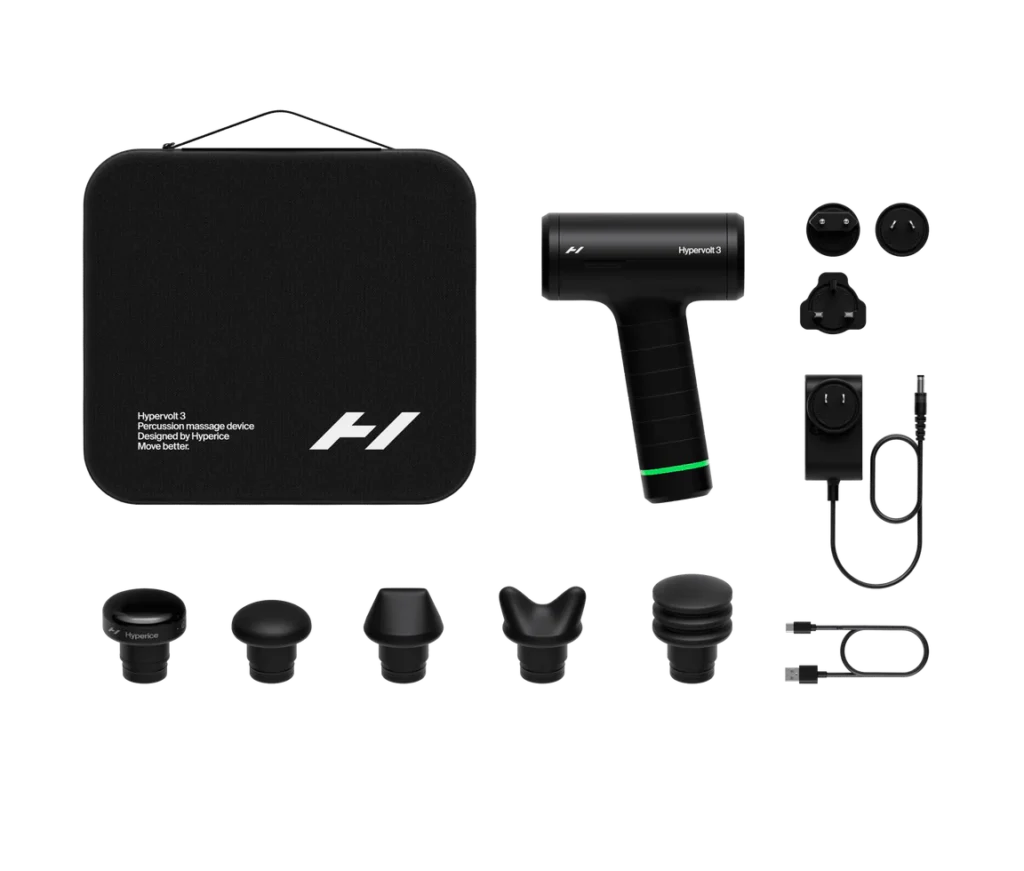
What Hyperice does confirm for the Hypervolt 3: five speeds on a digital dial (1500–2500 RPM), an LED pressure sensor that tells you when you’re pressing too hard, near-silent QuietGlide operation measured around 48 dB, a heated head attachment included in the box (three heat levels, up to ~120°F), Bluetooth and the Hyperice app for guided routines, four hours of battery, and a 2 lb weight. It ships with five attachments: the heated head, flat, wedge, fork, and cushion — all redesigned to be 33% larger than the Hypervolt 2 heads. It’s FSA/HSA-eligible in the US and TSA-friendly for carry-on.
For a runner, the standout features are the heated head and the noise level. Warming a tight calf before percussion makes the work more comfortable and more effective. And at 48 dB, you can use it while watching TV without anyone complaining, which, again, means you’ll actually use it.
Hypervolt 3 vs. Go 3 vs. 3 Pro: which one for runners?
| Model | Price* | Weight | Stall force | Amplitude† | Speeds | Heated head | Best for |
|---|---|---|---|---|---|---|---|
| Hypervolt Go 3 | $149 | 1.6 lb | 45 lbs | — | 5 | Sold separately | Travel, smaller budgets |
| Hypervolt 3 | $249 | 2 lb | 60 lbs | 12mm | 5 | Included | Most runners |
| Hypervolt 3 Pro | $349 | 2.5 lb | 70 lbs | 14mm | 6 | Included | High-mileage, dense legs |
The Go 3 is the value play: USB-C charging, just 1.6 lb, and 45 lbs of stall force — plenty for calves and quads, less for dense glutes. You lose the included heated head and three of the attachments. The 3 Pro adds a sixth speed, more weight (2.5 lb gets heavy in a long self-treatment), and a bit more power and depth for runners with thick, stubborn muscle. For the bulk of recreational-to-competitive runners, the standard Hypervolt 3 sits in the sweet spot.
Compare the Hypervolt 3 lineup and check prices →
Pros and cons
Pros
- Genuinely quiet (48 dB) — usable any time without disturbing anyone.
- Heated head included; warming tight calves before deep work is a real benefit.
- LED pressure sensor stops you from over-pressing a tender muscle.
- Strong stall force (60 lbs) holds up on big leg muscles without stalling.
- Excellent app with guided warm-up and recovery routines.
- FSA/HSA-eligible and TSA-friendly.
Cons
- Hyperice won’t publish amplitude or stall force; you’re trusting third-party numbers.
- Even low speeds aren’t gentle; very tender areas or nervous beginners may find it intense.
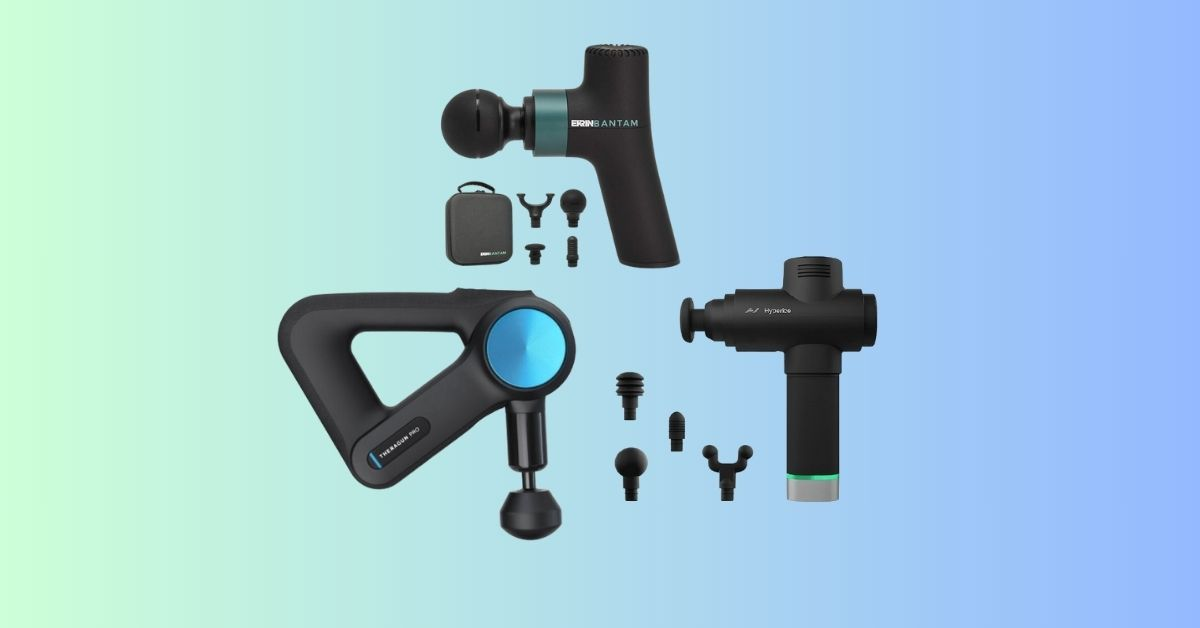
- No angled handle, so reaching your own mid-back is harder than with a Theragun’s triangle or Ekrin’s 15° grip.
- 12 mm amplitude, not the 16mm some deep-tissue guns offer.
- At $249, the Ekrin B37 ($229.99) matches it on power and adds a lifetime warranty.
- The app gently funnels you into the Hyperice ecosystem.
Coach’s Take
I’d put a Hypervolt in the bag of every athlete I coach through a marathon block. I would also tell most of them they’re using it wrong.
Here’s what I mean. In a marathon build, the part that breaks down first usually isn’t the engine; it’s the lower leg. The soleus and the deep calf take a pounding over weeks of volume; they tighten, and that tightness travels up into the Achilles. A foam roller can’t reach the soleus properly. A massage gun can, and that’s the single best reason a runner owns one. Two minutes per calf at a low-to-moderate speed after your long run keeps that tissue moving, and it has kept more of my athletes off the physio table than any attachment Hyperice puts in the box.
Recovery only counts when it’s the thing you absorb the training with, which is exactly why our training plans build easy days and down weeks into every block. The gun is a small lever inside that. Pull it consistently, and it helps.
How to use the Hypervolt for runner recovery
This is the protocol I give athletes. It isn’t on the box.
- Before a run (warm-up): 30–60 seconds per muscle — calves, quads, glutes — on a low speed. Use the heated head if your legs are cold. The goal is blood flow, not depth.
- After an easy run: Optional. If something’s tight, 1–2 minutes on the spot at a moderate speed.
- After a long run or hard session: The high-value window. 2–3 minutes per muscle group — calves and soleus first, then quads, hamstrings, glutes — slow, gliding passes at low-to-moderate speed. You’re flushing, not drilling.
- During taper: Dial it back. Lighter, shorter sessions; your tissue is sensitive as volume drops.
- Race week: Light activation only. Don’t introduce deep or novel work in the 48 hours before a race.
Hard rules: never more than 15 minutes total in a session, never on a joint, the spine, or directly on the Achilles tendon, and never to push through sharp pain. Pair this with genuinely easy easy-days — our heart rate zone calculator keeps your recovery runs in the right zone so the Hypervolt isn’t cleaning up after junk miles.
Who should skip the Hypervolt?
Be honest with yourself first.
- If you have an acute injury — a flaring Achilles, shin splints, a recent strain — put it down and see a professional. Percussing inflamed tissue makes it worse.
- If budget is tight, the Go 3 or an Ekrin B37 gets you 90% of the benefit for less.
- If you want a maximum 16 mm depth or an angled handle for back reach, a Theragun PRO suits you better.
- If you already foam roll consistently with no problem areas, the marginal gain is small.
Is the Hyperice Hypervolt worth it for runners?
Yes, with a condition. If you’ll use it consistently, the Hypervolt 3 is one of the best-built recovery tools a runner can own, and the heated head plus near-silent motor are the features that make consistent use likely. Buy it for that, not the logo.
If $249 is a stretch, the Go 3 at $149 covers a runner’s real needs and costs less than a decent pair of shoes. Either way, the device is the easy part. The hard part is doing the two minutes on your calves after every long run, keeping your easy days easy, and letting the training do the work. Do that, and the Hypervolt earns its place. Skip that, and no massage gun on the market will save your block.
Get the Hypervolt 3 →
See more recovery gear in the Gear We Recommend hub, and if you’re chasing a goal time, our training plans build recovery into every week.
Ready to Start Training?
Training plans are designed and reviewed by Ilya Tyapkin, Rio 2016 Olympian. Find the plan that matches your goal:
FAQ
Is the Hyperice Hypervolt good for runners? Yes. It increases blood flow and loosens tight muscles before and after running, and it reaches the deep calf and soleus a foam roller can’t. It’s a recovery aid, not a fix for overtraining or poor mileage progression.
What’s the difference between the Hypervolt 3 and Hypervolt 3 Pro? The Pro ($349) adds a sixth speed, more weight (2.5 lb vs 2 lb), and slightly more power and depth — built for high-mileage runners with dense muscle. The standard Hypervolt 3 ($249) suits most runners and is lighter to hold.
How often should runners use a Hypervolt? Most days is fine if you keep sessions short. Use it 30–60 seconds per muscle before runs and 2–3 minutes per muscle after long or hard sessions. Cap any session at 15 minutes total and avoid deep work right before a race.
Is the Hypervolt worth it over a cheaper massage gun? Only if its quietness, heated head, and app make you use it consistently. On raw power, a $230 Ekrin B37 matches it. Buy the Hypervolt for the polish; buy budget if you just want the function.
What amplitude does the Hypervolt 3 have? Hyperice doesn’t publish it, which is a fair criticism. Independent testing puts it around 12mm — deep enough for legs without being uncomfortable. Verify before relying on the figure.
Can I use the Hypervolt before a race? Yes, but lightly. Stick to 30–60 seconds per muscle at a low speed for activation. Don’t do deep or unfamiliar work in the 48 hours before a race — sensitive tissue on race morning helps no one.
Where should runners avoid using the Hypervolt? Off the Achilles tendon, the shin bone, the spine, the back of the knee, and any swollen or injured area. Work the muscles around those structures, not the structures themselves. Stop at sharp pain.