
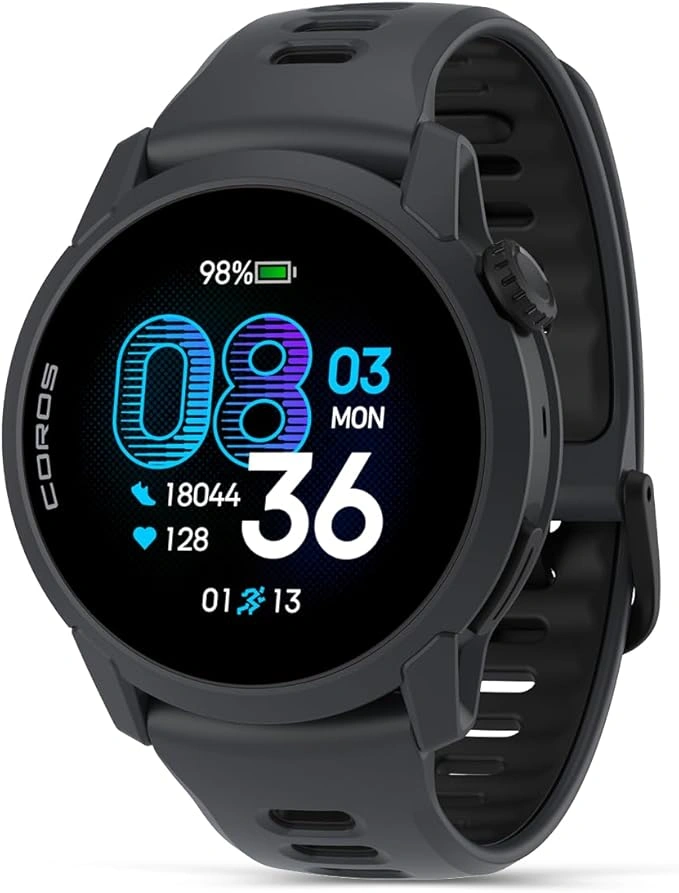
On one side: the Coros Pace 4 at $249, arguably the most capable running watch available for under $250. AMOLED display, dual-frequency GPS, 41-hour GPS battery, and the full Coros training ecosystem in a 32-gram body that you’ll barely notice on your wrist.
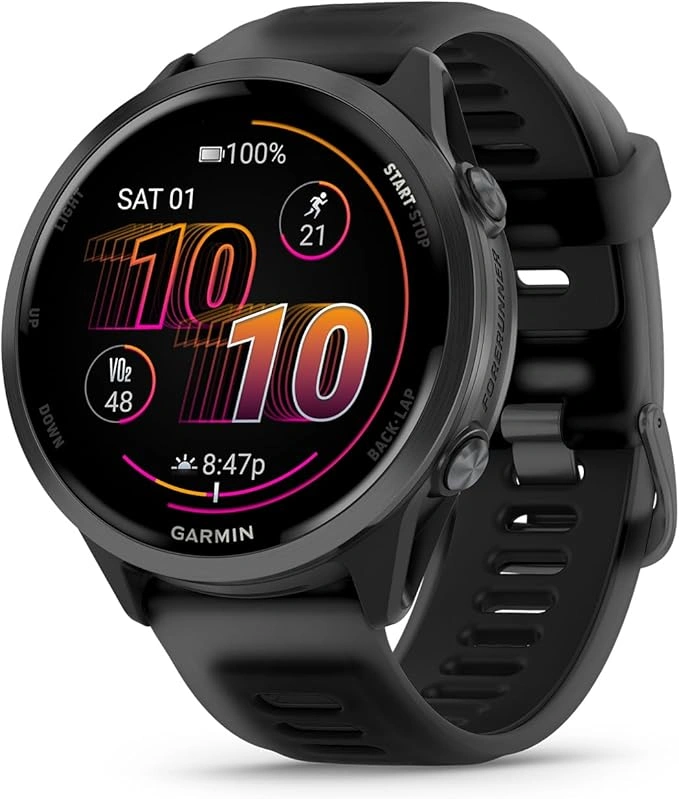
On the other: the Garmin Forerunner 570 at $549, Garmin’s latest mid-range flagship, loaded with the Elevate Gen 5 HR sensor, a built-in speaker and microphone, on-wrist phone calls, Spotify streaming, and the deepest training analytics in Garmin’s history at this price tier.
Let’s break it down properly in Garmin Forerunner 570 vs Coros Pace 4
Quick Comparison Table
| Feature | Coros Pace 4 | Garmin Forerunner 570 |
|---|---|---|
| Price | $249 | $549 |
| Display | 1.2″ AMOLED, 390×390 | 1.4″ AMOLED, 454×454 (47mm) |
| Weight | 32g (nylon) | 50g (47mm) |
| Battery (Smartwatch) | 19 days (raise-to-wake) | Up to 11 days |
| Battery (GPS Standard) | 41 hours | Up to 18 hours |
| Battery (Dual-Freq GPS) | 31 hours | Up to 13 hours (multiband) |
| GPS | All-Systems dual-frequency | Multi-band SatIQ |
| HR Sensor | Redesigned optical | Elevate Gen 5 |
| Speaker | ❌ | ✅ |
| Microphone | ✅ (Voice Pins only) | ✅ (on-wrist calls) |
| On-Wrist Calls | ❌ | ✅ |
| Music | MP3 storage | Spotify, Deezer, Amazon Music |
| Navigation | Breadcrumb only | Breadcrumb only |
| Offline Maps | ❌ | ❌ |
| Garmin Pay / Payment | ❌ | ✅ Garmin Pay |
| Training Plans | ✅ Coros | ✅ Garmin Coach + Triathlon Coach |
| HRV / Recovery | HRV + Recovery Timer | HRV Status + Training Readiness |
| Water Rating | 5 ATM | 5 ATM |
| Triathlon Mode | ✅ | ✅ |
| USB-C Charging | ✅ | ❌ (Proprietary) |
| Size Options | 42mm only | 42mm + 47mm |
Garmin Forerunner 570
Coros Pace 4
Price
There’s no dancing around it. The Coros Pace 4 costs $249. The Garmin Forerunner 570 costs $549. That’s a $300 difference, enough to buy a year’s worth of Garmin Connect Plus, a pair of quality running shoes, or a decent GPS bike computer on the side.
So the central question running through this entire comparison is simple: what does $300 extra actually buy you?
The honest answer: meaningful upgrades in some areas (HR sensor quality, smart features, display size, triathlon tools) and surprisingly little in others (GPS accuracy, navigation, offline maps — neither watch has them). Whether those meaningful upgrades matter to your running is what this comparison is really about.
If you’re a data-driven runner who primarily wants accurate GPS, solid training load analytics, and long battery life, the Pace 4 at $249 covers most of what you need. If you want on-wrist calls, Spotify streaming, Garmin Pay, and the best wrist HR available in Garmin’s non-flagship lineup — the FR570 earns its premium.
Related: Best GPS Running Watches / Best Affordable watches
Display — Garmin Goes Bigger
Both watches use AMOLED displays, and both are excellent. But they’re not the same.
The Coros Pace 4 has a 1.2-inch AMOLED at 390×390 resolution, vivid, sharp, and perfectly readable in all conditions, including direct sunlight. It’s a big step up from the Pace 3’s MIP display, and at this screen size, the Pace 4 holds its own against anything in the market.
The Garmin Forerunner 570 uses a 1.4-inch AMOLED at 454×454 resolution on the 47mm model larger, higher resolution, and notably brighter. Garmin calls it their brightest AMOLED ever, and reviewers confirm it’s a meaningful step forward from the FR265. The larger screen makes map data, training summaries, and data fields more readable at a glance, particularly for athletes with imperfect mid-run eyesight.
The FR570 also comes in a 42mm option with a 1.2-inch display, which puts it on near-identical footing with the Pace 4’s screen. If you go for the 42mm FR570, the display advantage narrows considerably.
Winner: Garmin Forerunner 570 (47mm) — larger and brighter. Draw on the 42mm.
Design & Weight
This is where the Coros Pace 4 has an argument that no spec sheet can fully capture — you have to put both watches on your wrist to appreciate it.
The Coros Pace 4 weighs 32g with the nylon band. That’s extraordinary for a watch with dual-frequency GPS and an AMOLED display. It genuinely disappears during runs, swims, and overnight sleep tracking.
The Garmin Forerunner 570 weighs 50g on the 47mm model (42g on the 42mm). The 47mm is noticeably heavier — not uncomfortable, but present on the wrist in a way the Pace 4 never is. For athletes who care deeply about race weight, the difference is real.
The FR570 uses an aluminum bezel — a step up from the polymer of the FR265, but still not metal throughout. The Pace 4 uses plastic throughout. Both feel appropriate for their respective price points.
The FR570 uses a proprietary charging cable — a perennial Garmin frustration in a USB-C world. The Pace 4 charges via standard USB-C — grab any cable from your bag, laptop, or hotel room. Small detail, repeated inconvenience.
Winner: Coros Pace 4 on weight and charging. Garmin FR570 on build materials.
GPS Accuracy — Essentially Equal
Both watches use dual-frequency multi-band GPS, and both are genuinely excellent at it.
The Coros Pace 4 uses All-Systems dual-frequency GPS across GPS, GLONASS, Galileo, BeiDou, and QZSS. In real-world testing across road runs, trail sessions, and urban environments, GPS accuracy is consistently rated as strong and reliable.
The Garmin Forerunner 570 uses SatIQ multi-band GPS with intelligent mode switching, conserving battery in easy conditions, switching to full multi-band when signal demands it. GPS performance matches the best in Garmin’s lineup.
Both watches will give you clean tracks, accurate splits, and reliable pacing data in almost any environment. Spending $300 more does not buy you a meaningfully better GPS.
Winner: Draw — both are excellent. Neither justifies a price premium on GPS alone.
Heart Rate Accuracy — Garmin’s Biggest Advantage
This is where the FR570 earns a meaningful portion of its premium, and it’s worth being direct about why.
The Garmin Forerunner 570’s Elevate Gen 5 is Garmin’s best optical HR sensor. Designed specifically to improve accuracy during cold-weather runs, downhill efforts, and high-intensity intervals where wrist motion makes optical HR harder to track. In head-to-head testing against a Garmin HRM-600 chest strap during a 10K race, the Gen 5 sensor tracked closely throughout, impressive for a wrist sensor under race conditions.
The Coros Pace 4’s redesigned optical sensor is improved over the Pace 3, with larger LEDs for better skin contact and reduced spiking during intense efforts. It’s a solid sensor for most training purposes, and a real step forward from its predecessor.
But in direct comparison, the Elevate Gen 5 is more accurate, more consistent under intensity, and better validated against gold-standard chest strap data. For athletes doing structured heart rate zone training, particularly high-intensity intervals where HR zone precision drives every rep, this difference is meaningful.
Winner: Garmin Forerunner 570 — the Elevate Gen 5 is genuinely better for serious training.
Battery Life — Coros Wins, and It’s Not Close
If heart rate is the FR570’s biggest advantage, battery life is the Pace 4’s, and the gap here is dramatic.
| Mode | Coros Pace 4 | Garmin Forerunner 570 |
|---|---|---|
| Smartwatch | 19 days (raise-to-wake) | Up to 11 days |
| GPS Standard | 41 hours | Up to 18 hours |
| Dual-Freq GPS | 31 hours | Up to 13 hours |
The FR570’s AMOLED display is brighter, the speaker and microphone are power-hungry, and the overall feature load is higher, and the battery reflects that. 18 hours of GPS battery is adequate for marathons and most ultramarathon distances, but it’s the smartwatch battery that stings most: 11 days vs 19 days. The FR570 needs charging roughly every 5–7 days in real-world use. The Pace 4 goes nearly three weeks between charges.
For anyone who uses sleep tracking, always-on display for racing, or simply hates thinking about charging, the Pace 4’s battery is a quality-of-life advantage that $300 can’t close.
Winner: Coros Pace 4 — comfortably.
Training Features — Garmin Goes Deeper
Both watches have strong training ecosystems. But Garmin runs deeper, particularly for triathlon athletes and runners who want every metric tracked and coached.
Coros Pace 4 Strengths
- Training Load Trend and Recovery Timer — cumulative stress and recommended recovery time
- Race Predictor, Virtual Pacer, Strava Live Segments
- Voice Pins — record GPS-pinned voice notes mid-run (unique feature)
- PacePro-style pacing tools (added via firmware)
- ClimbPro-style tracking (added via firmware)
- HYROX support
- Clean, intuitive Coros Training Hub — consistently rated better than Garmin Connect for ease of use
Garmin Forerunner 570 Strengths
- HRV Status — tracks heart rate variability trends and flags imbalance before you feel it
- Training Readiness — composite daily score combining sleep, HRV, load, and recovery
- Body Battery — real-time energy monitoring throughout the day
- Morning Report and Evening Report — daily training and recovery summaries
- Garmin Triathlon Coach — full adaptive triathlon training plans across swim, bike, and run
- Training Balance — new metric visualizing whether your training load is building sustainably
- Heat and Altitude Acclimation tracking
- AutoLap by Timing Gates — snaps laps to real race markers on known courses
- Suggested Finish Lines — trims post-run data automatically
- Track Mode for accurate lap splits
- Garmin Coach — free adaptive training plans for 5K, 10K, and half marathon
- Race Predictor, PacePro, Performance Condition
- Full golf features, including 42,000+ course maps
The gap in recovery analytics specifically is real. HRV Status, Training Readiness, and Body Battery together form a coaching system that actively tells you when to push and when to back off. Coros has Recovery Timer and HRV data, but the depth and integration of Garmin’s recovery insights at this price is ahead of what Coros offers.
Winner: Garmin Forerunner 570 — particularly for triathlon athletes and anyone who wants the deepest recovery analytics available at this price.
Smart Features — Garmin Pulls Away
This is the clearest area where $300 buys you something the Pace 4 simply doesn’t have.
The Garmin Forerunner 570 includes:
- On-wrist phone calls via built-in speaker and microphone — answer calls, hear the other person, speak back, all from the watch
- Spotify, Deezer, and Amazon Music offline streaming — download playlists via Wi-Fi and run phone-free
- Garmin Pay — contactless payments at any NFC terminal
- Siri / Google Assistant access via voice
The Coros Pace 4 includes:
- Voice Pins via built-in microphone — record mid-run notes, no speaker
- MP3 music storage — load your own files, no streaming services
- No contactless payments
If on-wrist calling, Spotify, and Garmin Pay are important to your daily life, the FR570 is the only choice. If you run with your phone anyway and don’t need any of those features, they’re $300 worth of value you’ll never use.
Winner: Garmin Forerunner 570 — significantly on smart features.
Ready to Start Training?
Training plans are designed and reviewed by Ilya Tyapkin, Rio 2016 Olympian. Find the plan that matches your goal:
Who Should Buy the Coros Pace 4?
The Pace 4 is the right call if:
- Budget matters — $249 is the right number, and $549 isn’t an option right now
- Battery life is a priority — 41 hours GPS and 19 days smartwatch are in a different league
- You’re a lightweight-obsessed runner — 32g is hard to beat at any price
- You primarily road run or do triathlons on familiar routes where navigation isn’t needed
- The Coros ecosystem appeals — cleaner app interface, active firmware update cadence
- You don’t need Spotify, on-wrist calls, or Garmin Pay — MP3 music is enough, or you run with your phone anyway
- You’re coming from a Garmin Forerunner 55 or 165 and want a meaningful upgrade without overspending
Who Should Buy the Garmin Forerunner 570?
The FR570 is the right call if:
- Training analytics depth drives your improvement — HRV Status, Training Readiness, Body Battery, and Garmin Triathlon Coach are genuinely more comprehensive than Coros’s equivalents
- Heart rate accuracy during intervals matters — the Elevate Gen 5 is meaningfully better for structured zone training
- On-wrist calling and Spotify are useful to your daily life — the smart features are real-world practical
- You’re a triathlete who wants the deepest multisport coaching ecosystem at a non-Fenix price
- You want a larger AMOLED display — the 47mm FR570’s 1.4-inch screen is noticeably more readable than the Pace 4’s 1.2-inch panel
- Garmin Pay is genuinely useful to you — contactless wrist payments are surprisingly practical mid-run
- You’re upgrading from a Forerunner 265 or 255 and want the latest Garmin hardware
Final Verdict
Here’s the honest bottom line: for most runners, the Coros Pace 4 at $249 is the smarter buy.
It covers dual-frequency GPS, AMOLED display, 41-hour GPS battery, and solid training analytics for $300 less than the FR570. Unless you specifically need the Elevate Gen 5 HR sensor, on-wrist calling, Spotify streaming, or Garmin’s deeper recovery ecosystem, you’re paying $300 for features you either won’t use or won’t notice during actual running.
The Garmin Forerunner 570 is worth it if you’re a serious runner or triathlete who actively uses training readiness data to plan your season, want the most accurate wrist HR available short of a Fenix, and genuinely uses smart features like calls and Spotify day-to-day. In that case, the premium is justified.
The Pace 4 wins on value. The FR570 wins on depth. Know which one you actually need, and spend accordingly.
This comparison is based on aggregated expert testing data, official specifications, and real-world user feedback compiled from across the running and triathlon community. We bring together the most accurate and up-to-date information so you can make a confident buying decision.
Frequently Asked Questions
Is the Garmin Forerunner 570 worth $300 more than the Coros Pace 4?
For most runners — no. The Pace 4 offers GPS accuracy, an AMOLED display, and core training analytics for $249. The FR570’s premium buys you a better HR sensor, on-wrist calls, Spotify, Garmin Pay, and deeper recovery analytics. If those specific features matter to your training and daily life, yes. If you run with your phone anyway and don’t use streaming music, the Pace 4 is the smarter buy.
Which has better GPS — Garmin Forerunner 570 or Coros Pace 4?
Both use dual-frequency multi-band GPS and deliver essentially equivalent real-world accuracy. GPS precision is not a meaningful differentiator between these two watches.
Does the Coros Pace 4 have a better battery than the Forerunner 570?
Yes — significantly. The Pace 4 delivers 41 hours of GPS vs 18 hours on the FR570, and 19 days of smartwatch vs 11 days. The Pace 4 needs charging roughly every two weeks in daily use; the FR570 roughly every week.
Can I stream Spotify on the Coros Pace 4?
No, the Pace 4 supports MP3 file storage only. Offline streaming on Spotify, Deezer, and Amazon Music is exclusive to the Garmin Forerunner 570 (and other Garmin models with streaming support).
Is the Coros Pace 4 good for triathlons?
Yes — it handles triathlon multisport mode, pool and open water swimming, cycling, and training load across disciplines. For deeper adaptive triathlon training plans, the Garmin Forerunner 570 includes Garmin Triathlon Coach, which goes further.
Which is lighter — Coros Pace 4 or Garmin Forerunner 570?
The Pace 4 is 32g with the nylon band. The FR570 is 50g (47mm) or 42g (42mm). A significant difference — especially noticeable on long runs and during sleep tracking.
Garmin Forerunner 570 vs Coros Pace 4 for heart rate accuracy?
The FR570’s Elevate Gen 5 sensor is meaningfully better for high-intensity interval training and rapid effort changes. For steady-state running and general daily use, both sensors perform similarly. Serious interval athletes will notice the difference.