
The Apple Watch Ultra 3 and Garmin Fenix 8 represent the absolute best their respective companies have ever made. But they’re built on completely different philosophies, and buying the wrong one for your lifestyle will leave you frustrated, no matter how good the hardware is.
The Ultra 3 is the world’s best smartwatch, and it also excels at sports. The Fenix 8 is the world’s best sports watch that also does smart things. That single sentence explains most of what you need to know. But the details matter, especially when you’re spending this kind of money.
Here’s the full, honest breakdown of Apple Watch Ultra 3 vs Garmin Fenix 8
Quick Comparison Table
| Feature | Apple Watch Ultra 3 | Garmin Fenix 8 (47mm AMOLED) |
|---|---|---|
| Price | $799 | From $999 |
| Display | 1.99″ LTPO3 AMOLED, 3,000 nits | 1.4″ AMOLED, 1,000 nits |
| Case Material | Aerospace-grade titanium | Titanium or stainless steel |
| Glass | Sapphire crystal | Sapphire crystal (Fenix 8) |
| Weight | ~61g | 58g (titanium) / 65g (stainless) |
| Battery (Smartwatch) | Up to 42 hours | Up to 18 days |
| Battery (GPS) | ~20 hours continuous | Up to 57 hours |
| GPS | Precision dual-frequency L1+L5 | Multi-band SatIQ (L1+L5) |
| HR Sensor | Optical + ECG | Elevate Gen 5 + ECG |
| Offline Maps | ❌ | ✅ TopoActive |
| Satellite | ✅ Globalstar LEO | ❌ (Fenix 8 Pro only) |
| 5G/LTE | ✅ | ❌ |
| Flashlight | ❌ | ✅ LED |
| Dive Rating | WR100 / 40m | 10 ATM / 40m |
| Speaker/Mic | ✅ | ✅ |
| Music | Streaming + offline | Streaming + offline |
| Compatibility | iPhone only | iOS + Android |
| ECG | ✅ | ✅ (US) |
Price — The Surprising Truth
Garmin Fenix 8
Apple Watch Ultra 3
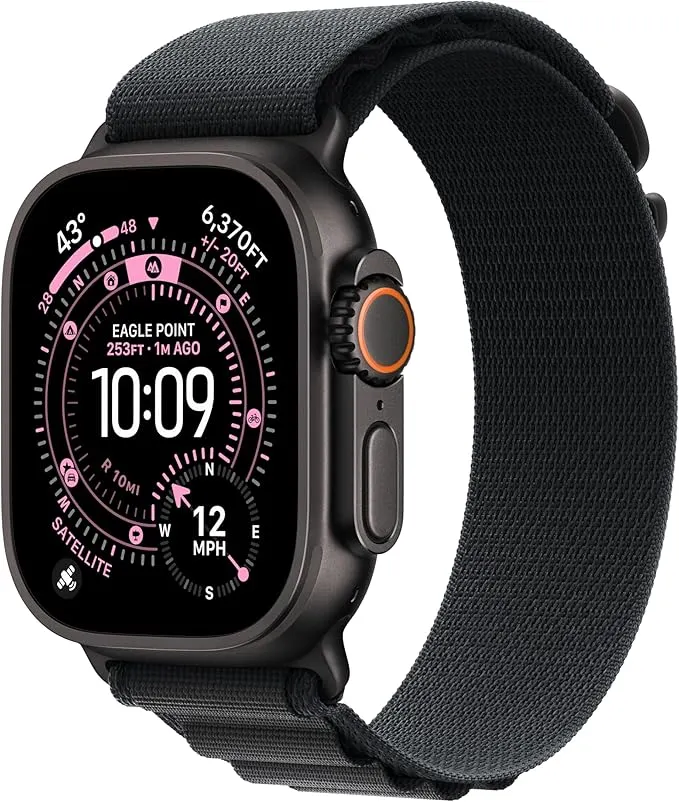
Here’s something that surprises people: the Apple Watch Ultra 3 is actually cheaper than the Garmin Fenix 8 AMOLED.
The Ultra 3 starts at $799. The Fenix 8 AMOLED starts at $999, and the version with offline maps preloaded (Sapphire edition) pushes higher. The Fenix 8 Pro with satellite messaging starts at $1,199.
That said, price comparisons at this tier need context. The Ultra 3 includes 5G cellular hardware as standard, so you’re getting LTE connectivity built in. The Fenix 8 has no cellular at all (that’s the Pro’s territory). Carrier plans are still required to use 5G on the Ultra 3, but the hardware cost is baked in.
For athletes, the more relevant question isn’t which costs more at checkout; it’s which delivers more value for your specific use case. And that’s where the real divergence begins.
Related: Best GPS Running Watches / Best Affordable watches
Design — Two Very Different Expressions of Premium
Both watches use aerospace-grade titanium and sapphire crystal. Both feel immediately premium in hand. But they look and feel completely different on the wrist.
The Apple Watch Ultra 3 is unmistakably Apple Watch, a 49mm flat rectangular case with a distinctive Action Button on the left side, a Digital Crown and Side Button on the right, and a flat sapphire display that extends almost edge-to-edge. It’s bold, modern, and recognizable from across the gym. The design is polarizing; some love it, some find it too square. Wrist comfort is generally excellent, and the case extends to protect the crown during activity.
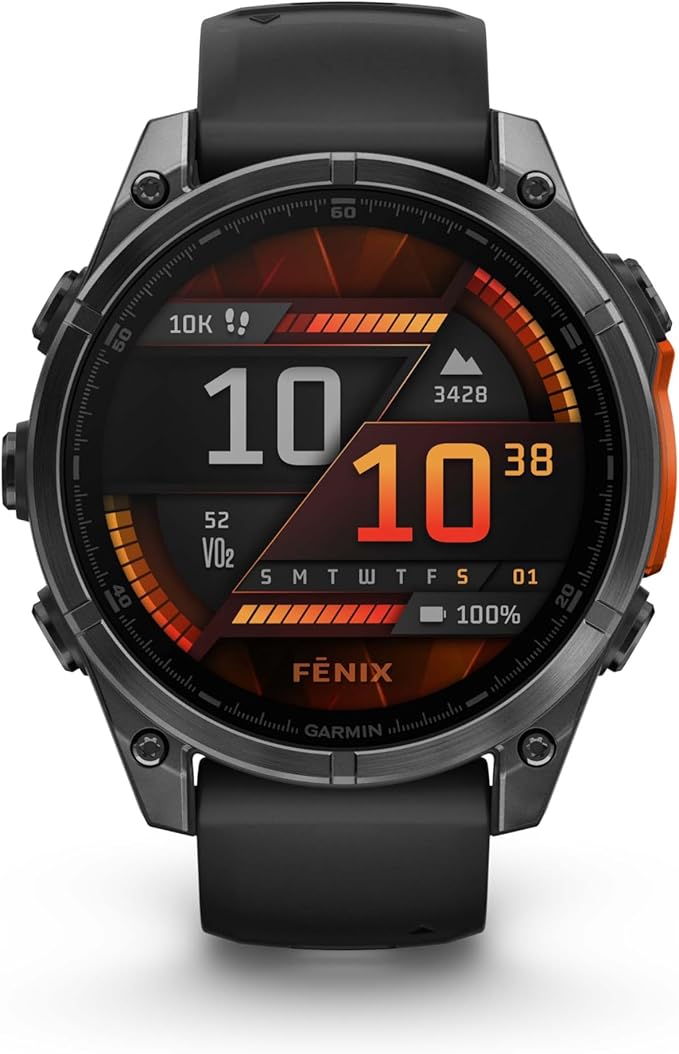
The Garmin Fenix 8 is unmistakably a Garmin outdoor watch, a round case, five physical buttons, a centered display, and a more traditional sport watch aesthetic. It comes in stainless steel or titanium, with the titanium shaving around 7g off the total weight. The raised button surrounds are designed specifically to prevent accidental presses during sport. The LED flashlight sits at the top of the case, genuinely useful on trails, at campsites, or in a tent at 3 am before a race start.
One meaningful design difference: the Fenix 8’s buttons use inductive sensor technology (required for the 40m dive rating), which gives a lighter, shallower press feel compared to older Fenix models. Some athletes miss the deep mechanical click of previous generations, especially with cold hands or gloves.
Both watches are available in multiple colorways. Both come with band options suited to sport and everyday wear.
Winner: Personal preference — Ultra 3 for modern rectangular aesthetics, Fenix 8 for traditional round sport watch design. Neither is objectively better.
Display — Apple Wins, But Garmin Is No Slouch
Apple builds the best displays on wrist devices. That’s just the current state of the market, and the Ultra 3 reinforces it.
The Ultra 3’s 1.99-inch LTPO3 display at 3,000 nits is the brightest, largest, and most visually impressive screen on any sports watch. It renders maps from third-party apps with clarity, makes workout data immediately readable at any pace, and looks stunning on a watch face. The wide-angle design keeps data visible even when you’re not looking directly at it — useful during races.
The Fenix 8’s 1.4-inch AMOLED at 1,000 nits is excellent by sports watch standards — bright, colorful, and readable in direct sunlight. Topographic map rendering is detailed and legible for navigation. But it’s a noticeably smaller, less vivid experience compared to the Ultra 3’s panel.
One practical consideration: the Fenix 8 AMOLED has a night auto-dimming issue that hasn’t been fully resolved; it dims more aggressively than expected in low light with no manual override currently available. For trail runners moving fast in the dark, this can be frustrating. The Ultra 3 handles night visibility more consistently.
Winner: Apple Watch Ultra 3 — by a comfortable margin on brightness, size, and visual quality.
Training Features — This Is Where They Split Apart
This is the most important section of this comparison. For serious athletes, this is the decision.
Apple Watch Ultra 3
- Custom Workouts with multiple intervals, rest periods, and targets
- Advanced running metrics: cadence, stride length, ground contact time, vertical oscillation, running power
- Precision dual-frequency GPS for accurate outdoor tracking
- Workout Buddy — AI-powered spoken coaching and pacing guidance (requires iPhone + AirPods)
- Swim tracking with auto stroke detection
- Depth gauge for diving and water sports
- Training load as a percentage relative to last 4 weeks, simple and accessible
- Health monitoring: ECG, hypertension notifications, blood oxygen, sleep apnea, sleep score
- Satellite SOS, messaging, and Find My, off-grid safety without a subscription (2 years free)
- 5G cellular for independent connectivity
What’s missing: deep periodization analytics, week-by-week training cycle management, advanced HRV trending, and the kind of nuanced training load breakdown that serious runners use to build across a season.
Garmin Fenix 8
- Full Garmin Firstbeat training ecosystem — Training Readiness, HRV Status, Body Battery, Training Load, Training Effect
- Daily Suggested Workouts that adapt to your fitness, fatigue, and goals
- Garmin Triathlon Coach — free adaptive triathlon training plans
- ClimbPro for real-time climb visualization on loaded courses
- TopoActive offline maps preloaded (Sapphire models) — navigate without phone or signal
- Dynamic round-trip routing — enter a distance, get suggested routes
- LED flashlight — white and red modes
- Dive mode to 40m — scuba and apnea profiles, dive log
- Heat and altitude acclimation tracking
- Training Balance — new metric visualizing sustainable load distribution
- Morning Report, Evening Report, race predictor, Endurance Score, Hill Score
- Running dynamics with a compatible chest strap
What’s missing: the kind of seamless smartwatch integration, health monitoring depth, and off-grid satellite communication that the Ultra 3 brings.
Winner: Garmin Fenix 8 for serious training analytics. The Firstbeat ecosystem is simply deeper, more granular, and more actionable for athletes who structure training across weeks and months. The Ultra 3 is excellent for general fitness, but it doesn’t go as deep.
GPS Accuracy — A Genuine Draw
Both watches use dual-frequency GPS (L1+L5), the same technology tier, approaching from different implementations.
The Apple Watch Ultra 3 uses Apple’s Precision GPS, tested against leading dual-frequency sport watches in urban environments and claimed as best-in-class. In real-world reviews, GPS performance is consistently rated excellent, with clean tracks in both open and challenging conditions.
The Garmin Fenix 8 uses multi-band SatIQ technology supporting GPS, GLONASS, Galileo, BeiDou, and QZSS. SatIQ intelligently switches between modes to balance accuracy and battery. Real-world GPS performance is also consistently rated as class-leading across road runs, technical trails, and mountain terrain.
Both are excellent. Both will give you accurate pace and distance data in almost any environment. The practical difference in day-to-day running is negligible.
Winner: Draw — both are at the top of what dual-frequency GPS can deliver.
Heart Rate Accuracy
Both watches include ECG capability and optical heart rate sensors.
The Garmin Fenix 8’s Elevate Gen 5 is Garmin’s best optical sensor, improved for accuracy in cold weather, downhill running, and other challenging conditions compared to previous generations. It tracks closely with chest straps during interval training and is one of the better wrist optical sensors available at any price.
The Apple Watch Ultra 3’s optical HR sensor is solid for steady-state and moderate efforts. For high-intensity interval work, pairing with AirPods Pro 3 (which provide biometric heart rate data) significantly closes the gap and can rival chest-strap accuracy.
Winner: Garmin Fenix 8 for standalone wrist HR accuracy, particularly during high-intensity structured training.
Battery Life — Garmin Wins Decisively
This is the starkest difference between the two watches, and for many athletes, it’s the deciding factor.
| Mode | Apple Watch Ultra 3 | Garmin Fenix 8 (47mm AMOLED) |
|---|---|---|
| Smartwatch | Up to 42 hours | Up to 18 days |
| Continuous GPS | ~20 hours | Up to 57 hours |
| Low Power Mode | Up to 72 hours | — |
The Apple Watch Ultra 3 requires daily charging for most users, or at a minimum, every other day. It’s simply the nature of an LTPO3 display with 5G, a large screen, and the power demands of watchOS.
The Garmin Fenix 8 can last 18 days in smartwatch mode and 57 hours in GPS mode. Real-world users with regular GPS activity charge roughly once a week. For multi-day expeditions, the Solar MIP models extend this dramatically further.
For athletes whose training includes long days, multi-day events, or adventures where charging isn’t possible, the Fenix 8 isn’t just better, it’s in a completely different category.
Winner: Garmin Fenix 8 — by a very wide margin.
Ready to Start Training?
Training plans are designed and reviewed by Ilya Tyapkin, Rio 2016 Olympian. Find the plan that matches your goal:
Navigation & Offline Maps
This one isn’t close either.
The Garmin Fenix 8 preloads TopoActive offline maps on Sapphire models, topographic maps covering multiple continents, with trail names, road routing, points of interest, and turn-by-turn navigation. You can navigate technical mountain terrain, unknown trail networks, and international routes entirely from your wrist without a phone. Dynamic routing lets you generate new routes on the fly. ClimbPro visualizes individual climbs as you approach them.
The Apple Watch Ultra 3 has no offline topographic maps. It can cache Apple Maps tiles for limited offline use, and supports route following via the Compass app with breadcrumb-style waypoints. Third-party apps like WorkOutDoors add some offline map capability, but it’s not comparable to Garmin’s built-in TopoActive system.
For trail runners, mountaineers, and adventure athletes, this gap is significant. For road runners who stick to familiar routes, it’s irrelevant.
Winner: Garmin Fenix 8 — not close.
Smart Features & Connectivity
This is where the Apple Watch Ultra 3 goes to a place Garmin simply can’t follow.
5G cellular means the Ultra 3 makes calls, streams music, sends messages, and runs apps completely independently of your iPhone. Leave your phone at home, run 15 miles, and answer a call from your coach on the trail. The Fenix 8 has no cellular at all, it requires your phone nearby for real-time connectivity.
Satellite connectivity on the Ultra 3 uses Globalstar LEO satellites for Emergency SOS, two-way text messaging, and Find My location sharing when completely off-grid. The Fenix 8 requires upgrading to the Pro model (starting at $1,199) for satellite messaging via inReach.
App ecosystem: watchOS 26 gives Ultra 3 users access to thousands of third-party apps, Strava, Komoot, WorkOutDoors, coaching apps, sleep apps, and mindfulness tools. Garmin Connect IQ is functional but significantly narrower in scope and polish.
AirPods integration: Ultra 3 paired with AirPods Pro 3 delivers biometric heart rate and audio coaching in a seamless ecosystem that nothing on Garmin can replicate.
Winner: Apple Watch Ultra 3 — significantly.
Who Should Buy the Apple Watch Ultra 3?
Buy the Ultra 3 if:
- You’re an iPhone user who wants a premium device that handles sport, health, daily life, and off-grid safety in one package
- 5G cellular connectivity from your wrist matters — you want to leave your phone at home
- Satellite safety without a separate subscription is important for your adventures
- You’re primarily a road runner, triathlete, or gym athlete whose training doesn’t depend on offline maps or multi-week battery life
- Health monitoring breadth is a priority — hypertension notifications, ECG, sleep apnea, and blood oxygen represent the deepest health suite on any smartwatch
- The Apple ecosystem is central to your life — AirPods, iPhone, and Health app integration is seamless
Who Should Buy the Garmin Fenix 8?
Buy the Fenix 8 if:
- You’re a serious outdoor athlete — trail runner, mountaineer, triathlete, or hiker — who needs offline maps, real navigation, and multi-day battery life
- Training analytics depth drives your improvement — Training Readiness, HRV Status, Body Battery, Training Load, and Suggested Workouts together form a serious coaching system
- Battery life is non-negotiable — 57 hours GPS and 18 days smartwatch mode changes how you relate to charging anxiety
- You don’t use an iPhone — Android users have no path to the Ultra 3
- You dive or do water sports requiring a 40m-rated watch with dedicated dive profiles
- You want an LED flashlight on your wrist — genuinely useful for trails, camping, and pre-dawn starts
Final Verdict
If someone asked which of these watches is “better” in an absolute sense, the honest answer is: it depends on who’s asking.
For a trail runner training in the mountains who needs maps, a multi-day battery, and the deepest training analytics available, the Garmin Fenix 8 wins. It’s simply a more capable outdoor sports tool, and the extra cost over the Ultra 3 is justified by what it delivers.
For an iPhone-using road runner or triathlete who wants the best all-around wrist device, incredible display, 5G independence, satellite safety, health monitoring, and a seamless daily experience, the Apple Watch Ultra 3 wins. And it does so for $200 less than the starting Fenix 8 price.
The mistake most buyers make is treating this as a pure sports watch competition. It isn’t. One of these watches will get you home safely from a mountain you’ve never climbed before. The other will let you call your family from the summit. Both are extraordinary. Know which one you actually need.
This comparison is based on aggregated expert testing data, official specifications, and real-world user feedback compiled from across the running, triathlon, and outdoor athlete community. We bring together the most accurate and up-to-date information so you can make a confident buying decision.
Frequently Asked Questions
Apple Watch Ultra 3 vs Garmin Fenix 8 — which is better for running?
For road running, both are excellent. For trail running that requires offline maps and a multi-day battery, the Fenix 8 is the better tool. For iPhone users who want training metrics alongside smartwatch integration and satellite safety, the Ultra 3 is a compelling alternative.
Does Apple Watch Ultra 3 have offline maps?
No preloaded offline topographic maps. It supports route following and limited cached Apple Maps tiles. Third-party apps add some offline capability, but it doesn’t match Garmin’s built-in TopoActive mapping system.
Which has better battery life — Ultra 3 or Fenix 8?
The Fenix 8 by a wide margin. The Ultra 3 lasts up to 42 hours total (72 in Low Power Mode). The Fenix 8 lasts up to 18 days in smartwatch mode and 57 hours in GPS. For multi-day events or expeditions, this gap is decisive.
Does the Garmin Fenix 8 work with an iPhone?
Yes, the Fenix 8 is compatible with both iOS and Android via the Garmin Connect app.
Can you use a Garmin Fenix 8 without a phone?
For GPS tracking, yes — it works fully standalone. For real-time messaging and calls, you need your phone nearby (no cellular). The Fenix 8 Pro adds satellite messaging via Skylo/inReach.
Which has better GPS — Apple Watch Ultra 3 or Garmin Fenix 8?
Both use dual-frequency GPS (L1+L5) and deliver class-leading accuracy. In real-world testing, performance is comparable across most environments. The practical difference for most runners is negligible.
Apple Watch Ultra 3 or Garmin Fenix 8 for triathlon?
The Fenix 8 has a deeper triathlon ecosystem, Garmin Triathlon Coach, adaptive plans, seamless multisport mode, and training load across all disciplines. The Ultra 3 handles triathlon tracking competently but without the same analytical depth. Serious triathletes will find the Fenix 8 more capable.