

This post is for informational purposes. Significant ankle pain, inability to weight-bear, or suspected fracture should be assessed by a GP, physiotherapist, or sports medicine physician before resuming running.
Ankle pain during running falls into three main categories: acute sprains from rolling or twisting the ankle, overuse tendinopathies (Achilles or peroneal) from cumulative loading, and stress injuries to the bone. Which category you’re dealing with determines whether the fix is rest-and-ice, a specific rehabilitation programme, or an urgent medical assessment. Location of the pain is the fastest diagnostic shortcut. Pain at the back of the ankle points to the Achilles tendon; pain on the outer ankle after a roll points to a sprain; pain on the inner or outer side during long runs points to peroneal or tibial tendinopathy.
Use our running calculator to review your recent training paces and weekly mileage — rapid load increases are a primary driver of all three overuse categories and are entirely preventable.
The Anatomy: Why Runners’ Ankles Are Vulnerable
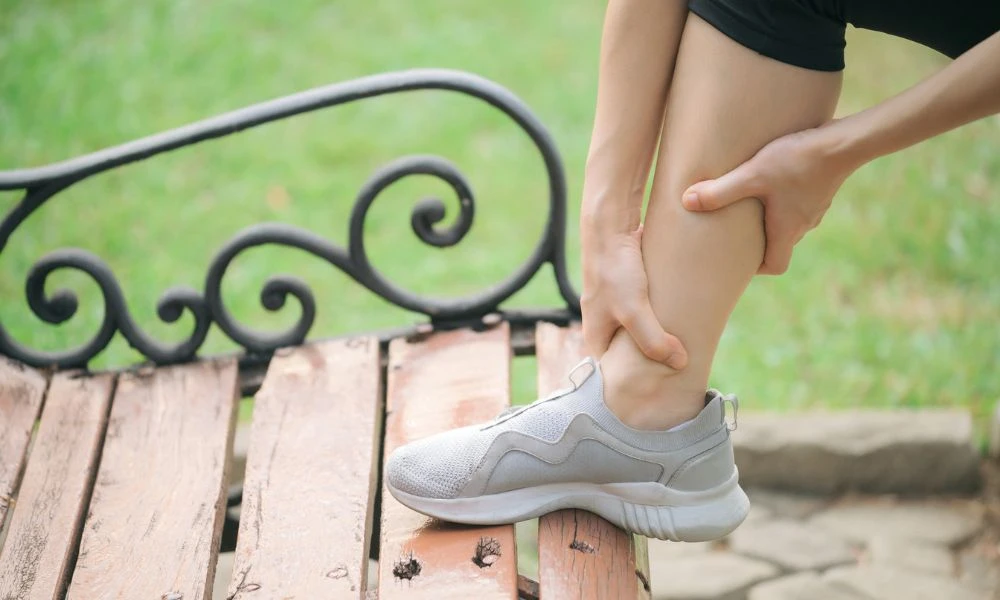
The ankle joint is one of the most mechanically complex structures in the body. It manages the transition between foot strike and propulsion across thousands of repetitions per run. Running places the ankle under 2–3× body weight of impact force with each stride. At 180 steps per minute over a 90-minute run, that’s more than 16,000 cycles of loading on the same structures.
The joint’s versatility, allowing dorsiflexion, plantarflexion, inversion, and eversion, is also its vulnerability. Any unexpected surface variation that takes the ankle beyond its normal range in any direction can cause ligament or tendon damage. And cumulative overuse can cause tendinopathy or stress injury even without a single traumatic event.
According to research published in the American Journal of Sports Medicine, foot and ankle injuries account for approximately 28% of all running injuries. The majority involve the lateral (outer) ankle complex.
Cause 1: Ankle Sprain
What It Is
An ankle sprain occurs when the foot rolls inward (inversion) or, less commonly, outward (eversion), stretching or tearing the ankle ligaments beyond their capacity. The anterior talofibular ligament (ATFL) on the outer ankle is the most commonly damaged structure, accounting for the majority of lateral ankle sprains.
Signs of a sprain:
- Sudden onset of pain following a roll or awkward landing
- Audible or felt “pop” at the moment of injury
- Immediate swelling over the outer ankle
- Bruising develops within hours
- Pain when attempting to rotate the foot inward or outward
- Difficulty with weight-bearing, ranging from reduced capacity to complete inability
Grading Ankle Sprains
Understanding sprain severity guides return-to-running timelines:
| Grade | Injury | Swelling | Weight-bearing | Return to running |
|---|---|---|---|---|
| Grade I | Ligament stretching, microtrauma | Mild | Full or near-full | 1–2 weeks |
| Grade II | Partial ligament tear | Moderate, rapid onset | Painful but possible | 3–6 weeks |
| Grade III | Complete ligament rupture | Severe | Very limited or impossible | 8–12+ weeks with rehab |
Grade III sprains should be assessed by a sports medicine physician or physiotherapist some cases, surgical consultation is required, particularly with associated tendon or cartilage damage.
Immediate Treatment: The PEACE & LOVE Framework
Current sports medicine guidance (British Journal of Sports Medicine, 2019) has updated sprain management from the traditional RICE/PRICE approach to a more evidence-informed framework:
PEACE (first 1–3 days):
- Protect — avoid activities that cause pain for the first 1–3 days; limit load enough to prevent increased swelling
- Elevate — keep the ankle above heart level when resting to reduce fluid accumulation
- Avoid anti-inflammatories — both NSAIDs and ice applied for their anti-inflammatory effect may slow the natural healing process by suppressing the inflammatory response needed for tissue repair. Ice for pain relief in short applications is reasonable; prolonged icing specifically to suppress inflammation is no longer recommended
- Compress — a compression bandage or ankle support reduces swelling
- Educate — understand that the goal is to return to loading, not extended rest
LOVE (after 3 days onwards):
- Load — begin gentle movement and progressive weight-bearing as pain allows; early loading promotes better tissue remodelling than prolonged immobilisation
- Optimism — recovery outcomes are improved by realistic positive expectations
- Vascularise — low-intensity aerobic activity that doesn’t stress the ankle (cycling, pool running) from days 2–3 maintains cardiovascular fitness and promotes healing through blood flow
- Exercise — targeted rehab exercises (range of motion, then strengthening, then proprioception) drive full recovery
On ice: A 1982 study found that immediate ice application reduced recovery time versus delayed icing (13 vs 30 days). This remains valid for ice as a pain management tool. However, the evidence that ice specifically improves long-term healing outcomes rather than just making the early days more comfortable is more limited than previously assumed. Apply ice for pain relief (10 minutes on, 10 off, repeat) during the first 48–72 hours; don’t continue beyond this window for anti-inflammatory purposes.
Rehabilitation Exercises for Ankle Sprains
Research by Mattacola and Dwyer from the University of Kentucky established a progressive rehab sequence that remains well-supported:
Days 2–4 after injury:
- Foot alphabet — draw every letter of the alphabet with your big toe, moving only the ankle. Can be performed with the ankle elevated or submerged in cold water
- Calf stretches — gentle gastrocnemius and soleus stretches, held 20–30 seconds, 3 sets each side
- Ankle circles in both directions, 10 repetitions each
Once walking without pain (typically days 5–14 for Grade I):
- Resistance band dorsiflexion and plantarflexion — 3 sets of 15 against light resistance
- Resistance band inversion and eversion — 3 sets of 15
- Calf raises on a step (double-leg initially, progressing to single-leg)
- Single-leg balance — 30 seconds per leg, progressing to eyes closed and unstable surfaces
Balancing and proprioception work is essential — not just for this sprain but for reducing recurrence risk, which is the primary concern after an initial ankle sprain. An ankle that has been sprained once is significantly more likely to be sprained again if proprioception is not specifically rehabilitated.
Return to Running After an Ankle Sprain
Criteria before beginning the return-to-running protocol: full weight-bearing without pain, ability to walk at a normal pace without a limp, and full or near-full range of motion.
Walk-run progression (start with Grade I timeline; Grade II adds 1–2 weeks at each stage):
| Session | Running | Walking |
|---|---|---|
| Session 1 | 6 × 1 min | 6 × 4 min |
| Session 3 (after 1 rest day) | 6 × 2 min | 6 × 3 min |
| Session 5 | 6 × 3 min | 6 × 2 min |
| Session 7 | 6 × 4 min | 6 × 1 min |
| Session 9 | 20 min continuous easy running | — |
| Session 11+ | Gradually build to normal training volume | — |
Begin on flat, even surfaces (track or smooth road). Return to trails and uneven terrain only after completing the full walk-run progression and after single-leg proprioception exercises feel stable and confident. If you’re following a structured training plan, restart at a significantly reduced volume and rebuild gradually. Don’t attempt to maintain the schedule you were on before the injury.
Cause 2: Achilles Tendinopathy
What It Is
Achilles tendinopathy causes pain at the back of the ankle specifically along the Achilles tendon or at its insertion point on the heel bone (calcaneus). It is one of the most common running overuse injuries, affecting the thick tendon that connects the calf muscles to the heel.
There are two distinct presentations: mid-portion tendinopathy (pain 2–6cm above the heel, in the body of the tendon) and insertional tendinopathy (pain at the bone attachment point). Treatment protocols differ between the two an important distinction.
Signs of Achilles tendinopathy:
- Pain and stiffness in the back of the ankle, typically worst in the first few minutes of running and in the morning
- A “warm-up phenomenon” pain that eases as the tendon warms up but returns after the run
- Localised tenderness to touch along the tendon
- Mild swelling or thickening of the tendon, sometimes with a palpable nodule
- Pain that worsens with increased mileage or hill running
Unlike a sprain, Achilles tendinopathy does not typically follow a single traumatic event it develops progressively from cumulative loading beyond the tendon’s capacity to adapt.
Treatment
The most evidence-supported treatment for mid-portion Achilles tendinopathy is a progressive loading programme specifically eccentric or heavy slow resistance calf exercises. The Alfredson protocol (eccentric heel drops on a step, 3 sets of 15 repetitions twice daily for 12 weeks) has the strongest evidence base, with multiple randomised controlled trials demonstrating meaningful pain reduction.
Basic eccentric heel drop protocol (mid-portion tendinopathy):
- Stand with the ball of the foot on the edge of a step, heel hanging off
- Use both legs to rise onto tiptoes
- Transfer weight to the injured leg and lower slowly over 3–4 seconds to maximum heel drop
- Repeat 15 times, 3 sets, twice daily
- When this becomes comfortable without significant pain, add load progressively (hold a weight, wear a weighted vest)
Important: Insertional tendinopathy does not respond as well to deep heel drops (which compress the tendon at the bone attachment), a modified protocol avoiding end-range plantarflexion is required. If pain is specifically at the heel attachment, work with a physiotherapist for the appropriate variant.
Continue running (with modifications) if symptoms allow: Unlike a sprain, tendinopathy is managed with continued loading; complete rest allows the tendon to decondition, often worsening the problem on return. Reduce mileage and avoid hill running and speed work while the loading programme builds tendon capacity. If running increases pain significantly (more than 5/10 on a pain scale after the run), reduce the load further.
Timeline: Mid-portion Achilles tendinopathy typically responds meaningfully to loading programmes within 6–12 weeks of consistent adherence. Chronic cases or those with tendon structural changes may take longer.
Cause 3: Peroneal Tendinopathy
What It Is
The peroneal tendons run along the outer ankle behind the lateral malleolus (the bony outer ankle prominence) and are responsible for eversion of the foot and lateral ankle stability. Peroneal tendinopathy causes pain along the outside of the ankle, typically worsening with running and resolved partially by rest.
It is often confused with a lateral ankle sprain; the location overlaps but peroneal tendinopathy develops gradually rather than acutely, lacks the significant swelling of a sprain, and the pain is specifically over the tendon path rather than the ligaments.
Signs:
- Gradual onset of outer ankle pain, typically worsening with increased mileage
- Pain along the peroneal tendon path behind and below the outer ankle bone
- Mild swelling along the tendon, not over the joint itself
- Pain with resisted eversion (pushing the foot outward against resistance)
Treatment
Peroneal tendinopathy is treated with load management (reduce mileage and avoid camber running that stresses the outer foot), progressive strengthening of the peroneal muscles (eversion exercises against a resistance band), and calf complex strengthening. Recovery typically takes 6–12 weeks with consistent rehabilitation.
Cause 4: Stress Fracture of the Fibula or Tibia
What It Is
A stress fracture is a partial crack in bone from cumulative loading beyond the bone’s remodelling capacity unlike an acute fracture, which results from a single traumatic force. The fibula (outer lower leg bone) and tibia (inner lower leg bone) are the most common sites in runners.
Signs that distinguish stress fracture from tendinopathy:
- Pain that is pinpoint-specific to one spot on the bone, not diffuse along a tendon
- Pain that worsens progressively over a run and does not “warm up” like tendinopathy
- A positive “hop test” single-leg hopping on the affected side, causes sharp pain
- Night pain or pain at rest in later stages
- No single traumatic event, but pain develops during a period of rapid mileage increase
What to Do
Stop running if a stress fracture is suspected. Continue running through a stress fracture can cause progression to a complete fracture, which requires significantly longer recovery. Seek assessment from a GP or sports medicine physician. Imaging (MRI is more sensitive than X-ray in early stages) is needed to confirm the diagnosis.
Recovery from a fibula stress fracture is typically 6–8 weeks of modified loading, followed by a graduated return to running. Tibial stress fractures can take longer, particularly at higher-risk sites on the tibia.
Prevention: Building Ankle-Resilient Running
Calf and ankle strengthening. Single-leg calf raises (progressing to on a step with heel drop), resistance band eversion and dorsiflexion, and tibialis posterior strengthening all increase the load tolerance of the ankle complex. Two sessions per week of 15–20 minutes are sufficient for preventive maintenance.
Proprioception training. Balance training on an unstable surface, such as a balance board, a wobble cushion, or simply single-leg balance with eyes closed, significantly reduces ankle sprain recurrence rates. Even runners who haven’t sprained their ankle benefit from regular single-leg balance work. One minute per leg, two or three times per week.
Progressive mileage increases. The 10% weekly rule is particularly important for ankle and lower leg structures, which adapt more slowly than cardiovascular fitness. Rapid mileage increases the load on ankle tendons and bones before they’ve had time to remodel adequately.
Warm up before runs on technical terrain. Our dynamic warm-up guide covers ankle mobilisation and activation exercises that prepare the ankle complex for trail running in particular.
Calf stretching post-run. Tight calf and Achilles complex increases stress on the Achilles tendon and alters foot mechanics in ways that load the ankle unevenly. Static gastrocnemius and soleus stretches for 30–60 seconds each side after every run are a straightforward preventive habit. Our cool-down guide covers the full post-run stretching sequence.
Trail-appropriate footwear. Shoes with adequate lateral support and appropriate outsole grip for the terrain you’re running on reduce the mechanical stress events that cause acute sprains. For gear recommendations, see the Gear We Recommend hub.
We never rush the return. The test I use is simple — can you do single-leg calf raises without pain, and can you run a 5-minute easy kilometre without compensating? Both boxes need to be checked before we add any quality work. An ankle that’s been sprained once needs to earn back the right to do hill reps.
When to See a Doctor: The Ottawa Ankle Rules
The Ottawa Ankle Rules are a clinical decision tool validated for determining when imaging is required after an ankle injury. Seek assessment if any of the following apply:
X-ray indicated if:
- Bone tenderness at the back edge or tip of the fibula (outer ankle bone) in the bottom 6cm
- Bone tenderness at the back edge or tip of the tibia (inner ankle bone) in the bottom 6cm
- Bone tenderness over the navicular (midfoot inner prominence)
- Bone tenderness at the base of the fifth metatarsal (outer midfoot prominence)
- Inability to weight-bear both immediately after the injury and in the clinical setting (4 steps)
Also seek assessment if:
- Significant swelling without a clear mechanism explaining a sprain
- Suspected peroneal tendon subluxation (a snapping sensation over the outer ankle)
- Pain that is not improving after 3–4 weeks of appropriate self-management
- Any suspicion of stress fracture (progressive bone-specific pain during a high-mileage period)
For the broader injury prevention framework, including how to manage training load to reduce overuse injury risk, see our injury prevention hub.