
A proper cool-down takes 10–15 minutes and does three things: it allows your cardiovascular system to reduce heart rate and blood pressure gradually avoiding the dizziness and light-headedness that can follow abrupt stops it provides a flexibility window while muscles are still warm and pliable, and it signals the nervous system to begin shifting from sympathetic (exercise) to parasympathetic (recovery) state.
None of these outcomes requires an elaborate protocol. A short walk, five to eight minutes of static stretching, and optional foam rolling cover everything most runners need after the majority of their sessions.
Before the cool-down comes, use our Pace Calculator to set your training zones so you know what kind of cool-down each session warrants.
What a Cool-Down Actually Does (and Doesn’t Do)
It helps to know which claims about cool-downs are supported and which are overstated because the genuine benefits are worth having, even if they’re more modest than fitness culture suggests.
What the evidence supports:
Cardiovascular safety. Stopping hard exercise abruptly causes blood to pool in the lower limbs, which can cause a sudden drop in blood pressure, producing the dizziness or light-headedness some runners experience at the finish line. Transitioning gradually from jogging to walking allows the cardiovascular system to reduce heart rate progressively and redistributes blood flow safely. This is the most well-established benefit of any cool-down.
Flexibility work while muscles are warm. Muscles at running temperature are more extensible than cold muscles. Static stretching immediately post-run, when tissue temperature is elevated, produces greater range of motion gains than equivalent stretching performed hours later. This is the practical argument for doing flexibility work in the cool-down rather than as a separate session.
Psychological transition. The cool-down provides a structured boundary between effort and rest. For runners who struggle to switch off after hard training, the 10-minute walk-and-stretch routine creates a deliberate physiological and mental wind-down. The evidence on this is largely self-reported, but the pattern is consistent enough across athlete accounts to be worth acknowledging.
What the evidence does not strongly support:
DOMS prevention. Several systematic reviews have found that cool-down protocols, including walking, jogging, and static stretching, produce minimal reduction in delayed onset muscle soreness (DOMS) compared to passive rest. DOMS is driven by the delayed inflammatory response to muscle microdamage, a process that a 10-minute jog does not meaningfully interrupt. If you’re sore 48 hours after a hard session, the cool-down probably didn’t fail — DOMS at that level was likely unavoidable given the session’s stimulus.
Lactate clearance. Lactate (often incorrectly called “lactic acid”) clears rapidly from muscles during and after exercise, regardless of cool-down activity; it does not accumulate in a way that requires active flushing. Lactate is not a cause of DOMS. Presenting lactate clearance as the primary cool-down mechanism is an outdated model.
Injury prevention. The evidence that cool-down routines directly prevent injury is limited and inconsistent. The more defensible claim: consistent post-run flexibility work contributes to the long-term range of motion, which may reduce injury risk over months and years not from a single cool-down session.
The Standard Cool-Down Protocol
This is the baseline routine that works after most training runs. Adjust by session type (below) for harder or longer efforts.
Step 1: Transition Walk (3–5 minutes)
At the end of your run, reduce pace to an easy jog for 1–2 minutes, then walk. Let your heart rate drop below 100 bpm before stopping entirely. The walk should feel completely easy. This is deceleration, not exercise.
Don’t stop and stand immediately at the end of a hard run. The sudden cessation of leg movement removes the “muscle pump” that assists venous return blood pools in the lower limbs and blood pressure drops. Walking prevents this.
Step 2: Static Stretching (5–8 minutes)
With muscles still warm, work through the major running muscle groups. Hold each position 20–30 seconds long enough to feel a genuine lengthening, short enough to move through all groups without rushing.
Priority muscle groups for runners:
Hamstrings: Lie on your back, straighten one leg, and gently pull it toward your chest. Or stand and hinge forward with a soft knee, feeling the pull through the back of the upper leg. Hamstrings absorb significant eccentric load during running and shorten progressively over a long session.
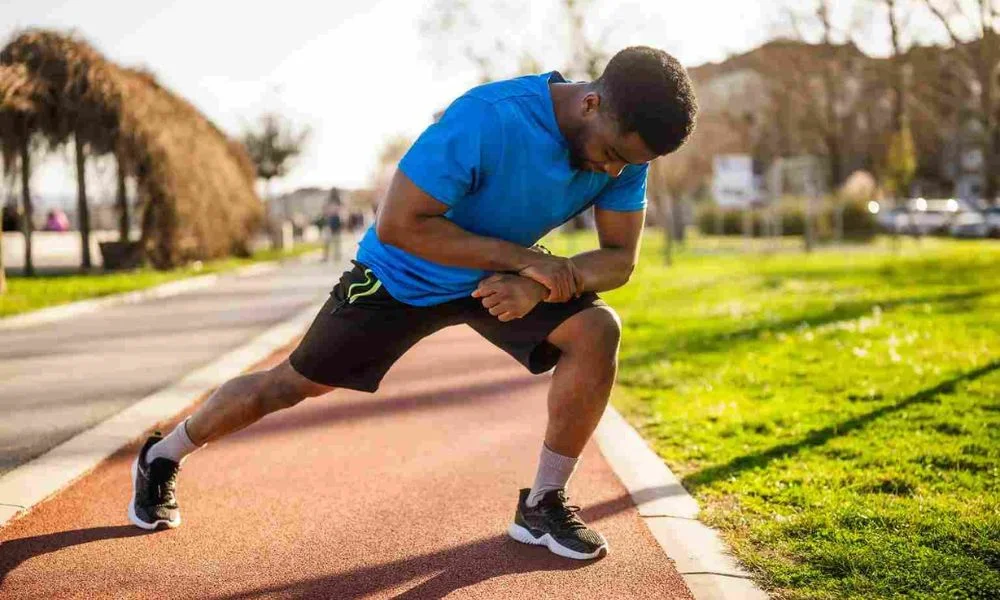
Hip flexors/iliopsoas: Step into a low lunge, back knee on the ground, and push the hips gently forward. This is the group most affected by prolonged sitting; tight hip flexors affect stride length and contribute to anterior pelvic tilt.
Quadriceps: Standing, pull one foot toward the glute, keeping knees together. Use a wall or fence for balance. The quad is heavily loaded in downhill running and fast-paced efforts.
Calves (gastrocnemius and soleus): Two stretches are needed to cover both calf muscles: one with the knee straight (gastrocnemius), one with the knee slightly bent (soleus). The soleus is particularly relevant for Achilles tendon health.
Glutes/piriformis: Seated figure-four cross one ankle over the opposite knee, sit upright, and lean gently forward. Addresses the deep hip rotators that support lateral stability during running.
IT band and outer hip: Standing crossover cross one leg behind the other, and lean away from the crossed leg. Addresses the iliotibial band and the tensor fasciae latae, common sources of lateral knee pain in runners.
Step 3: Foam Rolling / Myofascial Release (optional, 5–10 minutes)
Foam rolling (myofascial self-release, or SMR) is a useful adjunct to static stretching for runners who have access to a roller and time to use it. Its primary benefit is reducing localised muscle tension and improving the short-term range of motion. Evidence for long-term structural benefits is limited, but most runners find it a useful and satisfying addition to the post-run routine.
Technique notes:
- Move slowly — 2–3 cm per second over the muscle belly
- When you find a tender spot, pause for 20–30 seconds rather than rolling through it
- Apply steady, moderate pressure — enough to feel effective without sharp pain
- Avoid rolling directly over joints, the lower back (lumbar spine), and areas of acute injury or skin damage
Contraindications for myofascial release: Varicose veins, active thrombophlebitis, open wounds or skin lesions in the area, acute inflammatory conditions, pregnancy. If in doubt, consult a physiotherapist before starting foam rolling.
Cool-Down Protocols by Session Type
After an Easy or Recovery Run (30–60 minutes, low intensity)
Minimal protocol needed. Two minutes of walking to normalise heart rate, then 5 minutes of light stretching targeting whatever feels tight. No foam rolling required unless you enjoy it. Total time: 7–10 minutes.
After a Hard Interval or Tempo Session
Full protocol. The cardiovascular demand is higher, so the walk transition should be longer, 5 minutes, before shifting to stretching. Give particular attention to the hamstrings and hip flexors, which bear the most load at speed. Foam rolling the calves and quads is worthwhile after high-intensity speed work. Total time: 15–20 minutes.
After a Long Run (over 90 minutes)
A longer cool-down is warranted, but often skipped by tired runners who just want to stop. At minimum: 3–5 minutes of walking, 8–10 minutes of stretching covering all major groups, and light hydration and nutrition within 30–60 minutes. Foam rolling is optional but beneficial for the IT band and calves after long efforts. Prioritise recovery nutrition first if you’re choosing between it and foam rolling. Total time: 15–20 minutes.
After a Marathon
In a unique case, the miles-long race is already a cool-down in structure, and the body’s inflammatory response will dominate recovery regardless of what you do in the minutes after finishing. Walk slowly for 10–15 minutes rather than standing still (orthostatic hypotension risk is significant). Prioritise: fluid and electrolytes, a small carbohydrate and protein snack, warm clothing (core temperature drops rapidly post-race), and rest. Aggressive static stretching on highly inflamed, microdamaged muscles immediately post-marathon can cause discomfort without meaningful benefit. Light walking and gentle movement are sufficient; save stretching for 24–48 hours later.
For race-week and post-marathon recovery nutrition guidance, see our marathon training plan hub and the full recovery tips guide.
Common Cool-Down Mistakes
Stopping abruptly. The most common and most consequential error. Standing still immediately after a hard effort allows blood to pool in the legs, reducing venous return and dropping blood pressure. A 2–3 minute walk to normalise heart rate is the minimum after any moderate-to-hard session.
Treating static stretching as the whole cool-down. Stretching without the preceding cardiovascular step (walk/jog) means stretching while the heart is still at an elevated rate and blood pressure is still high. The walk comes first.
Skipping the cool-down entirely after short, easy runs. While minimal protocol is needed after easy efforts, a 5-minute walk and brief stretch costs almost nothing in time and establishes the habit that makes you do it consistently after harder sessions too.
Stretching to pain. Static stretching in the cool-down should feel like a sustained, comfortable lengthening, not pain. Sharp or acute pain during a post-run stretch is a signal to back off not a sign the stretch is “working.”
Foam rolling too aggressively on sore muscles. A common mistake after hard efforts: applying maximum pressure to already-inflamed muscle tissue. If the muscle is acutely sore from a hard session, reduce roller pressure and slow down. Aggressive rolling on inflamed tissue can worsen rather than aid recovery.
The Warm-Up / Cool-Down Pair
The cool-down is the bookend to the warm-up. If you’re running structured sessions with a dynamic warm-up before (the research-supported approach), completing a cool-down after maintains the symmetry and protects both ends of the session. Our dynamic warm-up for runners guide covers the pre-run side in full.
Post-Run Hydration and Nutrition
The cool-down window overlaps with the critical post-run nutrition window, the 30–60 minutes after finishing, during which carbohydrate and protein intake most effectively accelerates glycogen resynthesis and muscle repair.
Start rehydrating during your cool-down walk. Aim for 500ml of water or an electrolyte drink in the 30 minutes post-run, and a carbohydrate-protein snack within 60 minutes. For runs over 90 minutes, this window matters significantly more than for shorter sessions. Our running hydration guide covers post-run fluid targets in detail.