
When choosing a running watch, it’s important to consider several key factors, including functionality, comfort, battery life, and price.
Let’s find out how not to get confused by the models and functions and how to determine a set of parameters for your training objectives and fitness level.
To choose the perfect running watch, you need to take three important steps:
- Study the main features and note the ones you need and will use.
- Select a range of models with the required functionality. You’ll have to read descriptions of the watch’s features, and you’ll likely find 2-3 options from different manufacturers.
To make a final decision, study the possibilities of software for computers and smartphones from different manufacturers, comparing their appearance and ease of operation. For example, problems may arise if the watch is operated using only a touch screen.
Related: Best Running Watches
Why You Might Want a Running Watch in the First Place
Before diving into features, ask: Do you need a running watch?
Here’s why most runners love them:
Pace & Distance: No more guessing how far or fast you’re going.
Heart Rate Tracking: Helps you train smarter, not just harder.
Motivation: Seeing data over time keeps you excited.
Workout Planning: Many watches let you create intervals or follow training plans.
If you’re just starting, see my guide on how to train for your first 5K — many beginners start running before investing in a watch.
Key Features of Running Watches
Every year, watches get smarter, and the list of their features grows. Choosing a watch for runners is complicated by the fact that each manufacturer has its own names for many technologies.
Watches of the same level have approximately the same capabilities. We have gathered the main features of a running watch that you should pay attention to when choosing one.
1. Accurate GPS Tracking
For most runners, GPS accuracy is the #1 feature. It tracks your pace and distance on outdoor runs.
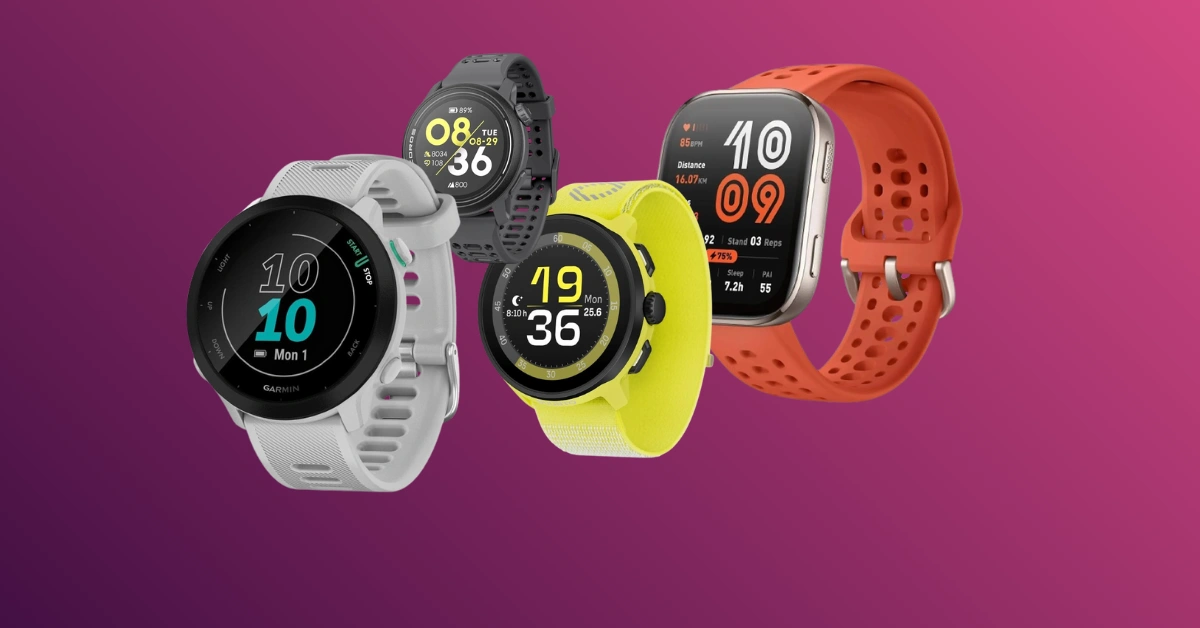
- Basic watches (like the Garmin Forerunner 55) offer simple, accurate GPS.
- More advanced models (like the Garmin Forerunner 265 or Coros Pace 3) also show your running route on a map afterward.
If you mostly run on roads, nearly any modern GPS watch is fine. If you trail run under trees or tall buildings, look for multi-band GPS (dual-frequency GNSS), which is more precise.
2. Heart Rate Monitoring
A built-in optical heart rate sensor tracks your pulse on your wrist.
- Helps with zone training (easy vs hard days).
- Some watches even give VO2 max estimates or recovery suggestions.
For the most precise heart rate, a chest strap is still the gold standard — but for everyday running, wrist sensors are plenty good.
3. Battery Life
How many hours of GPS tracking can it handle?
- Entry-level watches: ~10-15 hours (fine for most runners).
- Ultra models: 40+ hours (good for ultra races or multi-day hikes).
Ask yourself: How often do I want to charge it?
Daily? Or every couple of weeks?
4. Training & Smart Features
- Interval workouts: Can it buzz you for 1 min fast, 1 min slow repeats?
- Running power, cadence, and vertical oscillation? (Important for serious training.)
- Smartphone notifications? Music storage? Contactless payments?
If you like to leave your phone at home, you might want music on the watch.
5. Price & Durability
- Good running watches start around $150–200.
- Premium multisport watches (Garmin Fenix, Coros Vertix) can hit $600+.
My Real-World Tips from Coaching Runners
I’ve worked with runners from couch-to-5K to sub-3-hour marathons. Here’s what I’ve learned:
Beginners
Start simple. You don’t need a $500 watch. You can limit yourself to the basic features: they have the necessary set of functions and are easier to learn. This will help you focus on training and further progress, rather than on tracking numerous and not yet very clear indicators.
The short duration of workouts does not require a persistent battery. This will also reduce the cost of the watch. Upgrade later if you stick with it.
Intermediate
A mid-range watch is the optimal choice: such models have a good balance between features and price. When selecting a model, focus on your training volume and the duration of your competition runs. A marathon requires at least 3-5 hours of battery life, while an ultramarathon requires 10-20 hours or more. The more powerful the battery, the more expensive the watch.
Advanced / Trail
For this category, the watch becomes a real assistant in the training process. They can help track the level of exertion and assess recovery, while integration with phone and computer apps allows for detailed analysis.
For a high-level athlete, it is much more difficult to find ways for further progress, so there are no trifles – any parameter that can be measured can become key to improving sports skills.
Choose the right sports watch for your needs, so that you can enjoy your watch and improve your performance!
Why is a Running Watch Better Than a Smartphone?
Smartphones can perform almost all of the above functions, and if you connect a heart rate sensor, they will also collect heart rate data. But there are a number of reasons why it is better to use a sports watch during workouts.
- Compactness. All the information is on your wrist. You don’t have to figure out which pocket or bag to put your phone in so that it doesn’t get in the way.
- Protectability. Sports watches can easily withstand rain and immersion in water, so they are ready to meet any adventure.
- Autonomy. The operating time of the watch in GPS mode is much higher than that of a smartphone. Plus, you don’t need cellular service to record a track or view maps, and sometimes you lose it at the worst possible moment.
- Dedicate yourself to working out. Sometimes you can afford to spend a couple of hours without calls or texts, alone with your thoughts and feelings. Try it, you’ll love it!
Helpful for Other Sports
If you’re into something else besides running or switch to another sport in the off-season, look into usability for them as well.
For cycling, the ability to connect additional sensors, such as a power meter or cadence sensor, will be a plus.
For triathlons or swimruns, a multi-sport mode is a must, allowing you to quickly transition from one sport to another. For swimming, there’s an array of features for analyzing stroke efficiency and frequency, determining style, and counting pool lengths. Tracking activity, steps taken, and calories consumed will help you stay in shape and keep your health in check.