
Curated by Esen Bay, competitive runner (PRs: 5K–marathon). Recommendations based on published specs, independent reviews from GearJunkie, Switchback Travel, iRunFar, and Outdoors Magic, and verified runner feedback. About the author →
The best running pack for most trail and long-distance road runners is the Salomon ADV Skin 12 — a vest-style pack that consistently tops independent roundups from GearJunkie, Switchback Travel, and iRunFar for its dialed fit, smart storage, and proven comfort over long distances. At 8.4 oz and 12L, it covers everything from half marathons to full-day mountain runs. For runners needing more volume for multi-day fastpacking, the Ultimate Direction Fastpack 30 is the most practical pick with vest-style front storage in a 30L body.
How We Selected These Packs
Each pack was chosen based on published specs verified against brand official pages, independent test results from GearJunkie, Switchback Travel, iRunFar, and Outdoors Magic (updated February 2026), and verified runner feedback from structured communities. Packs were not personally tested by the author for this roundup. Where independent reviewer findings contradict manufacturer claims, that is noted.
Running Vests vs Running Backpacks — What’s the Difference?
Running vests (also called hydration vests or race vests): form-fitting, vest-style packs with a harness that hugs the chest and shoulders. Capacity typically 5–12L. Front pockets for flasks, gels, and a phone accessible while running. Minimal bounce. Best for races, trail runs, and long training days where fit and weight matter most.
Running backpacks (also called fastpacks): higher-capacity packs (15–40L) worn on the back. More like traditional backpacks but with running-optimized harness systems. Best for full-day mountain runs, fastpacking trips, commuters who run with gear, and ultra distances where you need to carry more than a vest can hold.
Most runners doing trail or long-distance road running want a vest, not a backpack. If your primary use case is daily training, the Salomon ADV Skin 12 or Osprey Duro Pro 7 are the right starting points. If you need to carry extra layers, camping gear, or food for 8+ hours, the Ultimate Direction Fastpack 30 or RAB Tensor are the right tier.
Best Running Packs & Vests: At a Glance
| Pack | Type | Capacity | Weight | Hydration | Buy |
|---|---|---|---|---|---|
| Salomon ADV Skin 12 | Vest | 12L | 8.4 oz / 238g | 2 soft flasks + 2L reservoir | |
| Osprey Duro Pro 7 | Vest | 7L | 9.5 oz / 269g | 1.5L reservoir included | |
| Black Diamond Distance 15 | Pack | 15L | 12.8 oz / 363g | 17 oz + reservoir pocket | |
| RAB Tensor 10 | Pack | 10L | 14 oz / 397g | 2L bladder compatible | |
| Ultimate Direction Fastpack 30 | Fastpack | 30L | 1.52 lbs / 690g | 3L reservoir + dual flask holsters |
Prices may vary by retailer and colorway.
See also: Best Waterproof Running Jackets → | Running Gear Hub →
Best Running Backpacks
1
Best Overall — Salomon ADV Skin 12
Pros
Cons
What the Data Shows
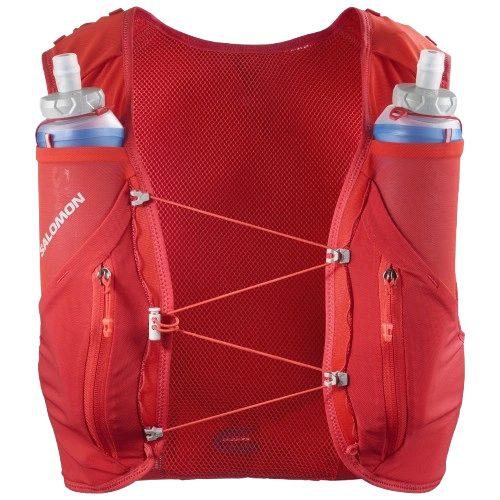
The Salomon ADV Skin 12 is the most independently tested and consistently top-ranked running vest in its category. GearJunkie’s update calls it their best overall running hydration pack for its “dialed fit, smart storage, and proven long-distance comfort.” Switchback Travel ranks it their top vest for its Y-shaped Sensifit build that creates a near-body-mapped fit, and the updated flask holders reduce front bounce to a point where most runners report forgetting they’re wearing it.
The 12L capacity is the key differentiator from smaller race vests. Three stretchy rear sleeves expand to carry a meaningful amount of gear alongside the 2L reservoir, without the weight or bulk of a traditional backpack. For runners training for trail races, ultras, or long mountain days when you need to carry layers, nutrition, and an emergency kit without stepping up to a full fastpack, the ADV Skin 12 is the clearest recommendation available.
The honest limitation: vest-style packs fit differently on different bodies, and the Sensifit harness works best for runners whose torso measurements match Salomon’s sizing. Trying on before buying is strongly recommended. For runners who find vest harnesses uncomfortable on their shoulders or chest, the Osprey Duro Pro 7’s traditional strap system is worth considering instead.
For training that pairs with a structured plan, see our marathon training plans → and half marathon plans → — both include long runs where carrying water and nutrition becomes essential.
Best for: trail runners, ultramarathon training, long-distance road running, day mountain missions, runners who want a vest they can race and train in. Not for: runners needing more than 12L, short runs where a vest is overkill, runners who dislike vest-style harnesses.
2
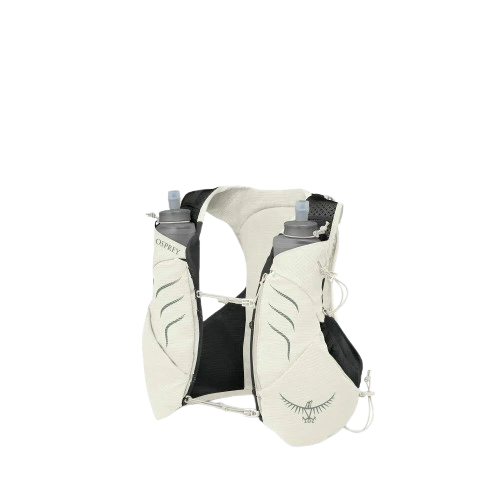
Best for Trail Running — Osprey Duro Pro 7
Pros
Cons
What the Data Shows
The Osprey Duro Pro 7 is Outdoors Magazine’s best-in-test running pack as of their February 2026 update, praised for being “one of the best running packs tested in recent years.” Where the Salomon ADV Skin uses a close-fitting vest harness, the Duro Pro 7 uses a traditional shoulder strap system, which is meaningfully better for runners who find vest harnesses chafe, pinch, or create pressure points on the chest and shoulders.
The 7L capacity is right-sized for trail runs of 1–4 hours with weather protection, nutrition, and 1.5L of water. The rear compartment is organized to put a waterproof jacket accessible on top of the reservoir a practical detail that makes adding or removing a layer mid-run genuinely easy. The hip belt is proportionally sized to actually transfer some weight off the shoulders, which most running vests can’t claim.
The trade-off is the reservoir system. Soft flask-forward vests like the Salomon ADV Skin make refilling fast: pull out a flask, fill it, drop it back in. With a reservoir, you typically need to stop, open the back, and refill through the bladder opening. For runners who hit aid stations infrequently or don’t mind stopping, this isn’t a problem. For runners who need to fill up on the move, soft flask priority vests are easier.
Best for: trail runners who prefer traditional backpack harness feel, runs of 1–4 hours, runners who prioritize a locked-in zero-bounce fit over front flask access. Not for: runners wanting soft flask accessibility, runs needing more than 7L, runners who find hip belts uncomfortable.
3
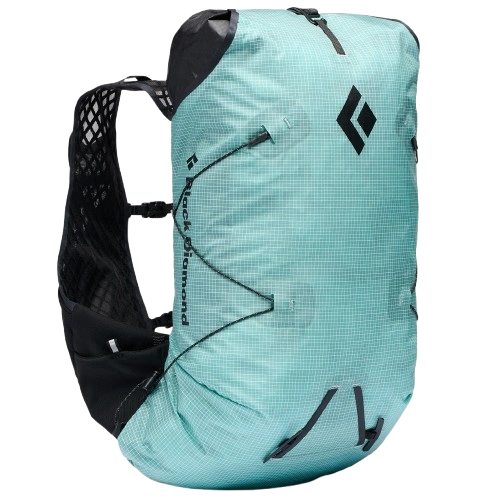
Best Ultralight Pack — Black Diamond Distance 15
Pros
Cons
What the Data Shows
The Black Diamond Distance 15 occupies a useful middle ground: it’s built on a running vest chassis (body-hugging shoulder harness, front accessible pockets) but delivers 15L of backpack capacity through a roll-top main compartment. The result is a pack that feels like a vest when moving but holds considerably more than any vest in this roundup.
The four oversized mesh harness pockets are the standout feature, large enough for a big phone or a 500ml flask, they keep the most frequently accessed items within reach without removing the pack. The Dynex main compartment is rugged and weather-resistant, though its rigidity means you can’t overload it the way you can with stretch-panel vests.
The honest limitation is the lack of a hip belt. At 15L fully loaded, all weight transfers through the shoulder harness are manageable for 2–4 hour runs, but potentially uncomfortable for longer efforts with a heavy load. Runners planning 6+ hour days will want to consider the Fastpack 30 instead.
Best for: mountain runners needing more than a vest but less than a full fastpack, trail runners carrying mandatory kit for long events, runners who want vest-style access with backpack volume. Not for: overnight runs (capacity too small), runners needing hip belt weight transfer, or beginners who prefer a simpler design.
4
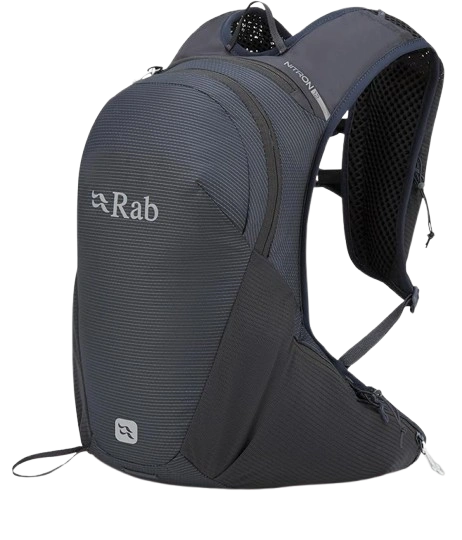
Most Affordable — RAB Tensor 10
Pros
Cons
What the Data Shows
The RAB Tensor 10 is the honest answer to one specific question: “I want a running pack for long runs that doesn’t cost more than $70.” RAB, better known for equipping high-altitude mountaineers, applies the same “deliberately simple, durably built” philosophy to the Tensor. The streamlined design is intentional, nothing to snag on branches, nothing to bounce, nothing to break.
At 10L, it holds a windbreaker, snacks, sunscreen, and a 2L hydration bladder. The shoulder straps are padded and comfortable for steady efforts, though the harness is more functional than performance-tuned. Runners accustomed to vest-style packs will notice the difference in front accessibility. There are no harness pockets, so everything is in the main compartment.
The reflective rear panel is a practical safety detail. The PFAS-free certification is increasingly uncommon at this price point. For trail runners who want a simple, durable pack for shorter mountain runs without spending $130+, the Tensor 10 is exactly what it claims to be.
Best for: budget-conscious trail runners, beginners to trail running and packs, shorter mountain runs (under 3 hours), runners who want simple and durable over feature-rich. Not for: runners wanting front pocket access, long-distance runs requiring significant gear, wide body types (one-size fit).
5
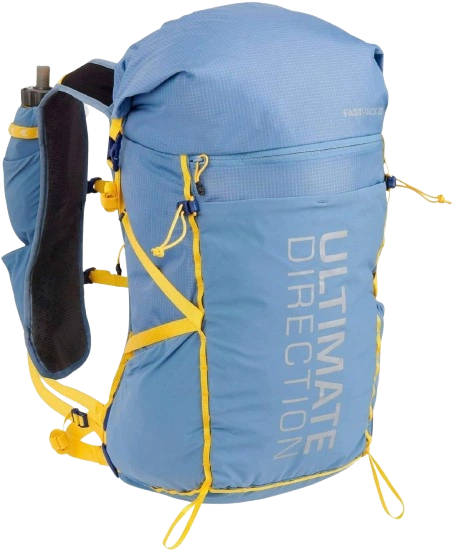
Best for Fastpacking & Long Days — Ultimate Direction Fastpack 30
Pros
Cons
What the Data Shows
The Ultimate Direction Fastpack 30 sits in a category of its own in this roundup: it’s designed for runners who need to carry 2+ days of gear while still being able to run. The front-loaded flask holsters and harness pocket system maintain vest-style accessibility for nutrition and hydration, while the 30L roll-top main compartment holds camping gear, spare clothing, or a race mandatory kit that vests simply can’t accommodate.
The Infiknit harness and FastFlow back panel are genuine upgrades from earlier Fastpack versions, improving breathability and reducing back sweat on sustained efforts. The removable T-hook waistbelt allows load transfer on heavier carries important at 30L fully loaded, which can easily reach 15+ lbs.
The honest critique from iRunFar’s fastpacking roundup: the Fastpack “does a job; it just doesn’t do it super well” compared to more specialized fastpacking packs. At 1.52 lbs unloaded, it’s heavier than comparable volume options from Hyperlite Mountain Gear or Pa’lante Packs, and the pocket layout on the women’s FastpackHer 30 2.0 is reduced compared to the unisex version. For runners whose primary use is day runs and trail races, a vest is a better tool. For runners planning overnight or multi-day runs who want a single pack that fits like a vest and carries like a pack.
Best for: fastpacking and overnight runs, full-day mountain adventures, ultra mandatory kit, runners who need vest-style access with 30L capacity. Not for: trail races and short training runs (overkill), runners wanting minimum weight, women prioritizing front pocket access (see FastpackHer limitation above).
Verdict Box
| Your Use Case | Best Pick |
|---|---|
| Best overall — trail running & long runs | Salomon ADV Skin 12 |
| Best trail vest — traditional harness | Osprey Duro Pro 7 |
| Best ultralight pack — 15L | Black Diamond Distance 15 |
| Best value — budget trail running | RAB Tensor 10 |
| Best for fastpacking — multi-day & long adventures | Ultimate Direction Fastpack 30 |
For most trail runners and long-distance runners, the Salomon ADV Skin 12 is the right starting point, independently top-ranked, widely available, and proven across hundreds of miles of real runner testing. If budget is the constraint, the RAB Tensor 10 at $65 is a legitimate alternative for shorter efforts. If you need to carry overnight gear, the Ultimate Direction Fastpack 30 is the category choice.
What to Consider in a Running Pack
Vest vs Pack — Choose the Right Format First
The single most important decision is vest or pack. Vests fit like a second skin and minimize bounce right for races, long training runs, and any situation where fit and weight matter. Packs carry more volume on a traditional harness, right for multi-day trips, commuters, and runs requiring 15L+ of gear. Buying the wrong format and expecting the other’s benefits is the most common mistake.
Capacity — Match to Your Longest Run
- 0–8 hours / up to ~15L: A vest handles the hydration, nutrition, and emergency layer you need
- 8–12 hours / 15–25L: A running-specific pack like the Black Diamond Distance 15
- 12+ hours / overnight / 25–40L: A fastpack like the Ultimate Direction Fastpack 30
Harness Fit — This Matters More Than Any Feature
A poorly fitting pack bounces no matter how good the design. Vest-style harnesses (Salomon Sensifit, Nathan) fit best for runners with an athletic torso and work well for most. Traditional shoulder straps (Osprey Duro Pro) work for a wider range of body shapes. If possible, load the pack with your running kit weight and jog in place before buying.
Hydration System — Reservoir vs Soft Flask
Soft flasks (Salomon, Nathan, Ultimate Direction) are easier to refill on the move, lighter when empty, and accessible from the front. Reservoirs (Osprey, most traditional packs) hold more water but require stopping to refill and are harder to monitor. For races with frequent aid stations, soft flasks. For long self-supported runs, a reservoir or a combination of both.
Weight and Bounce Management
Running-specific packs use compression straps, elastic panels, and body-mapped harnesses to minimize bounce. The most important indicator isn’t stated weight, it’s loaded bounce, which only shows up on the run. Independent reviews that describe bounce behavior are more useful than manufacturer specs on this point.
Ready to Start Training?
Training plans are designed and reviewed by Ilya Tyapkin, Rio 2016 Olympian. Find the plan that matches your goal:
FAQ
What is the difference between a running vest and a running backpack?
Running vests are form-fitting packs with a harness that hugs your chest and shoulders, typically 5–12L, with front pockets for flasks and nutrition accessible while running. Running backpacks (or fastpacks) are higher-capacity packs (15–40L) with a traditional back-mounted design. Vests are better for races and long training runs; backpacks are better for overnight trips and high-gear-volume adventures.
How much capacity do I need in a running pack?
For runs under 8 hours on a marked trail with aid stations, 8–12L is usually sufficient. For full-day mountain runs with minimal support, 12–20L. For overnight fastpacking or very remote runs without resupply, 25–40L. When in doubt, start smaller — a well-packed 12L vest handles more than most runners expect.
Are soft flasks or a hydration reservoir better for trail running?
Both work, and the best answer depends on your use case. Soft flasks are easier to refill at aid stations or streams while moving, and they fold flat when empty to reduce weight. Reservoirs hold more water in one container but require stopping to refill. Many runners use both — a reservoir for the bulk of hydration and one or two front flasks for easy mid-run access.
What is the best running pack for ultramarathons?
The Salomon ADV Skin 12 is the most widely used vest in the ultramarathon community for its dialed fit and 12L capacity. For longer ultras with mandatory gear requirements, the Black Diamond Distance 15 or Ultimate Direction Fastpack 30 provides the additional volume needed. Check your specific race’s mandatory kit list before choosing.
Should my running pack bounce?
No, a properly fitting running pack should produce minimal bounce even at running pace. Significant bounce usually means the pack is the wrong size, improperly adjusted, or too loosely loaded. Load the main compartment with heavier items closest to your back, use compression straps to tighten the load, and adjust the sternum strap snugly. If bounce persists after adjustment, the harness size or style may not match your body.