
The Coros Pace 3 launched in September 2023. It delivered dual-frequency GPS, a 38-hour GPS battery, music storage, and Coros’s full training ecosystem in a 30-gram body for just $229.
The Coros Pace 3 is not perfect. There’s no AMOLED display, no offline maps, and no streaming music. But for runners who want accurate GPS, exceptional battery life, and clean training analytics in the lightest possible package at the lowest possible price.
Here’s everything you need to know in the Coros Pace 3 review
Quick Verdict
Overall Rating: 4.3 / 5
| Best For | Budget-conscious runners and triathletes who want dual-frequency GPS and long battery life under $200 |
| Skip If | You want an AMOLED display, offline maps, or are ready to spend $249 for meaningful upgrades |
| Price | $199 (reduced from $229 since Pace 4 launch) |
| Standout Feature | Dual-frequency GPS + 38-hour GPS battery + 30g weight at $199 |
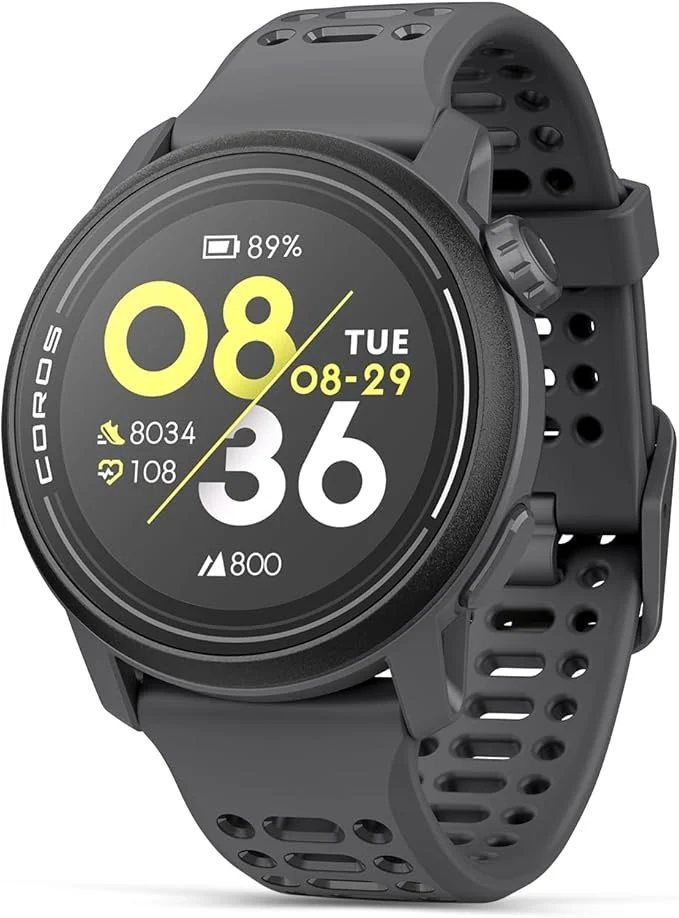
Coros Pace 3
Pros
Cons
Specs Overview
| Spec | Details |
|---|---|
| Display | 1.2″ Always-On MIP touchscreen, Mineral Glass |
| Case Size | 41.9mm |
| Thickness | 11.7mm |
| Weight | 30g (nylon band) / 39g (silicone band) |
| Battery (Smartwatch) | Up to 17 days |
| Battery (GPS Standard) | Up to 38 hours |
| Battery (All Systems GPS) | Up to 25 hours |
| Battery (UltraMax GPS) | Up to 60 hours |
| GPS | Dual-frequency: GPS + GLONASS + Galileo + BeiDou + QZSS |
| Heart Rate | Optical, 5-LED + 4 photodetector + SpO2 |
| Water Rating | 5 ATM (50m) |
| Maps | Breadcrumb navigation only |
| Music | MP3 storage + Bluetooth playback |
| Charging | Proprietary magnetic cable |
| Storage | 4GB |
| Price | $199 (current) |
| Released | September 2023 |
Related: Best GPS Running Watches / Best Affordable watches
Price
The Coros Pace 3 launched at $229 and has since been repriced to $199 following the Pace 4’s arrival. That reduction makes it one of the most compelling GPS watches at any price, putting dual-frequency GPS and a 38-hour GPS battery within reach of almost any runner’s budget.
| Watch | Price | AMOLED | Dual-Band GPS | Offline Maps | GPS Battery | Weight |
|---|---|---|---|---|---|---|
| Coros Pace 3 | $199 | ❌ | ✅ | ❌ | 38 hrs | 30g |
| Coros Pace 4 | $249 | ✅ | ✅ | ❌ | 41 hrs | 32g |
Coros Pace 3 vs Pace 4 comparison
Garmin Forerunner 55 vs Coros Pace 3
Ready to Start Training?
Training plans are designed and reviewed by Ilya Tyapkin, Rio 2016 Olympian. Find the plan that matches your goal:
Design
The Coros Pace 3 is built around simplicity and lightness. At 30g with the nylon band, and just 11.7mm thin, it’s one of the smallest and lightest GPS watches with dual-frequency capability on the market. Multiple reviewers and long-term users report forgetting it’s on their wrist during long runs and overnight sleep tracking.
The 41.9mm case is made from fibre-reinforced plastic, not metal. Compared to the titanium bezel of the Apex 2 or the aluminum of the Forerunner 570, it has a more budget feel in hand. On the wrist during activity, this rarely matters, but it’s worth knowing if you’re looking for a premium aesthetic.
Navigation uses a digital crown and one back button, a two-control layout that keeps the design minimal. The crown functions as a scroll and confirms control; it’s well-regarded among Coros users for feeling precise and tactile. A touchscreen is also available for swiping between data screens, though it requires a firmer touch than most modern touchscreens and doesn’t work reliably with gloves.
Both silicone and nylon bands are available. The nylon band is lighter, more breathable, and faster-drying, the right choice for most runners. Bands attach via a quick-release pin that makes swapping straightforward.
Available in black and white, clean and understated. A small selection of colorways is available depending on the retailer.
Display
The Coros Pace 3 uses a 1.2-inch always-on MIP (Memory-in-Pixel) touchscreen with Mineral Glass protection. It’s not AMOLED, there’s no color vibrancy, no deep blacks, and no visual drama. What you do get is a display that’s always readable in direct sunlight, always on without significant battery cost, and sharp enough for all essential running data at a glance.
Reviewers consistently describe the display as clear and functional exactly what a running watch needs. Night mode keeps the backlight active for pre-dawn and post-sunset runs. Data pages are clean, well-organized, and scrollable via the digital crown or touchscreen swipe.
The one consistent criticism: the touchscreen requires a deliberate, firm touch to register reliably. With bare hands during a run, this is manageable. With gloves or in cold rain, it can frustrate, making the digital crown the more reliable primary control in harsh conditions.
If AMOLED is non-negotiable for you, the Pace 4 at $249 or the Garmin Forerunner 165 at $249 are the alternatives. If you’re comfortable with MIP and many runners strongly prefer it for battery life and sunlight readability, the Pace 3 display does the job well.
Training Features
Despite its budget positioning, the Coros Pace 3 carries almost the full Coros training analytics stack, the same software features found on much more expensive Coros watches.
Running Tools
Cumulative training stress tracking across disciplines, see whether you’re building, maintaining, or tapering
Post-workout recovery time recommendation based on effort and HRV data
Daily readiness combining recent training load and recovery quality
Estimated finish times for 5K, 10K, half-marathon, and marathon based on current fitness level
Set a target pace and receive alerts with Pacer when drifting above or below
Composite metric tracking fitness level over time, viewable in the Coros app
Lactate Threshold and VO2 Max estimates are accessible in the app post-activity
Compete against PRs and other athletes in real time on Strava segments (added via firmware update)
PacePro pacing tool (added via update)
HYROX support (added via update)
Navigation
- Breadcrumb navigation: Follow uploaded GPX routes with a course line and deviation alerts
- Turn-by-turn alerts: Audio and visual notification when approaching a turn
- Sun Movement tracking: Sunrise/sunset warnings to plan around daylight
- Distance to destination and elevation profile: Viewable pre-activity and during
Music
- Load music files to the watch via computer, and play back through paired Bluetooth headphones
- No streaming services, such as Spotify, Apple Music, and similar, require your phone
- Play, pause, skip on paired phone via the watch
Health & Recovery
- Automatic detection with sleep quality scoring
- HRV monitoring: Overnight HRV informs recovery recommendations
- Blood oxygen (SpO2)
- Stress tracking
- Menstrual cycle tracking
- Barometric altimeter: Real-time elevation with auto-calibration
Smart Features
- Smartphone notifications: Calls, texts, app alerts
- GoPro and Insta360 camera control trigger your camera from your wrist mid-activity
- Wi-Fi sync: Firmware updates and data transfer without plugging in
- Strava, TrainingPeaks, Nike Run Club, Apple Health integration
UltraMax GPS Mode
A standout feature for long-distance athletes: UltraMax reduces GPS recording frequency to extend battery life up to 60 hours, enough for most ultramarathon events without any need to charge mid-race. This mode is not available on competing budget watches like the Garmin Forerunner 165.
Bottom line on training features: Remarkably complete for $199. The full Coros training load and recovery analytics, UltraMax GPS for ultras, and music storage are all features. Navigation is route-based only, with no offline maps.
Performance
GPS Accuracy
The Pace 3 supports dual-frequency GPS with five satellite systems GPS, GLONASS, Galileo, BeiDou, and QZSS. In standard GPS mode (single-band), battery life reaches 38 hours. Switching to All Systems multi-band mode drops to approximately 25 hours but delivers improved accuracy in urban environments, dense trails, and other challenging GPS conditions.
In real-world testing on roads, forest trails, and mixed terrain, GPS accuracy is consistently rated as excellent for the price one of the most accurate budget watches available. In a controlled 2.8-mile GPS benchmark test, the Pace 3 recorded within ±0.14 miles of the known distance, competitive with watches at twice the price.
One important note: like the Pace 4, Coros prioritizes battery efficiency over maximum GPS sampling rate in some modes. Sharp switchbacks on technical trails may show slight smoothing. For road runners, open trail runners, and most everyday training, this is entirely unnoticeable.
Heart Rate Accuracy
The 5-LED optical sensor with 4 photodetectors and SpO2 is one of the most accurate HR systems available on a budget running watch. In head-to-head testing against the Polar H10 chest strap, the Pace 3 recorded within ±1.54 BPM on average, an impressively tight result that outperformed many more expensive competitors in the same test. During steady-state and moderate-intensity running, HR accuracy is excellent. A brief lag is possible during sudden high-intensity changes, as with all wrist optical sensors.
Battery Life
Battery life is the Pace 3’s strongest competitive card at its price point:
- Standard GPS: 38 hours
- All Systems GPS: 25 hours
- UltraMax GPS: 60 hours
- Smartwatch mode: 17 days
Real daily training use consistently delivers 10+ days between charges for most runners doing 1–2 hours of GPS activity per day. Multiple reviewers report wearing the watch for three or more weeks without hitting low battery. For ultramarathon athletes, UltraMax mode provides 60 hours of continuous GPS tracking, more than most events require.
Who Should Buy It?
Buy the Coros Pace 3 if:
- Budget is the priority $199 is the sweet spot for serious GPS tracking without breaking the bank
- You want dual-frequency GPS without paying $249+ — the Pace 3 is one of the only watches delivering this under $200
- Battery life matters, 38 hours GPS and 17 days smartwatch mode at $199 is hard to match
- You’re a road runner or triathlete who trains on familiar routes and doesn’t need offline maps
- You want UltraMax GPS mode for ultramarathon events 60 hours of continuous GPS is extraordinary at this price
- You want music on your wrist without a phone, MP3 storage via Bluetooth headphones
- You’re upgrading from a basic fitness tracker or Apple Watch and want proper running analytics
- You appreciate a watch that improves over time. Coros’s firmware update track record is excellent
Skip it if:
- You want an AMOLED display the Pace 4 at $249 adds this plus an Action button and USB-C charging
- You need offline maps. The Coros Apex 2 at $349 is the right step up
- Streaming music is essential no Spotify or Apple Music, MP3 only
- You run frequently in cold weather with gloves, but the touchscreen frustrates in these conditions
- You want contactless payments, not available on the Pace 3
- You’re deeply invested in the Garmin ecosystem. Connect IQ and Garmin’s broader software stack aren’t available
Final Verdict
The Coros Pace 3 at $199 is one of the most honest value propositions in GPS running watches. Dual-frequency GPS, a 38-hour GPS battery, UltraMax mode for ultras, music storage, and the full Coros training analytics stack in a 30-gram body that most athletes forget they’re wearing.
It’s been superseded by the Pace 4, which adds AMOLED, a third button, a microphone, and USB-C charging for $50 more. For most runners who want the latest hardware, the Pace 4 is the better buy. But for budget-conscious athletes, those who prefer MIP for battery life, or anyone who simply wants the most training value per dollar spent, the Pace 3 at $199 remains one of the smartest purchases in the category.
Two years of software updates have only made it better. The watch you buy today is meaningfully more capable than what launched in 2023.
Scores:
| Category | Score |
|---|---|
| Design | 4.1 / 5 |
| Display | 3.5 / 5 |
| Training Features | 4.4 / 5 |
| Performance | 4.5 / 5 |
| Value | 5.0 / 5 |
| Overall | 4.3 / 5 |
Frequently Asked Questions
Is the Coros Pace 3 still worth buying?
Yes, especially at its current $199 price. The Pace 4 has replaced it as Coros’s headline entry-level watch, but the Pace 3 retains the same core strengths: dual-frequency GPS, 38-hour GPS battery, and Coros’s full training analytics at a price no serious competitor can match.
What is the difference between Coros Pace 3 and Pace 4?
The Pace 4 adds an AMOLED display (vs MIP), a dedicated Action button, a built-in microphone for Voice Pins, USB-C charging, and slightly improved GPS battery (41 vs 38 hours). The Pace 3 retains a slight weight advantage at 30g vs 32g and costs $50 less. For most runners, the Pace 4 is the better buy, but the Pace 3 at $199 remains an excellent value.
Is the Coros Pace 3 good for triathlons?
Yes, it supports triathlon multisport mode with seamless discipline switching, pool and open water swimming, cycling, and run tracking. Training load analytics cover all disciplines. It’s a capable beginner-to-intermediate triathlon watch.
Can I play music on the Coros Pace 3?
Yes — MP3 music files can be loaded onto the watch via computer and played back through paired Bluetooth headphones. Streaming services like Spotify are not supported. You can also control music playback on your paired phone from the watch.
This review is based on aggregated expert testing data, firmware update history, and real user feedback compiled from across the running and multisport community. We bring together the most accurate and up-to-date information so you can make a confident buying decision.