
You’re now getting a brilliant AMOLED touchscreen, multi-band GPS, wrist-based running power, Garmin’s full training and recovery ecosystem, Spotify streaming, Garmin Pay, and HRV tracking in a 47g watch that lasts 13 days on a charge, for under $350.
That’s a different proposition entirely. And for most runners, it’s the sweet spot in Garmin’s entire lineup.
Is it perfect? No. There are no offline maps, the bezel is plastic, and the FR570 has since arrived with a better HR sensor at a higher price. But if you’re a runner who wants Garmin’s best training tools without paying flagship prices and you’re fine with single-band GPS on the base version, this watch quietly delivers one of the best arguments in the category.
Here’s the full picture.
Quick Verdict
Overall Rating: 4.4 / 5
| Best For | Intermediate to advanced runners who want Garmin’s best training analytics and AMOLED display at a discounted price |
| Skip If | You need offline maps, the latest HR sensor, or you’re tempted by the Forerunner 570 at $549 |
| Price | ~$299–$350 (MSRP $449.99) |
| Standout Feature | Multi-band GPS + HRV Status + Training Readiness + AMOLED touchscreen at its current street price |
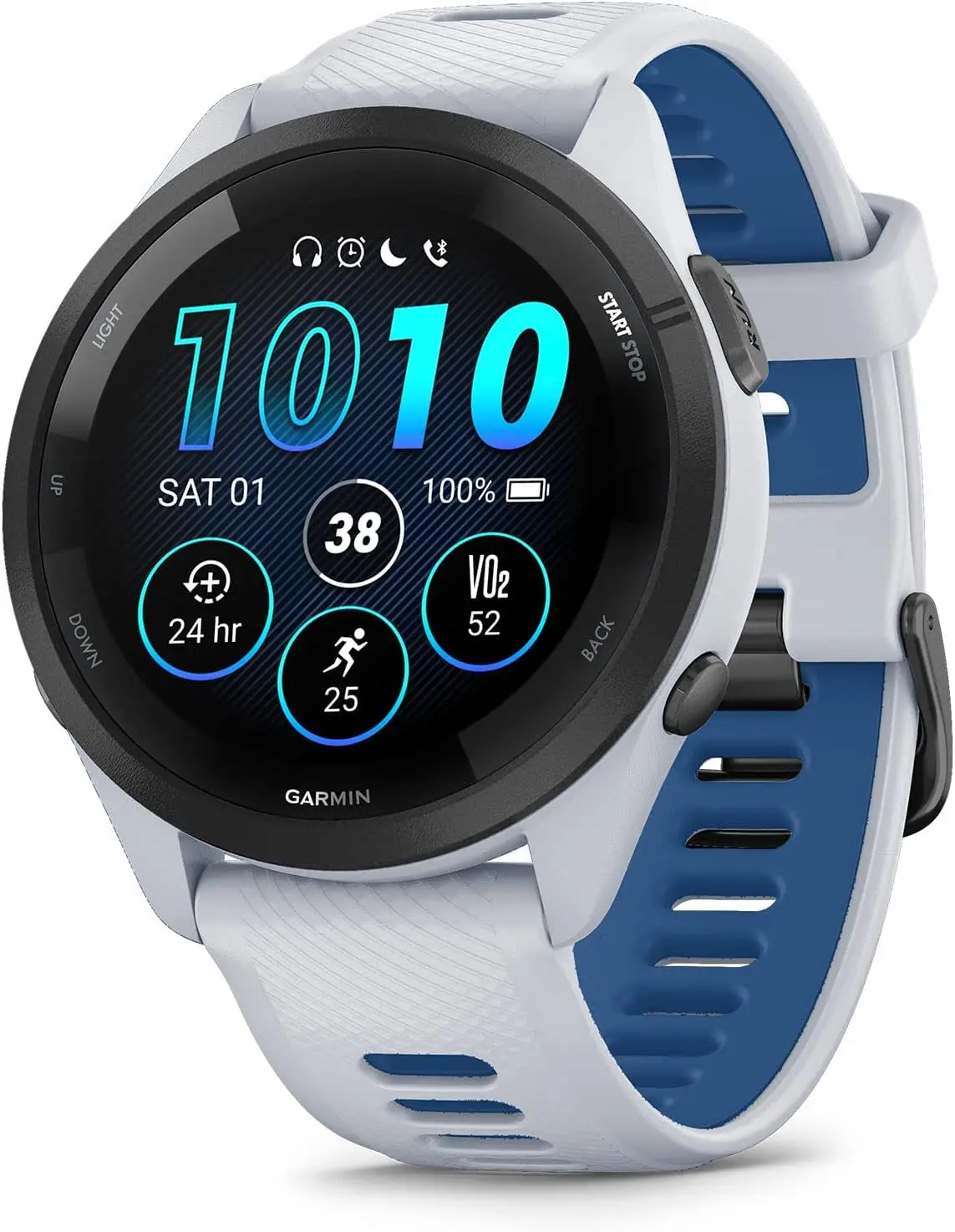
Garmin Forerunner 265
Pros
Cons
Specs Overview
| Spec | FR265 (46mm) | FR265S (42mm) |
|---|---|---|
| Display | 1.3″ AMOLED, 416×416 | 1.1″ AMOLED, 360×360 |
| Weight | 47g | 39g |
| Battery (Smartwatch) | Up to 13 days | Up to 15 days |
| Battery (GPS) | Up to 20 hours | Up to 24 hours |
| Battery (Multi-band GPS) | Up to 15 hours | Up to 17 hours |
| GPS | Multi-band (SatIQ) + GPS, GLONASS, Galileo, BeiDou | |
| Heart Rate | Elevate Gen 4 optical | |
| Altimeter | Barometric | GPS-based |
| Water Rating | 5 ATM (50m) | |
| Music Storage | 8GB | |
| Garmin Pay | ✅ | |
| MSRP | $449.99 | $449.99 |
| Current Street Price | ~$299–$350 | ~$299–$350 |
| Released | March 2023 |
Related: Best GPS Running Watches / Best Affordable watches
Price
The Forerunner 265 launched at $449.99 a price that put it squarely in the awkward zone between mid-range and premium.
In 2025–2026, the FR265 regularly sells for $299–$350, and has hit a record low of $299 at Amazon, representing a 33% discount off MSRP. At that price, it becomes one of the most compelling watches in the Garmin lineup.
Here’s the at current prices:
| Watch | Current Price | Multi-Band GPS | AMOLED | Maps | HR Sensor |
|---|---|---|---|---|---|
| Garmin FR265 | $299–$350-$449 | ✅ | ✅ | ❌ | Elevate Gen 4 |
Ready to Start Training?
Training plans are designed and reviewed by Ilya Tyapkin, Rio 2016 Olympian. Find the plan that matches your goal:
Design
The Forerunner 265 isn’t trying to be the most beautiful watch in the room. It’s trying to be the one you forget is on your wrist, and in that, it mostly succeeds.
The 46mm case is fiber-reinforced polymer with a matching polymer bezel. That means plastic, to call it what it is. There’s no aluminum, no titanium, and no premium material feel of the Coros Apex 2 or Garmin Fenix 8. What you get instead is a watch that’s light enough to wear for 24 hours a day without ever thinking about it. At 47g on the larger model and just 39g on the 265S, it genuinely disappears during runs and sleep.
The five-button layout with a complementary touchscreen is the best of both worlds. Buttons for precision input during races and sweaty training sessions. Touchscreen for navigating menus, scrolling through data, and swiping watch faces on the couch. After a few days, it becomes second nature you stop thinking about which input to use and just use whichever feels right.
Available in three colorways across both sizes: Black/Powder Gray, Whitestone/Tidal Blue, and a few others, depending on the retailer. Understated and clean. The silicone strap is functional, but a bit grippy on the skin during long runs many owners swap it out for a QuickFit-compatible nylon or silicone band.
One design note worth mentioning: the 265S doesn’t have a barometric altimeter it relies on GPS for elevation. If you run hilly routes and care about accurate climb data, go for the 265 standard model.
Display
If there’s one thing every reviewer agrees on about the Forerunner 265, it’s this: the screen is genuinely beautiful. The 1.3-inch AMOLED touchscreen at 416×416 resolution (265) or 1.1-inch at 360×360 (265S) pops with color in a way that makes Garmin’s older MIP displays feel like a different era. Watch faces come alive. Data fields are crisp and easy to read at a glance, mid-run. Notifications look like notifications rather than pixelated text blocks.
In direct sunlight the real test for any running watch display the AMOLED holds up well. Bright enough at full settings to be readable even on a blazing summer afternoon. It’s not quite at the 1,000-nit levels of the Garmin FR570 or 3,000 nits of the Apple Watch Ultra 3, but for day-to-day running use, it does the job without complaints.
The always-on display mode is available and works well for a glance at your pace without a wrist raise. It does eat into the battery meaningfully, though. Most users find the raise-to-wake gesture reliable enough for training and switch to always-on specifically for races and key workouts.
The touchscreen is responsive but not exceptional. It works well for menu navigation and watch face swiping. In heavy rain or with really sweaty hands, you’ll lean on the physical buttons more and that’s absolutely fine.
Training Features
This is where the Forerunner 265 earns its reputation and where it genuinely separates itself from similarly priced competition.
Running Tools
- Daily Suggested Workouts: Garmin’s algorithm analyzes your recent training, fitness trajectory, and recovery status and serves up a personalized workout recommendation each day. Easy run? Tempo? Recovery jog? It knows. And it adapts week by week as your fitness changes
- PacePro: Grade-adjusted pacing guidance for races and goal runs. Load a course, set a target time, and the watch calculates exactly what pace you need on every hill and flat not just an average, you’ll inevitably blow up at mile 10
- Wrist-based Running Power: No Stryd pod required. Running power is calculated directly from wrist movement and GPS data, useful for effort-based training, especially on hilly terrain, where pace alone is misleading
- Training Effect: Labels each workout with its aerobic and anaerobic training effect so you understand what you’re actually building with each session
- Race Widget: Enter an upcoming race, and the watch builds a training plan around it adaptive daily suggestions that account for your performance and recovery as you build toward race day
- Garmin Coach: Free built-in training plans for 5K, 10K, and half marathon from expert coaches adaptive, on-watch, and genuinely well-structured for beginner to intermediate runners
- Track Run Mode: Locks GPS to standard track geometry for accurate lap splits
Recovery & Readiness
This is arguably the FR265’s biggest differentiator versus the competition at its current price:
- HRV Status: Tracks your heart rate variability over time and flags whether you’re in a balanced, unbalanced, or low state. One of the most actionable health metrics available, when your HRV trends downward for multiple days, your body is telling you something before your legs do
- Training Readiness: A composite daily score (0–100) that combines sleep quality, HRV status, training load, and recovery time to tell you, bluntly, whether today is a day to push or a day to hold back
- Body Battery: Garmin’s proprietary energy monitoring score, updated throughout the day. Woke up at 85, had a hard workout, stressed about a presentation, skipped lunch, watch the score move in real time as your energy fluctuates
- Morning Report: Open your wrist on the way to the bathroom and get a rundown of last night’s sleep, your HRV status, today’s weather, and your suggested workout. It sounds gimmicky until you’ve used it for a month and realize how much it shapes your daily training decisions
- Sleep Score and Advanced Sleep Tracking: Light, deep, and REM stages tracked automatically, with a morning score that synthesizes quality and consistency
Multisport & Cross Training
Full triathlon mode, cycling, pool swimming, open water, indoor running, strength training, yoga, and 30+ activity profiles. The FR265 isn’t marketed as a triathlon watch, but it handles one comfortably.
Smart Features
- Spotify, Deezer, Amazon Music: Download playlists to the watch’s 8GB storage and run phone-free. This works reliably to sync over Wi-Fi before heading out
- Garmin Pay: Tap to pay at contactless terminals. Genuinely useful for mid-run coffee stops or post-workout grocery runs
- Incident Detection and LiveTrack: The watch detects accidents mid-run and automatically sends your location to emergency contacts
- Smartphone notifications: Calls, texts, and app alerts are all visible on the watch
Performance
GPS Accuracy
The FR265 uses SatIQ technology Garmin’s intelligent system that switches between GPS modes automatically to balance accuracy and battery life. Multi-band GPS (GPS + GLONASS + Galileo + BeiDou) kicks in when needed in urban canyons, dense forests, and other challenging environments where single-band struggles. On open roads and tracks, SatIQ conserves battery by using a lighter GPS mode.
In real-world testing including a half-marathon on a busy riverside path surrounded by other runners, GPS performance was impressive. Tracks are clean, pacing data is consistent, and position accuracy rarely wavers, even in tricky conditions. For road runners, it’s essentially as accurate as GPS watches get at any price.
Heart Rate Accuracy
The Elevate Gen 4 optical sensor is solid not the latest Gen 5 found in the FR570, but a proven sensor that performs well during steady-state and moderate-intensity running. In controlled testing against a Polar H10 chest strap, the FR265 tracked closely for easy runs and tempo sessions. During high-intensity intervals with rapid HR changes, a brief lag can occur as with any wrist optical sensor. For interval training where precise HR zones drive every rep, pairing with a chest strap is still the most reliable approach.
Battery Life
Battery life is one of the FR265’s consistent strengths:
- Smartwatch mode: Up to 13 days (265) / 15 days (265S)
- GPS mode: Up to 20 hours (265) / 24 hours (265S)
- Multi-band GPS: Up to 15 hours (265) / 17 hours (265S)
Real-world, with daily training and always-on, disabled, typically delivers 10–12 days between charges. That’s extraordinary for an AMOLED watch; most competing AMOLED watches require charging every few days. For reference, the Apple Watch SE 3 charges daily. The FR265 charges roughly weekly.
Who Should Buy It?
Buy the Garmin Forerunner 265 if:
- You’re an intermediate or advanced runner who wants Garmin’s full training ecosystem — HRV Status, Training Readiness, Running Power, PacePro, Daily Suggested Workouts — without paying $549+ for the FR570
- You care about long battery life — a 13+ days smartwatch, 20 hours GPS on an AMOLED watch is genuinely impressive
- You want Spotify or streaming music phone-free — the FR265 downloads playlists directly via Wi-Fi
- Garmin Pay matters to you — contactless payments are surprisingly useful mid-run
- You’re upgrading from a Forerunner 55, 245, or 255 and want a meaningful hardware leap
- You do occasional triathlon, cycling, or swimming — the FR265 handles multisport comfortably
- You want an AMOLED display in a watch that won’t need daily charging
Skip it if:
- You need offline maps — there are none. The Garmin Fenix 8 or Coros Apex 2 are better choices
- The Elevate Gen 5 HR sensor in the FR570 matters to you — Gen 4 is good, but not the latest
- You’re looking at the FR570 anyway and can stretch the budget — the Gen 5 sensor, speaker, mic, and updated training balance metrics are real improvements
- You’re primarily a trail runner in dense forest — no offline maps is a meaningful limitation off-road
- ECG is on your requirements list — not available on the FR265
Final Verdict
Launched in 2023 at $449.99, the Forerunner 265 felt expensive. At $299–$350 in 2025, it feels like one of the best value running watches Garmin has ever made.
The display is genuinely stunning. The training analytics HRV Status, Training Readiness, Body Battery, Running Power, PacePro, and Daily Suggested Workouts represent Garmin’s best coaching toolkit at any price. Battery life of 13+ days in a colorful AMOLED watch is something most competitors haven’t figured out yet. And the whole thing weighs 47g.
It’s not flawless. The plastic bezel shows the budget thinking. There are no maps. The Elevate Gen 4 HR sensor has been surpassed by Gen 5. And Garmin has since launched the FR570 to push the boundaries further. But if you’re shopping at current street prices and want the most training intelligence per dollar in the Garmin lineup, the Forerunner 265 remains the answer for most runners.
If it drops to $299 again, and it has done so several times, buy it without hesitation.
Scores:
| Category | Score |
|---|---|
| Design | 4.0 / 5 |
| Display | 4.6 / 5 |
| Training Features | 4.8 / 5 |
| Performance | 4.5 / 5 |
| Value | 4.7 / 5 |
| Overall | 4.4 / 5 |
This review is based on aggregated expert testing data, long-term user reports, and current market pricing compiled from across the running and fitness community. We bring together the most accurate and up-to-date information so you can make a confident buying decision.
Frequently Asked Questions
Is the Garmin Forerunner 265 still worth buying?
At its current street price of $299–$350, absolutely. The Forerunner 570 has since launched with upgrades, but the FR265 delivers multi-band GPS, HRV Status, Training Readiness, Running Power, and Spotify streaming at a price that’s hard to argue with. For most runners, it’s the sweet spot in Garmin’s lineup.
What’s the difference between Garmin Forerunner 265 and 265S?
Size, mostly. The 265 is 46mm and weighs 47g with a 1.3-inch display. The 265S is 42mm and weighs 39g with a 1.1-inch display. The 265S actually has slightly better battery life (15 vs 13 days smartwatch) and is better suited to smaller wrists. The 265 includes a barometric altimeter; the 265S uses GPS for elevation only.
Does the Garmin Forerunner 265 work for triathlons?
Yes, it has full triathlon multisport mode, open water swimming, cycling profiles, and training load tracking across disciplines. It’s not marketed as a triathlon watch, but it handles the distances and discipline switching comfortably for most athletes.