

Winter running is safe, productive, and for many runners, more enjoyable than summer once you’re properly equipped. The essential framework: dress in a three-layer moisture-management system, allow a longer warm-up, slow your pace on icy surfaces, and protect your airways by breathing through a buff or neck gaiter in extreme cold.
Most healthy runners can train comfortably down to approximately -15°C with appropriate clothing; below -20°C, the respiratory and frostbite risks increase meaningfully for prolonged outdoor efforts. The tips below cover everything from layering to ice traction to visibility in winter darkness.
Use our Pace Calculator to adjust your winter training targets — expect 5–15 seconds per kilometre slower in heavy cold-weather clothing, which is normal and expected.
- 1. Dress in Three Layers
- 2. Protect Your Head, Hands, and Neck — First
- 3. Breathing in Cold Air: The Facts
- 4. Extend Your Winter Warm-Up
- 5. Running on Ice and Snow: Gait Adjustments
- 6. Visibility and Safety in Winter Darkness
- 7. Temperature Guidelines: When to Modify and When to Stay Indoors
- 8. When Not to Run Outdoors in Winter
- 9. Hydration in Winter
- 10. Adjust Your Pace Expectations
1. Dress in Three Layers
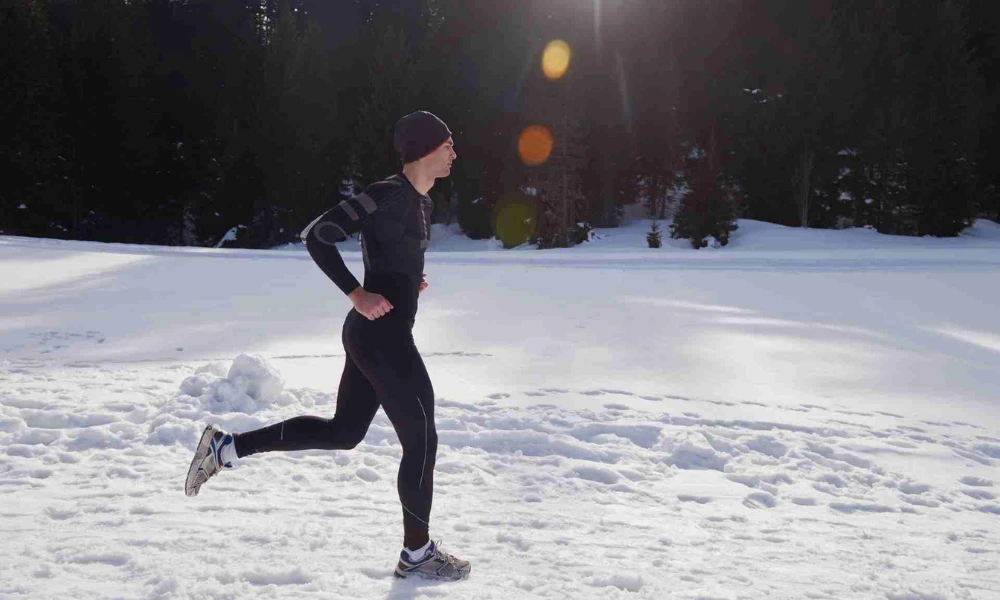
The three-layer system is the organising principle of cold-weather running clothing. Each layer has a specific function, and the combination works together:
Layer 1 — Moisture management (next to skin): This layer moves sweat away from the body to prevent chilling. The material must be synthetic (polyester, nylon) or merino wool — which wicks effectively while retaining warmth even when damp. Never use standard wool or cotton as a base layer; both absorb and retain moisture, causing rapid heat loss as sweat accumulates.
Layer 2 — Insulation (mid layer): Fleece or a lightweight insulating jacket traps warm air close to the body. This layer can be removed if you overheat. For temperatures above -5°C, many runners skip this layer and run in a heavier base layer with a windproof shell.
Layer 3 — Wind and weather protection (outer layer): A windproof, water-resistant running jacket blocks wind chill and precipitation without completely sealing moisture inside. Look for jackets with underarm ventilation panels or mesh lining — full waterproofing traps sweat in ways that increase chilling for sustained running efforts.
Temperature layering guide:
| Temperature | Suggested clothing |
|---|---|
| 0°C to 5°C | Long-sleeve base layer, running tights, light gloves |
| -5°C to 0°C | Base layer + fleece or insulating mid layer, tights, gloves, headband |
| -10°C to -5°C | Base + mid layer + windproof jacket, thermal tights, fleece gloves, hat |
| Below -15°C | Full three-layer system, balaclava or buff, thermal gloves, consider treadmill |
A useful rule: you should feel slightly cool at the start of a run. If you feel warm standing still before beginning, you’re overdressed and will overheat within 10 minutes.
For specific cold-weather running jacket and gear recommendations, see the Gear We Recommend hub.
2. Protect Your Head, Hands, and Neck — First
Heat loss is highest at the extremities in cold conditions. Three areas require attention before anything else:
Hands: Fingers lose heat rapidly because peripheral blood flow reduces when the body prioritises core temperature. Running gloves rated for the temperature are essential below 5°C. For below -10°C, consider thin glove liners under outer mittens — the combination is significantly warmer than gloves alone.
Head: A significant proportion of heat is lost through the head, particularly through the scalp and ears. A running hat or headband that covers the ears is the most effective single addition to cold-weather comfort. Balaclavas provide full face and neck coverage for extreme cold.
Neck: The buff or neck gaiter serves two purposes: it covers a significant skin surface area and — critically — can be pulled up over the nose and mouth in very cold conditions to warm and humidify inhaled air. This is particularly important for runners with exercise-induced bronchoconstriction, where cold, dry air is a primary trigger.
3. Breathing in Cold Air: The Facts
Cold air does not damage lung tissue in healthy runners. The airways warm inhaled air significantly before it reaches the delicate alveoli — this is the respiratory system working as designed. What cold air can cause:
- Throat and airway irritation: Dry, cold air can cause a raw, irritated feeling in the throat during and after a run. Breathing through a buff or neck gaiter pre-warms and humidifies incoming air and substantially reduces this effect.
- Bronchospasm in susceptible runners: Runners with exercise-induced bronchoconstriction (a form of exercise-triggered asthma) are more sensitive to cold, dry air. If you experience significant coughing, wheezing, or shortness of breath disproportionate to your effort, discuss cold-weather management with your GP before running below -5°C.
Nasal breathing vs mouth breathing: Nasal breathing warms and filters air more effectively than mouth breathing. For easy and moderate effort in cold conditions, nasal breathing is preferable. At higher intensities where nasal breathing can’t supply adequate airflow, combined or mouth breathing is appropriate — but pulling a buff over the nose and mouth maintains some warming effect even for mouth breathers.
For detailed breathing technique guidance, see our breathing while running guide.
4. Extend Your Winter Warm-Up
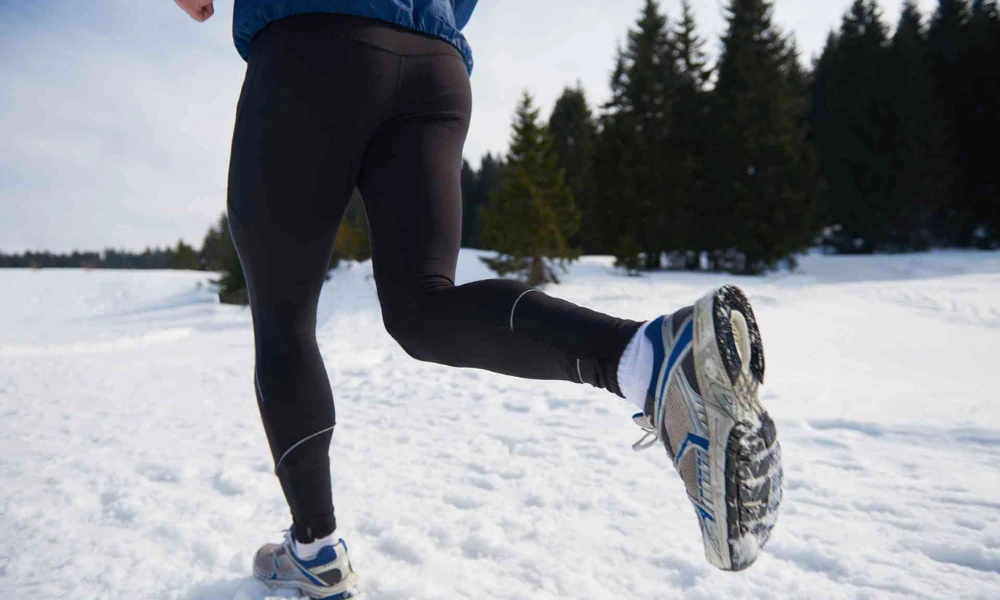
Cold muscles and connective tissue are less elastic than warm ones. The injury risk from starting a run without a proper warm-up is meaningfully higher in winter than in summer.
The winter warm-up protocol:
Indoors (if possible, 5–10 minutes): Before leaving the house, complete dynamic movements that raise core temperature and activate key muscle groups: leg swings, walking lunges, hip circles, high knees, and glute bridges. The goal is to arrive at the door with an elevated heart rate and warm muscles, not to start cold.
Outdoors first 5–10 minutes: Begin at a genuinely easy jog — slower than your usual easy pace. Let the cardiovascular system ramp up gradually. Don’t attempt any quality running (tempo, intervals) in the first 10–15 minutes in cold conditions.
For a complete dynamic warm-up sequence, see our pre-run warm-up guide.
5. Running on Ice and Snow: Gait Adjustments
Icy and snowy surfaces are the most significant winter running hazard — and most winter running injuries occur not from the cold but from falls.
Gait adjustments for slippery surfaces:
- Shorten your stride: A shorter stride keeps your foot contact closer under your centre of gravity, reducing the leverage that causes falls
- Lower your cadence slightly and increase ground contact: Allowing slightly longer contact time gives better grip assessment before committing weight
- Run flat-footed: Avoid heel-striking aggressively on ice — the heel has the least traction. A midfoot or flat landing distributes load across more surface
- Tighten your core and keep your arms low and wide: A wider arm swing provides lateral balance; a tight core stabilises the trunk if a foot slips
- Slow down: Ice adds 30–60 seconds per kilometre to a comfortable pace. Don’t fight it — accept the pace and protect the training stimulus
Traction options:
Ice traction cleats/microspikes: Metal coil or carbide spike attachments that fit over the outsole of your existing running shoes. Highly effective on compacted ice; less useful on loose snow. Most attach and remove in under 30 seconds.
Trail running shoes with deep lugs: Significantly better grip on packed snow and soft terrain than road running shoes. Not a substitute for ice cleats on hard ice.
Avoid: Running at your usual pace on any icy surface without traction — the injury risk is not worth the training benefit.
6. Visibility and Safety in Winter Darkness
Winter means shorter daylight hours. Many runners, particularly those training before work or after work in northern latitudes, spend most of their winter running in darkness or low light.
Essential visibility gear:
- Reflective running clothing or vest: Visible from vehicle headlights at 150+ metres. Most technical running jackets have some reflective elements; supplementing with a reflective vest ensures 360-degree visibility
- Headlamp or chest-mounted running light: Illuminates the path ahead and warns oncoming vehicles and cyclists. LED running headlamps weigh under 80g and clip to a hat or strap comfortably
- Tail light (clip-on): A small LED clip light on the back of your jacket or pack creates an additional rear visibility signal for road running
Route selection in winter: Choose well-lit routes where possible. Avoid poorly maintained pedestrian paths in winter darkness where ice patches are invisible. If running on roads, run facing oncoming traffic.
7. Temperature Guidelines: When to Modify and When to Stay Indoors
The practical temperature framework for healthy runners:
| Temperature | Running approach |
|---|---|
| 0°C to -10°C | Full winter running with appropriate clothing and traction |
| -10°C to -20°C | Reduce session duration; cover the face; monitor for frostbite signs on exposed skin |
| Below -20°C | Consider treadmill; if running outdoors, limit to 20–30 minutes and fully cover all skin |
| Below -25°C | Treadmill strongly recommended |
Signs that you should stop and warm up regardless of planned session length:
- Shivering that doesn’t resolve within 10 minutes of running
- Numbness or white patches on the nose, cheeks, ears, or fingers (early frostbite)
- Difficulty maintaining coherent thought or coordination
- Sweat that has cooled and isn’t evaporating — a sign of overdressing leading to a wet base layer
The overdressing trap: The most common cold-weather running mistake is wearing too much. A runner who is warm at the start of a run will be sweating within five minutes — that moisture in the base layer then causes chilling as pace slows or conditions change. You should feel slightly cool at the start; you will warm up.
8. When Not to Run Outdoors in Winter
Postpone or take to the treadmill when:
- You have a respiratory infection (cold, flu, bronchitis): cold air amplifies airway inflammation and extends recovery time
- You have untreated exercise-induced asthma that cold air triggers
- Temperatures are below -20°C, wind chill pushing feels-like to -25°C or below
- Ice is widespread, and you don’t have traction cleats
- Freezing rain or sleet — the most dangerous surface condition, creating a layer of liquid ice without visible indication
On exercising with mild illness: If symptoms are above the neck (runny nose, mild sore throat, no fever), easy running is generally tolerated. If symptoms include fever, body aches, chest congestion, or significant fatigue, rest is the correct choice. Running hard through a fever is not toughness — it delays recovery.
9. Hydration in Winter
Runners frequently underestimate winter hydration needs. Cold air is dry air; breathing rapidly in cold conditions causes significant respiratory fluid loss. You may not feel as thirsty as in summer, but fluid requirements for sustained winter running are comparable to warm-weather running at equivalent intensity.
Practical winter hydration:
- Drink before heading out — arriving at the cold already mildly dehydrated accelerates the problem
- Carry a flask or insulated bottle if running over 60 minutes — water in a standard bottle begins freezing at sustained temperatures below -5°C
- Post-run rehydration is as important in winter as in summer — the absence of obvious sweat doesn’t mean fluid wasn’t lost
For full hydration guidance, including sweat rate calculation, see our running hydration guide.
10. Adjust Your Pace Expectations
Winter running pace is slower than summer pace — this is normal, expected, and not a sign of fitness loss.
Why winter running is slower:
- Additional clothing weight and restriction limits stride length and arm drive
- Cold muscles produce less power until the warm-up period is complete
- Careful footing on slippery surfaces reduces pace naturally
- Cold air increases the work of breathing slightly, raising perceived effort at an equivalent pace
Expect 5–20 seconds per kilometre slower than your equivalent summer easy pace, depending on conditions. Don’t fight this. Run by effort (heart rate or perceived exertion) rather than pace in winter, and let the GPS numbers reflect the conditions honestly.
If you’re following a structured training plan through winter, adjust your pace-based targets by effort rather than trying to hit identical split times.