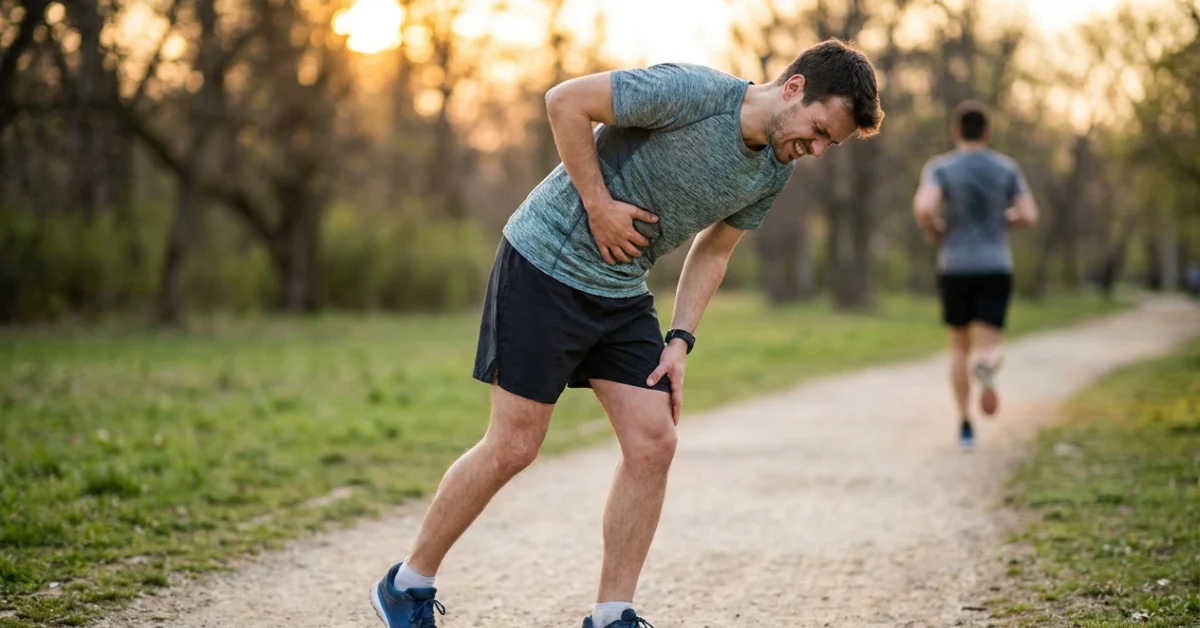

The treadmill is one of the best starting environments for beginner runners: controlled pace (preventing going out too fast), cushioned surface (reducing joint impact), no weather dependency, and a reliable stopping option within arm’s reach. If you’ve never run consistently before, starting on a treadmill removes several variables that make outdoor beginners give up in the first two weeks — specifically, uneven terrain, self-consciousness about pace, and weather excuses. Sessions of 20–30 minutes, three to four times per week, are enough to produce real aerobic fitness improvement. You do not need 40+ minutes to benefit.
Use our Pace Calculator to convert km/h speeds to min/km paces and find appropriate training zones. Our training plan hub integrates treadmill sessions into structured beginner progressions.
- Treadmill vs Outdoor Running: Key Differences
- What to Wear and Bring
- How to Start the Treadmill and Step On Safely
- Beginner Treadmill Workout: Walk-Run Protocol
- Running Technique on a Treadmill
- Treadmill Incline Settings
- Treadmill Workout Types
- Heart Rate Training on the Treadmill
- Calories Burned on a Treadmill
Treadmill vs Outdoor Running: Key Differences
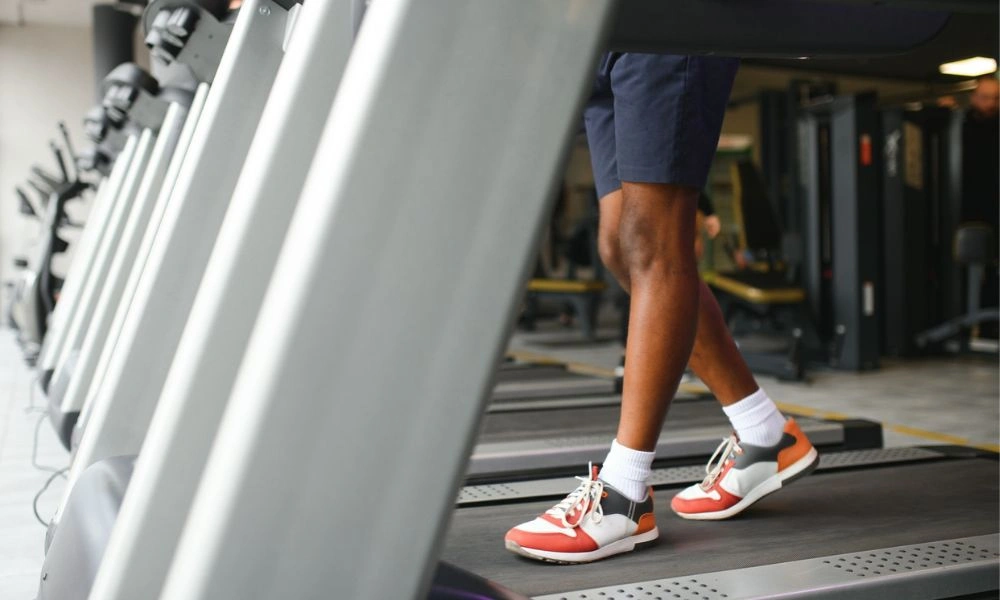
Before starting, understanding how treadmill running differs from outdoor running helps set the right expectations:
The belt does some of the work. On a treadmill, the belt moves under you, and you don’t need to propel yourself forward the same way you do outdoors. This makes treadmill running approximately 2–3% less demanding cardiovascularly than outdoor running at the same speed.
The standard fix: Set the treadmill to a 1% incline. Research (Jones & Doust, 1996) found that a 1% gradient on a treadmill produces energy expenditure equivalent to running on a flat outdoor surface at the same pace. Most experienced runners use 1% as the default for easy runs on the treadmill.
Biomechanics differ slightly. Treadmill running produces a slightly shorter stride and less hip extension at equivalent speeds. This is generally not a concern for beginners; the difference becomes relevant for competitive runners training specifically for outdoor races.
Perceived effort is often lower on a treadmill because there is no air resistance, no surface variation, and the environment is controlled. Some runners find this leads to underestimating their fitness relative to outdoor running.
Treadmill advantages for beginners:
- Controlled pace prevents starting too fast (the most common beginner error)
- Cushioned belt reduces impact forces on joints
- An emergency stop within reach provides psychological safety
- No weather dependency
- Heart rate monitors, calorie counters, and pace displays all in one place
What to Wear and Bring
Shoes: Proper running shoes appropriate for your foot type, not casual trainers, cross-trainers, or fashion shoes. Treadmill belts are cushioned, but shoes still matter for biomechanics. See our shoe selection guide for foot type and gait guidance. For current recommendations, see our Gear hub.
Clothing: Moisture-wicking technical fabric (synthetic or merino wool). Avoid cotton, as it retains sweat and causes discomfort. On a treadmill with no breeze, you’ll feel warmer than at equivalent outdoor effort.
Water: Keep a bottle on the treadmill console. Even in climate-controlled gyms, you’ll sweat. Drink small amounts throughout rather than waiting until thirsty.
Safety key: Every treadmill has a magnetic emergency stop key that clips to your clothing. Attach it. If you fall or stumble, the belt stops immediately. Don’t use a treadmill without it.
How to Start the Treadmill and Step On Safely
- Straddle the belt on the side rails — do not stand on the belt while it’s off
- Attach the safety key to your clothing
- Set the belt to the lowest speed (typically 1–2 km/h) and start the machine
- When the belt is moving slowly, step onto it with one foot at a time
- Walk at the starting speed to confirm you’re stable and comfortable
- Increase speed gradually — 0.5 km/h increments, not large jumps
Never:
- Jump onto a moving belt from the side at speed
- Increase speed and incline simultaneously (raises coordination demand suddenly)
- Step off a moving treadmill — reduce speed to below 1 km/h first
- Remove the safety key during a session
Beginner Treadmill Workout: Walk-Run Protocol
For runners who haven’t run consistently in months, start with walk-run intervals rather than continuous running. This applies on a treadmill exactly as it does outdoors; the physiology is the same.
Starting speed guidelines:
- Walking pace: 5–6 km/h
- Easy jogging pace: 6.5–8 km/h (adjust to where you can hold a conversation)
- Moderate running pace: 8–10 km/h
8-week beginner walk-run progression:
| Week | Running | Walking | Total |
|---|---|---|---|
| 1–2 | 1 min at 7 km/h | 2 min at 5.5 km/h | 4–5 cycles (20–25 min) |
| 3 | 2 min run | 2 min walk | 4–5 cycles |
| 4 | 2 min run | 1 min walk | 5–6 cycles (recovery week) |
| 5 | 3 min run | 2 min walk | 4–5 cycles |
| 6 | 5 min run | 2 min walk | 3–4 cycles |
| 7 | 8 min run | 2 min walk | 3 cycles |
| 8 | 20–25 min continuous easy run | — | — |
20 minutes of walk-run intervals is a completely legitimate and effective beginner session. Starting at 20 minutes and building to 30–35 minutes over 6–8 weeks is the correct progression, not jumping straight to 40+ minute sessions.
Running Technique on a Treadmill
The technique cues for treadmill running are largely identical to outdoor running:
Foot placement: Land with the foot under your body’s centre of mass — not reaching out in front. Overstriding on a treadmill creates the same braking forces as outdoors.
Posture: Upright — slight natural forward lean from the ankles. Don’t lean backward or crouch forward.
Arms: Elbows at approximately 90 degrees, hands relaxed, arms driving back (not sideways or crossing the body’s midline).
Gaze: Look ahead — at the screen, a mirror, or a fixed point in front of you. Looking down at the belt creates neck tension and affects breathing.
Handrails: Use to steady yourself during speed changes or if you need to recover balance. Do not hold the handrails continuously during running — this disrupts natural arm drive, throws off running biomechanics, and significantly reduces calorie expenditure (your arms are bearing some of your body weight). The reason to avoid continuous handrail-holding is biomechanical quality, not spinal load.
Treadmill Incline Settings
The 1% rule: Set the treadmill to 1% incline for standard easy running. This compensates for the absence of wind resistance and air drag that exist outdoors, making the cardiovascular cost equivalent to flat outdoor running.
Progressive incline use:
- 0%: Appropriate for walk-run warm-ups or recovery sections
- 1–2%: Standard easy running — equivalent to flat outdoor conditions
- 3–5%: Moderate hill simulation — increases cardiovascular and muscular demand
- 6–10%: Significant hill training — used for power walks, hiking intervals, and targeted hill work
- Above 10%: Advanced hill training — reduces running speed significantly; appropriate only at slow paces
Higher inclines are not inherently dangerous — they require appropriate speed adjustment. Running at your standard easy pace at an 8% incline is genuinely hard and would cause rapid fatigue. The same 8% incline at a walking or slow jogging pace is manageable and beneficial. Adjust the speed down when the incline goes up.
Treadmill Workout Types
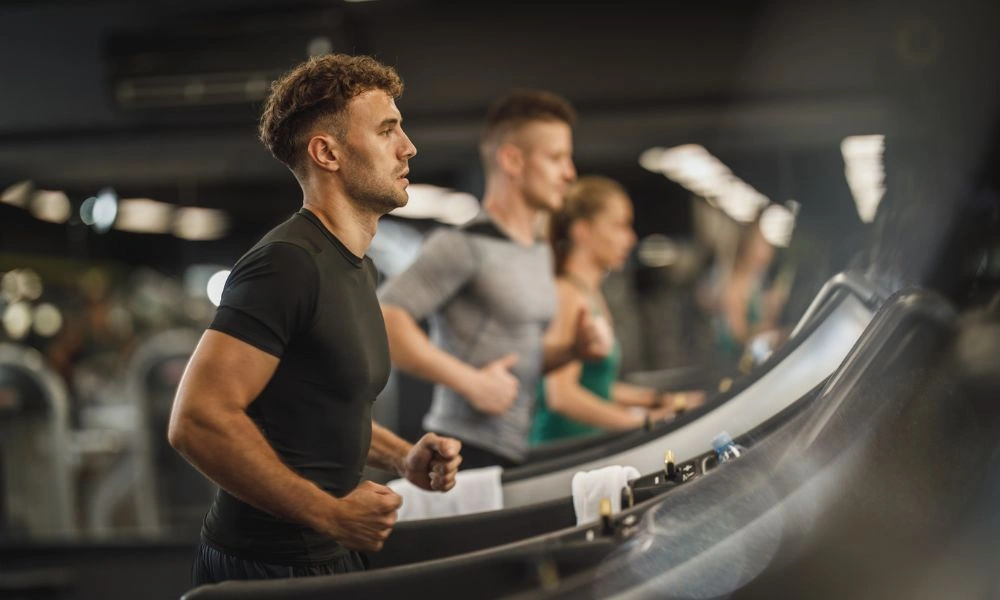
Plain Running (Beginner)
Belt parallel to the floor. The simplest form — build to 20–30 continuous minutes at an easy conversational pace over 6–8 weeks.
Walk-Run Intervals (Beginner–Intermediate)
Structured alternation of running and walking segments. The most appropriate starting format for most beginners. Builds aerobic base while managing fatigue and impact.
Incline Walking (All Levels)
Moderate-to-high incline at slow walking pace (4.5–5.5 km/h). Highly effective cardiovascular and lower-body workout with very low impact. Particularly useful for higher-weight beginners or runners recovering from lower-limb injuries.
Interval Running (Intermediate)
Alternating faster running segments (80–90% effort) with recovery walking or slow jogging. Same physiological benefits as outdoor intervals — improving VO2 max and running economy. See our interval training guide for specific protocols.
Tempo Running (Intermediate)
Sustained 20–25 minutes at threshold pace (comfortably hard — RPE 7–8). Easy to maintain a consistent tempo pace on a treadmill versus outdoors, where terrain varies.
Long Slow Run (Any Level)
Easy conversational pace for 45–90 minutes. Treadmill long runs at home are practical; gym treadmill limits may cap sessions at 30–60 minutes.
Heart Rate Training on the Treadmill
Treadmill heart rate monitors (grip sensors or chest strap) give real-time feedback that makes effort-based training practical without a GPS watch.
Estimating your maximum heart rate: Use 220 minus your age as a starting estimate (standard deviation ±10–12 bpm — actual maximum may be significantly higher or lower). For more accuracy, use the field test described in our heart rate while running guide.
Zone guidelines:
- Fat burning / aerobic development (Zone 2): 60–70% of max HR
- Cardiovascular development (Zone 3): 70–80% of max HR
- Threshold training (Zone 4): 80–90% of max HR
For beginners: Keep sessions in Zone 2 (60–70% of max HR) for the first 6–8 weeks. At this intensity, you should be able to speak in full sentences. If you can’t, slow the belt even if the speed feels embarrassingly easy.
Calories Burned on a Treadmill
Calorie burn on a treadmill depends primarily on your body weight and running speed. The approximate formula: 1 kcal per kilogram of body weight per kilometre.
A 70 kg runner at 7 km/h burns approximately 70 kcal per km or roughly 245–280 kcal in a 30-minute session at this pace. Increasing speed or incline increases calorie expenditure; decreasing them reduces it.
The treadmill’s built-in calorie counter is approximate; it becomes more accurate when you enter your weight, age, and gender into the machine’s settings, and more accurate still when connected to a heart rate sensor.
For detailed calorie calculations by weight and pace, see our calories burned running guide.
On weight loss expectations: A 30-minute easy treadmill session burns 200–350 kcal for most beginners. Combined with dietary awareness, consistent treadmill running produces meaningful but gradual weight loss, typically 0.1–0.3 kg per week. Losing 5–7 kg in 4 weeks from treadmill running alone is not realistic and sets expectations that lead to discouragement.