
Running is a full-body movement that engages more than 200 muscles simultaneously, but the primary movers are the glutes, quadriceps, hamstrings, calves, hip flexors, tibialis anterior, and core. The upper body muscles (shoulders, arms, upper back) play a supporting role.
Understanding which muscles do what during each phase of your stride helps you train the right muscles, stretch the right muscles, and understand why specific injuries occur in specific locations. Most recreational runners are weakest in the glutes and gluteus medius, the muscles most directly responsible for knee and hip injury prevention.
Use our running calculator to find training paces that develop each muscle group appropriately. Our training plans integrate the targeted strength work that addresses the most common muscle weaknesses in runners.
The Running Gait Cycle: When Each Muscle Works
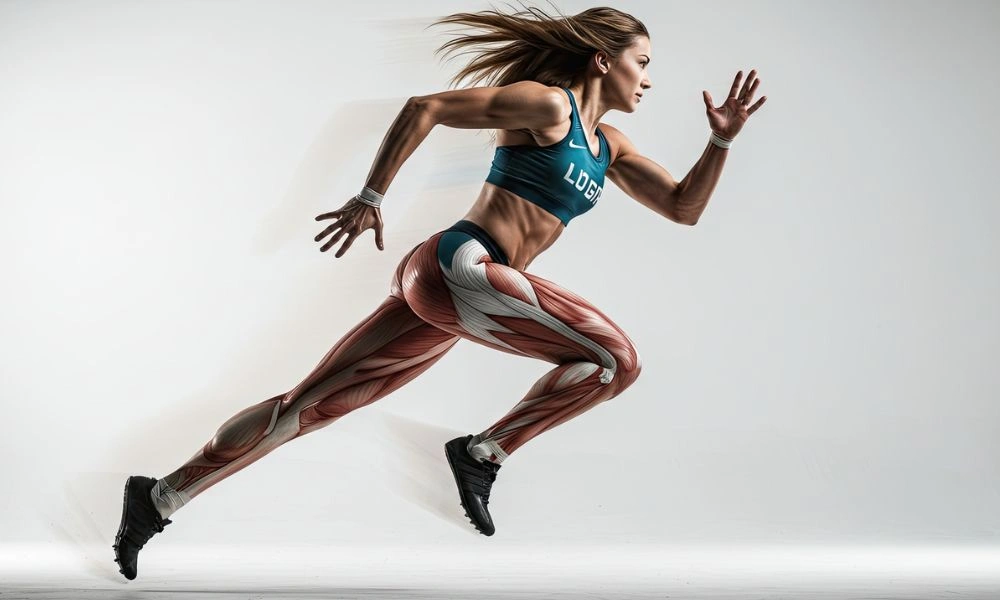
Each running stride has two phases: stance (foot on the ground) and swing (foot in the air). Different muscles are the primary movers in each phase.
Stance phase (~40% of the gait cycle):
- Initial contact/heel strike: Tibialis anterior (controls the foot lowering to the ground); quadriceps (eccentric loading to prevent knee buckling)
- Loading response: Gluteus medius (prevents hip drop on the unsupported side); gluteus maximus (begins generating propulsive force)
- Midstance: Core muscles (stabilise the trunk); hip abductors (lateral stability)
- Push-off / propulsion: Calf complex — gastrocnemius and soleus (primary ankle plantarflexors); gluteus maximus (hip extension force)
Swing phase (~60% of the gait cycle):
- Early swing: Hip flexors (bring leg forward after push-off); hamstrings (begin decelerating leg extension)
- Mid swing: Hamstrings (eccentric control of the swinging leg); tibialis anterior (holds the foot up during the swing)
- Terminal swing: Hamstrings (peak eccentric load as leg swings forward before contact); gluteus maximus (begins preparing for landing)
The practical implication: running is not just “legs.” It’s a coordinated sequence where each muscle must perform its specific task at the correct moment. When one muscle is weak, adjacent muscles compensate, which is the underlying mechanism of most overuse running injuries.
Primary Running Muscles
1. Glutes (Gluteus Maximus, Medius, and Minimus)
What they do: The gluteus maximus is the primary driver of hip extension — the push-off phase that propels the body forward. The gluteus medius (the side of the hip) controls pelvic stability during single-leg stance it prevents the hip from dropping on the unsupported side with every stride. The gluteus minimus assists the gluteus medius function.
Why they matter: Weak glutes are the most common finding in recreational runners who present with knee pain, IT band syndrome, and lower back pain. When the glute medius can’t maintain pelvic level, the hip drops and the knee caves inward, loading the patellofemoral joint and IT band in ways that cause pain over time.
To strengthen: Hip thrusts, single-leg deadlifts, clamshells (for medius), hip hikes, step-ups, glute bridges.
To stretch: Seated piriformis stretch, figure-four stretch (for deep glute).
For the connection between glute weakness and knee injury, see our runner’s knee guide.
2. Quadriceps (Four Muscles at the Front of the Thigh)
What they do: The quadriceps extend the knee and control the loading phase; they decelerate the body as the foot contacts the ground, preventing the knee from buckling under impact. They also work eccentrically during downhill running, which explains the significant quad soreness runners experience after hilly races.
The four quad muscles: rectus femoris, vastus lateralis, vastus medialis (VMO), and vastus intermedius. The VMO (inner quad) is particularly important for controlling kneecap tracking; weakness here contributes to patellofemoral pain syndrome (runner’s knee).
To strengthen: Squats, walking lunges, step-ups, terminal knee extensions (specifically targets VMO), leg press.
To stretch: Standing quad stretch, couch stretch (rectus femoris specifically).
3. Hamstrings (Three Muscles at the Back of the Thigh)
What they do: The hamstrings flex the knee and assist hip extension, but their most critical running function is eccentric control, decelerating the swinging leg as it reaches forward before foot strike. At higher speeds and during sprinting, hamstring demand increases dramatically, which is why hamstring strains are common at faster paces.
Why they’re commonly tight in runners: Most runners (and desk workers) have chronically shortened hamstrings from sustained hip flexion. Tight hamstrings reduce stride length, increase lumbar loading, and are a risk factor for hamstring strain.
To strengthen: Romanian deadlifts, Nordic hamstring curls (one of the most effective hamstring injury-prevention exercises in research), good mornings, Bulgarian split squats.
To stretch: Standing single-leg hamstring stretch, supine hamstring stretch hold 20–30 seconds each side, post-run.
4. Hip Flexors (Iliopsoas and Rectus Femoris)
What they do: The hip flexors bring the leg forward during the swing phase. They’re active in every stride, and at higher intensities, sprinting, hill running, they drive explosive knee lift.
Why they’re commonly tight: Most adults spend 7–9+ hours per day sitting, which keeps the hip flexors in a shortened position. Chronically tight hip flexors cause anterior pelvic tilt, which increases lumbar stress and reduces the effectiveness of the gluteus maximus during push-off.
To strengthen: High knee marching, resistance band hip flexion, step-ups with knee drive.
To stretch: Low lunge (kneeling hip flexor stretch) 60–90 seconds each side, twice daily. This is one of the most important regular stretches for any runner.
5. Calf Muscles (Gastrocnemius and Soleus)
What they do: The calf complex is the primary driver of push-off. At every footstrike, the Achilles tendon stores elastic energy, and the calf muscles contract to release it as propulsive force. The gastrocnemius (the visible two-headed calf muscle) works most when the knee is straight; the soleus (beneath the gastrocnemius) is the primary mover during the later push-off phase with the knee slightly bent, and is the muscle most implicated in Achilles tendinopathy.
Why they matter: The Achilles tendon manages 7–9× body weight of force during running push-off. Inadequate calf strength, particularly soleus strength, is the primary structural driver of Achilles tendinopathy, the most common tendon overuse injury in distance runners.
To strengthen: Calf raises on a step (straight knee for gastrocnemius; bent knee for soleus). Single-leg progression is essential most runners are significantly weaker on their non-dominant side.
To stretch: Gastrocnemius stretch (straight knee, against wall); soleus stretch (bent knee, against wall). Both should be held 30–60 seconds.
For the connection between calf strength and Achilles injury, see our ankle pain when running guide.
6. Tibialis Anterior (Front of the Shin)
What it does: The tibialis anterior runs along the front of the shin and controls dorsiflexion, lifting the foot. It works eccentrically at initial contact (lowering the foot to the ground in a controlled manner) and isometrically during the swing phase (keeping the foot from dragging).
Why it matters: New runners frequently develop shin splints from tibialis anterior overload the muscle isn’t conditioned for the repetitive dorsiflexion demand of running. Unlike the calf, which many runners train, the tibialis anterior is rarely specifically strengthened.
To strengthen: Toe raises (standing, heel on floor, lift toes); resistance band dorsiflexion; walking on heels.
To stretch: Kneeling shin stretch (toes pointed behind you, sit back gently).
7. Core Muscles
What they do: The core stabilises the spine and pelvis through the entire gait cycle, absorbs ground reaction forces that would otherwise travel directly up the spine, and maintains upright posture as fatigue accumulates in long runs.
The running-relevant core is primarily the deep core transverse abdominis, multifidus, and pelvic floor rather than the superficial six-pack muscles. Exercises that train global movement stability are more valuable than crunches.
To strengthen:
- Dead bugs (deep core, anti-rotation)
- Bird-dogs (deep core, lumbar stabilisation)
- Pallof press (anti-rotation core — more running-specific than Russian twists, which load the lumbar spine in rotation)
- Side planks (hip abductor and lateral core — address the hip-drop pattern)
- Front planks
To stretch: Prone cobra (thoracic extension); cat-cow (lumbar mobility).
8. Upper Body Muscles
What they do: The upper body provides counterbalance and rhythm. Arms drive the opposite leg faster, arm drive produces faster leg turnover, and a slower arm drive breaks the running rhythm. The upper back (particularly the mid and lower trapezius) holds the shoulders down and back, maintaining posture through the run.
Muscles involved: Deltoids (shoulder rotation), biceps and triceps (arm swing), pectorals (stability), upper back (mid and lower trapezius, rhomboids).
Common failure pattern: As upper body fatigue accumulates, shoulders elevate toward the ears (upper trapezius tightens), the chest closes, and breathing becomes restricted. This pattern increases perceived effort even when the legs are still capable.
To strengthen: Bent-over rows (mid-back), face pulls or band pull-aparts (rear deltoid and mid-trapezius), push-ups (chest and shoulder stability).
Which Muscles Are Most Commonly Weak in Recreational Runners?
Understanding where recreational runners are typically deficient helps prioritise strength training correctly.
Rank 1 — Gluteus medius: Almost universally weak in recreational runners who don’t do dedicated strength work. Responsible for lateral hip stability and is directly linked to runner’s knee, IT band syndrome, and lower back pain. The single most important muscle to specifically target.
Rank 2 — Soleus: The deep calf muscle is rarely trained but is under enormous load in running push-off. Soleus weakness is the primary driver of Achilles tendinopathy.
Rank 3 — Tibialis anterior: Undertrained and underappreciated. Overloading it in the early weeks of running is the most common cause of shin splints.
Rank 4 — VMO (vastus medialis oblique): The inner quad muscle that controls kneecap tracking. Weakness contributes to patellofemoral pain syndrome in runners.
Muscles Worked by Running Type
| Type of running | Primary muscle emphasis |
|---|---|
| Easy flat running | Glutes, calves, hip flexors, core stabilisers |
| Uphill running | Glutes (maximus), quadriceps, hip flexors |
| Downhill running | Quadriceps (eccentric), tibialis anterior |
| Sprinting | Hamstrings (eccentric), hip flexors, calves, glutes |
| Long runs | All lower leg muscles with increasing endurance demand on the soleus and the tibialis anterior. |