
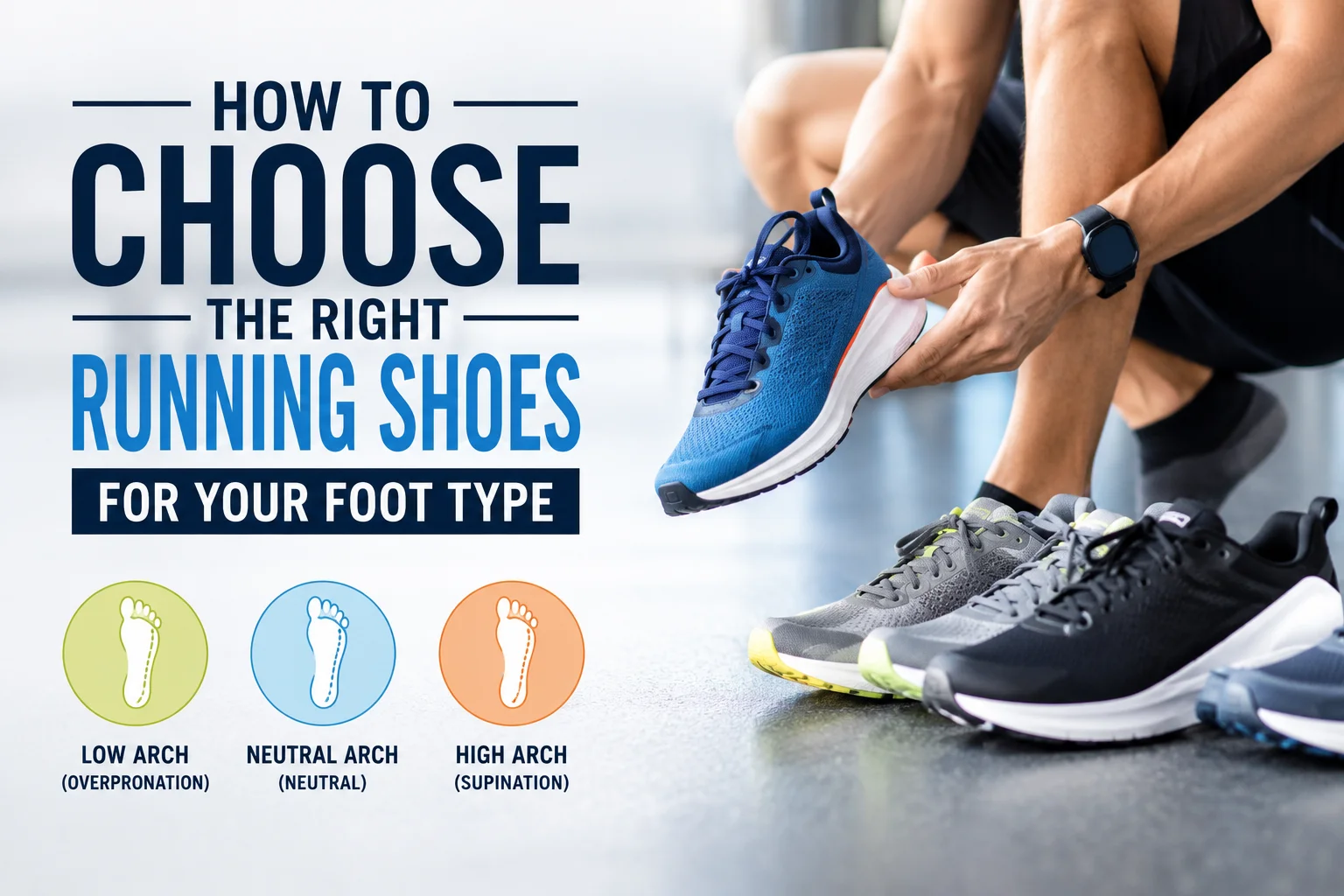
The core framework is simple: flat feet need stability or motion control shoes that limit inward roll; high arches need well-cushioned neutral shoes that absorb impact for a less flexible foot; and neutral arches have the most flexibility in shoe choice. Beyond arch type, three additional variables matter — your pronation pattern (how your foot rolls on landing), your running terrain (road, trail, or mixed), and your heel-to-toe drop preference (traditional or low-drop). Getting these right can be the difference between running comfortably for years and cycling through injuries. Getting them wrong is one of the most common causes of preventable running pain.
Use our Pace Calculator to track your training paces — the right shoe makes a measurable difference in how comfortably you can hold them. And if you’re building structured training toward a goal, see our training plan hub.
Step 1: Identify Your Arch Type
Your arch type determines how your foot distributes load with each stride, which is the primary factor in shoe selection.
The Wet Foot Test (At Home, Right Now)
The simplest self-assessment takes 30 seconds:
- Wet the bottom of your foot
- Step firmly onto a piece of dark paper, cardboard, or a paper bag
- Lift your foot and examine the imprint
What the imprint tells you:
Full imprint with minimal curve on the inner edge: Flat arch (low arch). The entire sole contacts the surface. Associated with overpronation.
Imprint showing a distinct curve on the inner edge, roughly half the foot width at the midfoot: Neutral arch (medium arch). The most common arch type.
Imprint showing a very thin connection at the midfoot, or the heel and forefoot appearing nearly disconnected: High arch. Associated with underpronation (supination).
Neutral Arch
A neutral arch means the foot strikes evenly and distributes load effectively across the foot’s natural contact points. Neutral-arch runners have the widest range of suitable shoe options and don’t typically need specialised support features. They can focus primarily on cushioning preference, weight, and terrain when choosing.
Flat Arch (Low Arch / Overpronation)
A flat arch means the foot’s arch collapses further inward with each stride — a motion called overpronation. The foot rolls excessively inward past the natural ankle midline, which over time transfers stress to the knee, hip, and lower back in misaligned ways.
Flat-arch runners typically do best with:
- Stability shoes: Dual-density foam or a medial post on the inner midsole that slows inward roll without eliminating natural motion
- Motion control shoes: More structured, firmer midsole construction for significant overpronation — typically heavier but appropriate for runners with severe pronation
For flat-arch runners, shoe selection is often linked to injury management. Overpronation-related injuries — medial knee pain, tibial stress, plantar fasciitis — frequently improve with appropriate footwear. Our ankle pain guide and knee pain guide cover the injuries associated with pronation patterns in detail.
High Arch (Underpronation / Supination)
A high arch means the foot doesn’t pronate enough — it remains more rigid through the gait cycle, failing to absorb impact through the natural inward roll that a neutral arch produces. Load is concentrated on the outer edge of the foot, the heel, and the ball of the foot.
High-arch runners typically do best with:
- Neutral cushioning shoes: Maximalist or well-cushioned neutral designs that add the shock absorption the rigid high-arch foot doesn’t generate internally
- Flexible construction: Shoes that allow some natural foot movement rather than adding structure that restricts the already-limited flexibility
High-arch runners are more prone to IT band syndrome, plantar fasciitis, and stress fractures in the outer foot from the concentration of impact loading.
Step 2: Understand Your Pronation Pattern
Arch type and pronation pattern are related but not identical. Pronation is the rotational movement of the foot — from initial heel contact through to toe-off — and is the dynamic version of what the arch test shows statically.
Neutral pronation: The foot rolls inward approximately 15 degrees through each stride — the natural shock-absorbing motion. Neutral-pronation runners can wear most shoe types.
Overpronation: Excessive inward roll beyond 15 degrees. More common in flat-arch runners. Requires stability or motion control features to guide the foot through a healthier motion path.
Underpronation (supination): The foot rolls outward rather than inward. More common in high-arch runners. Requires cushioning to compensate for reduced natural shock absorption.
How to check your pronation pattern:
- Wear patterns on old shoes: Overpronators show wear on the inner edge of the heel and forefoot. Supinators show wear concentrated on the outer edge of the heel and little toe area. Neutral runners show relatively even wear across the forefoot.
- Gait analysis: Most specialist running stores offer treadmill-based gait analysis using slow-motion video — free, takes five minutes, and provides the most accurate pronation assessment available without clinical tools.
Step 3: Know the Key Shoe Features
Cushioning
Cushioning absorbs impact with each foot strike. The appropriate level depends on your foot type, your body weight, and your running distance.
Maximalist cushioning: Large, soft midsole stack (often 35mm+ heel height). Excellent for long-distance running, heavier runners, and high-arch runners who need external shock absorption. HOKA-style shoes are the most recognisable maximalist category.
Standard cushioning: Moderate midsole stack. Suitable for most daily training across most foot types.
Minimal cushioning: Low stack, close to the ground. Appropriate for forefoot strikers with strong foot musculature. Not appropriate as a first shoe or for runners with flat arches who need support.
Support and Stability Features
Neutral shoes: No medial support features. Appropriate for neutral-pronation and supinating runners.
Stability shoes: A medial post (denser foam on the inner side of the midsole) that slows excessive inward roll without eliminating it. Appropriate for mild-to-moderate overpronators.
Motion control shoes: Rigid, structured construction that significantly limits medial collapse. Appropriate for significant overpronators — typically heavier, less flexible, but protective for the right runner.
Heel-to-Toe Drop (Offset)
This is one of the most misunderstood shoe variables and one of the most consequential, particularly for runners with a history of Achilles tendinopathy or those transitioning between shoe types.
Drop is the height difference in millimetres between the heel and the forefoot of the shoe.
| Drop category | Range | Running style implication |
|---|---|---|
| Traditional | 10–14mm | Heel-strike running; Achilles tendon shortened position |
| Moderate | 6–10mm | Common in daily trainers; most versatile |
| Low drop | 1–6mm | Encourages midfoot landing; more Achilles demand |
| Zero drop | 0mm | Forefoot/midfoot running; requires strong foot musculature |
Critical warning on transitioning drop: Moving from a traditional high-drop shoe to a low or zero-drop shoe significantly increases load on the Achilles tendon and calf complex. Runners who switch too quickly — wearing zero-drop shoes for full training immediately — are at high risk of Achilles tendinopathy. Transition gradually: reduce drop by 2–4mm at a time, over 6–12 weeks per step.
Carbon Plate and Super Shoes
Carbon fibre plate shoes — used in élite racing and increasingly by recreational runners — embed a rigid carbon plate in the midsole that returns energy with each stride, improving running economy by approximately 2–4% in research settings. They are race-day tools, not training shoes.
Who benefits: Runners racing at threshold effort or above for 5K through marathon. The energy return mechanism is most effective at faster paces where the plate can be loaded fully.
Who shouldn’t use them for daily training: Everyone. Carbon plate shoes have lower cushioning durability for training loads, cause faster fatigue when worn every session, and can create dependency on the plate’s energy return at the expense of developing natural foot and calf strength. One to two race-day pairs per year; daily training in conventional shoes.
Step 4: Match Shoe to Terrain
Road shoes: Smoother, lighter outsoles designed for consistent asphalt and concrete surfaces. Prioritise cushioning and weight over grip.
Trail shoes: Aggressive rubber lugs on the outsole for grip on dirt, mud, and rock. Typically, firmer construction than road shoes. Many include a rock plate to protect against sharp terrain puncturing the midsole.
Hybrid/cross-training shoes: Moderate lug depth suitable for mixed surfaces (grass, light trail, road). A practical choice for runners who don’t commit exclusively to one surface.
Running road shoes on technical trails is a genuine injury risk — smooth outsoles provide inadequate grip on wet rock or loose terrain. Running trail shoes on the road wears through the lugs rapidly and produces an unstable, uneven ride.
Step 5: Getting the Right Fit
Size: Running shoes should have approximately a thumb’s width of space between the longest toe and the end of the shoe. Feet swell by up to half a size during a long run — shoes that fit correctly in a shop will feel comfortable in kilometre 20.
Width: Many brands offer standard and wide-fit versions. A shoe that fits length correctly but pinches the toes laterally will cause blisters and black toenails on long runs.
Try shoes late in the day: Feet are at their largest in the afternoon and evening. Trying shoes when feet are at their smallest (morning) risks buying a shoe that fits at first and tightens uncomfortably after 8km.
Test the heel hold: The heel should feel secure without slipping. Heel slip causes blisters and Achilles friction. Test by walking fast — any movement of the heel in the shoe suggests a poor fit.
Step 6: When to Replace Running Shoes
The standard replacement guideline is 300–500 miles (480–800 km), but this varies significantly:
| Factor | Replacement end of range |
|---|---|
| Heavier runner (over 85kg) | Closer to 300 miles |
| Trail running (higher impact) | Closer to 300 miles |
| Road running, lighter runner | Up to 500 miles |
| Carbon plate race shoes | 150–300 miles (degraded plate response) |
The midsole foam compresses and loses resilience before the outsole shows visible wear. You cannot judge shoe life by the outsole alone. A shoe that looks intact on the bottom may have lost 40% of its cushioning — and a runner experiencing new aches despite no changes to training load should check their shoe mileage first.
Practical signals the shoe needs replacing:
- New or recurring soreness in the shins, knees, or hips without a change in training
- The shoe feels harder underfoot than when new
- The heel counter has collapsed or softened significantly
- Visible compression lines in the midsole foam
For specific shoe recommendations by foot type, terrain, and budget, see the Gear We Recommend hub.