
Let’s be honest. Most people buying a GPS running watch don’t need offline maps, a titanium bezel, or satellite messaging. They need something that tracks their runs accurately, tells them when they’re overdoing it, and doesn’t die halfway through a long run.
That’s exactly the space the Garmin Forerunner 55 and Coros Pace 3 both occupy. And right now, they’re the two best budget GPS running watches you can buy.
The Forerunner 55 sits at around $149. The Coros Pace 3 sits at $199. That $50 gap is real, and whether it’s worth it depends entirely on what kind of runner you are. Let’s work through it properly of Garmin Forerunner 55 vs Coros Pace 3.
Quick Comparison Table
| Feature | Garmin Forerunner 55 | Coros Pace 3 |
|---|---|---|
| Price | ~$149 | $199 |
| Display | 1.04″ Color MIP, 208×208 | 1.2″ Color MIP, 240×240 |
| Weight | 37g | 30g (nylon) |
| Battery (Smartwatch) | Up to 14 days | Up to 17 days |
| Battery (GPS) | Up to 20 hours | Up to 38 hours |
| Battery (All Systems GPS) | N/A | Up to 25 hours |
| Battery (UltraMax) | ❌ | Up to 60 hours |
| GPS | Single-band (GPS+GLONASS or Galileo) | Dual-frequency (5 systems) |
| Heart Rate | Optical wrist-based | 5-LED optical + SpO2 |
| Altimeter | ❌ | Barometric |
| Navigation | ❌ | Breadcrumb + turn-by-turn |
| Music | ❌ | ✅ MP3 storage |
| Touchscreen | ❌ | ✅ |
| Garmin Pay | ❌ | ❌ |
| Water Rating | 5 ATM | 5 ATM |
| Training Plans | ✅ Garmin Coach | ❌ |
| Charging | Proprietary USB-A | Proprietary magnetic |
| Released | June 2021 | September 2023 |
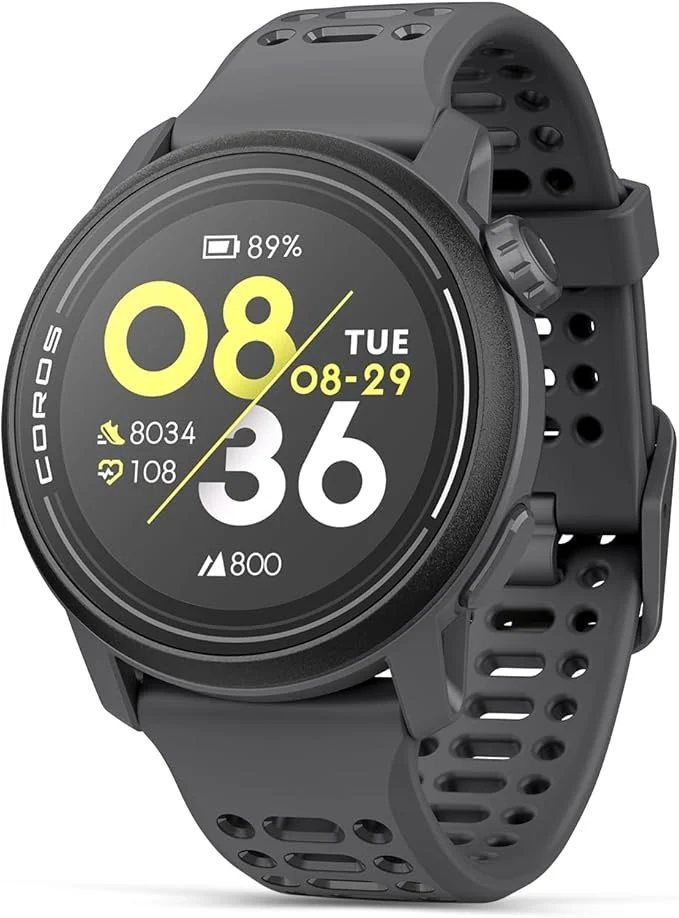
Coros Pace 3
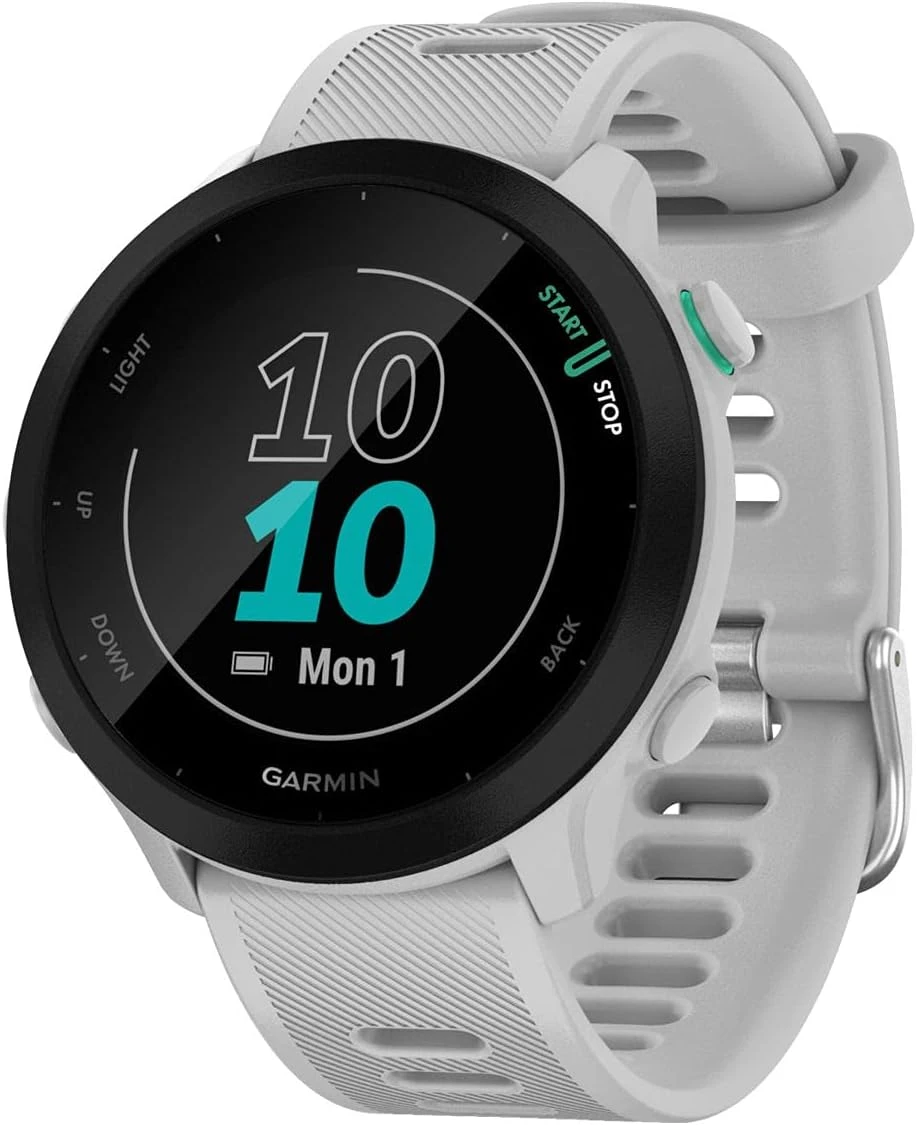
Garmin Forerunner 55
Price — Is $50 the Right Call?
At face value, $50 is $50. But here’s the thing: it’s worth understanding exactly what that $50 buys you before deciding.
The Garmin Forerunner 55 at ~$149 is older hardware but backed by one of the most trusted names in running watches. It’s been heavily discounted from its original $199.99 MSRP and now sits in genuinely excellent value territory.
The Coros Pace 3 at $199 launched two years later with meaningfully better hardware across almost every category, dual-frequency GPS, a barometric altimeter, breadcrumb navigation, MP3 music storage, a larger display, and lighter weight. You’re paying for real upgrades, not just a brand premium.
If budget is the absolute priority and you need something right now, the FR55 at $149 is a completely legitimate choice. If you can stretch $50 and plan to use this watch for 2–3 years, the Pace 3 is a better long-term investment. That extra $50 over two years works out to about $2 a month.
Related: Best GPS Running Watches / Best Affordable watches
Display — Bigger and Sharper on the Pace 3
Neither watch has an AMOLED display, both use color MIP panels, which is appropriate for this price bracket and actually works in their favor for sunlight readability and battery efficiency.
The Garmin Forerunner 55 has a 1.04-inch display at 208×208 resolution. It’s small, it’s functional, and by 2025 standards it looks noticeably dated — the resolution is low, and the pixel density makes text slightly fuzzy at small sizes. That said, it shows pace, heart rate, and distance clearly during a run, which is ultimately what matters.
The Coros Pace 3 steps up to a 1.2-inch display at 240×240 resolution with a touchscreen. The larger size makes data easier to read at a glance, mid-run. The touchscreen adds flexibility for menu navigation and data screen swiping, though it requires a firm touch and can be unreliable in cold or wet conditions, where the digital crown and back button are more reliable.
Winner: Coros Pace 3 — meaningfully larger and higher resolution, plus touchscreen functionality.
Design & Comfort
This one goes clearly to Coros, and the gap is bigger than you might expect.
The Coros Pace 3 weighs 30g with the nylon band. The Garmin Forerunner 55 weighs 37g. That 7g difference sounds trivial until you’re three hours into a long run and the watch has been pressing against your wrist bone for the last hour. Lightweight running watches genuinely disappear on your wrist — heavier ones occasionally remind you they’re there.
Both watches use plastic cases, appropriate for the price bracket. Both come with silicone straps as standard, though the Pace 3 also ships with a nylon band option. The Forerunner 55’s silicone strap is a bit grippy for some users during sweaty summer runs; many swap it for a thinner aftermarket option.
Five physical buttons on the Forerunner 55 vs digital crown + back button + touchscreen on the Pace 3. Both are easy to operate mid-run once you’re used to them. The Forerunner 55’s button-only layout has one distinct advantage: it’s completely reliable in rain, cold, and sweat, with no accidental screen touches ever.
Winner: Coros Pace 3 on weight. Garmin Forerunner 55 on bad-weather button reliability.
GPS Accuracy — A Clear Coros Advantage
This is the most significant performance difference between these two watches, and it’s worth understanding clearly.
The Garmin Forerunner 55 uses single-band GPS, paired with either GLONASS or Galileo. In open conditions roads, tracks, and parks, it performs excellently. Controlled testing recorded the FR55 within ±0.08 miles of a known 2.8-mile course, impressive for a budget watch. But in challenging environments, urban canyons between tall buildings, dense forest canopies, and mountain valleys, single-band GPS can show drift, lag, and occasional position jumps.
The Coros Pace 3 uses dual-frequency GPS with five satellite systems: GPS, GLONASS, Galileo, BeiDou, and QZSS. Multi-band GPS corrects for atmospheric signal interference that causes single-band drift, delivering more consistent accuracy meaningfully in exactly the environments where the FR55 struggles. In urban environments, tree-covered trails, and technical terrain, the difference is real and noticeable.
For a runner who does 95% of their miles on familiar open roads, the FR55’s GPS is completely adequate. For runners who explore city routes with tall buildings, train on wooded trails, or race in varied terrain, the Pace 3’s dual-frequency GPS is a genuine advantage worth the extra money.
Winner: Coros Pace 3 — dual-frequency GPS is a real-world improvement, not just a spec sheet number.
Heart Rate Accuracy
Both watches use optical wrist-based heart rate sensors, and both perform similarly for the core use case of monitoring effort during runs.
The Coros Pace 3’s 5-LED sensor with 4 photodetectors is one of the better budget optical HR sensors available. In controlled testing against a Polar H10 chest strap, it recorded within ±1.54 BPM on average, an impressive result that outperforms several more expensive watches. It also adds SpO2 blood oxygen monitoring for sleep and recovery insights.
The Garmin Forerunner 55’s optical sensor delivers solid results for steady-state running and general daily tracking. In comparable testing, it recorded within ±1.68 BPM, close to the Pace 3 but with a slightly wider variance. No SpO2 sensor.
Both watches support external ANT+ chest strap pairing for athletes who want maximum HR precision during interval training.
Winner: Coros Pace 3 — marginally better accuracy and adds SpO2.
Battery Life — Coros Wins Comprehensively
This might be the single most important spec difference between these two watches for runners who train hard and often.
| Mode | Garmin Forerunner 55 | Coros Pace 3 |
|---|---|---|
| Smartwatch | 14 days | 17 days |
| GPS Standard | 20 hours | 38 hours |
| All Systems GPS | N/A | 25 hours |
| UltraMax | ❌ | 60 hours |
The FR55 manages 20 hours of GPS battery. That’s enough for most marathon runners; a 4-hour marathon uses 20% of the GPS battery with room to spare. But for anyone doing back-to-back long runs on weekends, multiday running events, or ultramarathon distances, 20 hours gets tight quickly.
The Coros Pace 3’s 38 hours in standard GPS mode means virtually no runner will hit the ceiling during a single event. And the UltraMax mode at 60 hours covers even 100-mile ultramarathon finishers without needing a charge.
In smartwatch mode, the gap is real but less dramatic, 17 vs 14 days. Both require roughly weekly charging with daily activity tracking.
Winner: Coros Pace 3 — decisively. Nearly double the GPS battery life is a genuine competitive advantage.
Training Features — Garmin’s Coaching Tools vs Coros’s Data Depth
This is where things get interesting, because each watch wins on different aspects.
Garmin Forerunner 55 Strengths
- Garmin Coach: Free built-in adaptive training plans for 5K, 10K, and half-marathon from expert coaches. The plans adjust week by week based on your recent runs and recovery. For beginner and intermediate runners following a structured plan for the first time, this is genuinely valuable; you don’t need a separate app or subscription
- Daily Suggested Workouts: Garmin’s algorithm recommends a personalized workout each day based on your training history and recovery. Easy run? Tempo? Rest? It makes the call and adapts over time
- PacePro: Grade-adjusted pacing guidance for race day, tells you exactly what pace to run on each hill and flat section of a target course
- Body Battery: Garmin’s energy monitoring score based on HRV, sleep, stress, and activity. A practical daily metric for deciding when to push and when to hold back
- Incident Detection: Detects accidents mid-run and automatically sends your location to emergency contacts. A safety feature rarely found at $149
Coros Pace 3 Strengths
- Breadcrumb Navigation: Follow uploaded GPX routes with turn-by-turn deviation alerts — the Forerunner 55 has nothing equivalent
- Barometric Altimeter: Accurate real-time elevation data from a dedicated sensor — far more reliable than GPS-based elevation on the FR55, particularly on hilly routes
- MP3 Music Storage: Load tracks to the watch and run phone-free with Bluetooth headphones — not available at all on the FR55
- Training Load Trend: Tracks cumulative training stress across sessions — shows whether you’re building fitness or approaching overtraining
- Recovery Timer: Post-workout recommendation for how long to recover before the next hard effort
- UltraMax GPS: For ultramarathon athletes, 60 hours of GPS tracking is a feature in a class of its own at $199
- Strava Live Segments: Compete against PRs and other athletes on Strava segments in real time
Ready to Start Training?
Training plans are designed and reviewed by Ilya Tyapkin, Rio 2016 Olympian. Find the plan that matches your goal:
The Honest Summary
Garmin wins on coaching and guidance. If you want a watch that tells you what to do and when to do it, the Forerunner 55’s Garmin Coach and Daily Suggested Workouts are more accessible and beginner-friendly than anything Coros offers at this price.
Coros wins on data and hardware, dual-frequency GPS, a barometric altimeter, breadcrumb navigation, and an UltraMax battery represent more capable raw tools for athletes who know what they want to track.
Winner: Split — Garmin for beginners who want coached guidance. Coros for data-driven runners who know how to use the metrics.
Who Should Buy the Garmin Forerunner 55?
The FR55 is the right choice if:
- You’re a complete beginner who wants a watch that tells you what to do — Garmin Coach is one of the most beginner-friendly structured training tools available at any price
- Budget is the priority — $149 is the lowest price for a capable Garmin GPS watch
- You run almost exclusively on open roads and tracks where single-band GPS is fully adequate
- You want Garmin’s ecosystem — Body Battery, PacePro, and the broader Garmin Connect platform are genuinely useful and familiar to most runners
- You want Incident Detection — a safety feature that matters and is rare at this price point
- You’re buying a gift for a new runner who needs something simple, proven, and reliable
Who Should Buy the Coros Pace 3?
The Pace 3 is the right choice if:
- You want dual-frequency GPS for more consistent accuracy across all terrain types
- Battery life matters — 38 hours, GPS is nearly double the FR55’s 20 hours
- You run on trails, hilly routes, or in cities where GPS accuracy and elevation data make a real difference
- Breadcrumb navigation is useful — following uploaded routes in unfamiliar cities or on new trails
- You want music without your phone — MP3 storage is a meaningful quality-of-life feature on long runs
- You’re training for or racing ultramarathons — UltraMax GPS at 60 hours is unmatched at this price
- You’re a data-driven runner who wants training load, recovery timer, and race predictor without paying $300+
Final Verdict
If this were a hardware spec competition, the Coros Pace 3 would win comfortably. Dual-frequency GPS, barometric altimeter, navigation, music storage, better battery, lighter weight, larger display, it’s a more capable watch by almost every objective measure.
But running watches aren’t just about hardware. They’re about whether the watch actually helps you run better. And for a beginner runner who needs structured guidance, Garmin Coach and Daily Suggested Workouts on the FR55 deliver something the Pace 3 simply doesn’t have at this price, a coach in your pocket who tells you what to do each day and adapts as you improve.
Here’s the cleanest way to think about it:
Buy the Garmin Forerunner 55 if you’re new to structured running, want Garmin’s coaching tools, and $149 is the right number.
Buy the Coros Pace 3 if you know what metrics matter to you, want better GPS and battery, and the $50 premium is within reach.
Either way, you’re buying one of the best budget running watches available. You genuinely can’t go wrong.
This comparison is based on aggregated expert testing data, technical specifications, and real user feedback compiled from across the running community. We bring together the most accurate and up-to-date information so you can make a confident buying decision.
Frequently Asked Questions
Is the Garmin Forerunner 55 or Coros Pace 3 better for beginners?
The Forerunner 55 is more beginner-friendly thanks to Garmin Coach, free built-in adaptive training plans for 5K, 10K, and half-marathon. The Coros Pace 3 has deeper data tools but requires more self-direction. If you want a watch that tells you what to do each day, start with the FR55.
Does the Coros Pace 3 have better GPS than the Garmin Forerunner 55?
Yes — significantly. The Pace 3 uses dual-frequency GPS with five satellite systems. The FR55 uses single-band GPS. In open conditions, both are accurate, but in urban environments, under tree cover, and in technical terrain, the Pace 3 delivers more consistent tracking.
How long does the Garmin Forerunner 55 battery last vs the Coros Pace 3?
The FR55 delivers 20 hours of GPS and 14 days of smartwatch. The Coros Pace 3 delivers 38 hours of GPS (nearly double), 17 days of smartwatch, and 60 hours in UltraMax mode. For most runners, the FR55 is sufficient, but for ultramarathons or back-to-back long runs, the Pace 3 is the clear choice.
Is the Coros Pace 3 lighter than the Garmin Forerunner 55?
Yes, the Pace 3 is 30g with the nylon band. The FR55 is 37g. A 7g difference that most runners will notice over long training runs.
Which is better for marathon training — Forerunner 55 or Coros Pace 3?
Both handle marathon training competently. The FR55 has Garmin Coach with marathon-specific plans and PacePro for race-day pacing. The Pace 3 offers better GPS accuracy, longer battery, training load tracking, and breadcrumb navigation. For GPS accuracy and battery peace of mind, the Pace 3 is the stronger marathon training tool.
Should I buy the Garmin Forerunner 55 or save up for the Garmin Forerunner 165?
If you can stretch to $249, the Forerunner 165 adds an AMOLED display, touchscreen, HRV Status, Training Readiness, and better training insights. The FR55 is the right choice if $149 is the firm budget, it’s still excellent at that price.